

The UK news media ecosystem in 2026 stands at a decisive intersection of technology, audience behavior, and trust dynamics. Traditional journalism models are no longer the dominant force shaping public opinion; instead, digital-first platforms, algorithm-driven content distribution, and audience-centric analytics define how news is produced, consumed, and monetized.
Over the past few years, the acceleration of mobile news consumption, AI-assisted reporting tools, and hyper-personalized feeds has fundamentally reshaped how readers interact with information. In this environment, trust has become the most valuable currency for media organizations. Readers are no longer passive consumers; they actively evaluate credibility, source transparency, and editorial independence before engaging with content.
Within this evolving ecosystem, strategic media intelligence has become essential for publishers, agencies, and communication organizations seeking to understand not just what audiences read, but why they trust—or reject—specific narratives. This is where structured media intelligence frameworks and data-driven services play a defining role, particularly those offered by Time Intelligence Media Group.
Digital Consumption Patterns Reshaping UK News Media
Digital consumption in the UK has moved far beyond desktop-based browsing. In 2026, mobile-first news access dominates across nearly all demographics, with short-form video updates, push notifications, and AI-curated news feeds becoming standard entry points to information.
One of the most notable trends is the fragmentation of attention. Audiences no longer rely on a single trusted outlet; instead, they consume information across multiple platforms simultaneously. Social media, independent newsletters, podcast summaries, and aggregator apps all compete for attention in real time.
This fragmented consumption creates both opportunity and instability for publishers. On one hand, reach has expanded dramatically; on the other, brand loyalty has weakened. In this environment, understanding audience behavior is no longer optional—it is a strategic necessity.
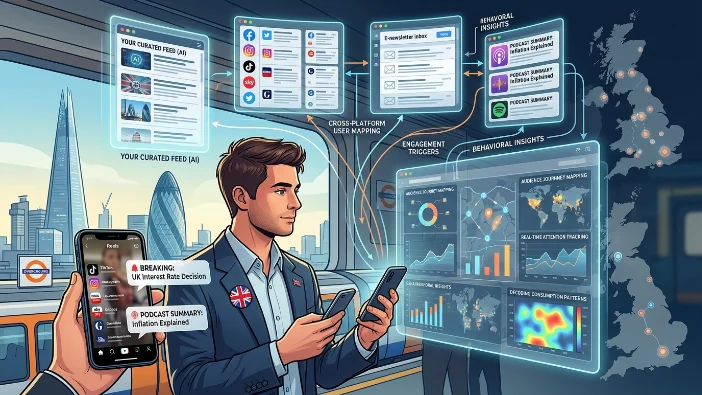
To navigate this complexity, organizations increasingly rely on Audience Insights Services, which help decode behavioral patterns, identify engagement triggers, and map audience journeys across platforms. These insights allow media houses and communication teams to understand how different segments interact with political, economic, and cultural news content.
When integrated effectively, audience intelligence reveals not just what content performs well, but also why certain narratives gain traction while others fail to resonate.
The Rise of Algorithm-Driven News Consumption
Algorithms have become the invisible editors of modern journalism. Whether on social platforms or news apps, content ranking systems determine visibility more than traditional editorial front pages.
This algorithmic mediation has introduced a new layer of complexity into trust formation. Readers often consume news without consciously selecting sources, which raises questions about transparency and bias. At the same time, algorithms reward engagement, sometimes prioritizing emotionally charged or polarizing content.
In the UK media landscape, this has led to a dual challenge: maintaining editorial integrity while competing for algorithmic visibility. Publishers are increasingly forced to optimize content for both human readers and machine-driven ranking systems.
Here, Research & Reports Services play a critical role by offering structured evaluations of content performance, platform distribution trends, and algorithmic impact analysis. These reports allow media organizations to identify which formats—such as long-form articles, short videos, or interactive explainers—are most effective in reaching targeted audiences.
Such research-driven insights are essential for developing sustainable content strategies in a landscape where visibility is no longer guaranteed by editorial quality alone.
Audience Trust as the Central Challenge of 2026
Trust in UK media continues to fluctuate due to misinformation concerns, political polarization, and the speed of digital dissemination. While established news brands still retain authority, younger audiences often approach traditional outlets with skepticism, preferring alternative or independent sources.
The challenge is not merely misinformation itself but the perception of bias. Even accurate reporting can be dismissed if audiences perceive it as aligned with a particular ideological stance. This makes transparency, data verification, and contextual reporting more important than ever.
Media organizations are responding by investing in trust-building strategies, including clearer sourcing, real-time fact-checking integrations, and audience engagement initiatives.
Within this context, Audience Insights Services become even more valuable, as they help organizations measure trust signals such as repeat engagement, dwell time, sentiment analysis, and cross-platform credibility indicators. These insights allow publishers to identify trust gaps and adjust editorial strategies accordingly.
The Role of Strategic Media Intelligence in Modern Journalism
The transformation of news media in the UK is not happening in isolation; it is being driven by the integration of advanced media intelligence systems. These systems combine analytics, audience behavior modeling, and content performance tracking to create a holistic view of the media environment.
Organizations like Time Intelligence Media Group operate at the intersection of data, journalism, and strategic communication, enabling media stakeholders to make informed decisions based on real-time insights rather than assumptions.
One of the most important applications of this intelligence is identifying emerging content trends before they reach mainstream saturation. By analyzing search behavior, social signals, and engagement patterns, media organizations can anticipate which topics will gain traction in the near future.
This predictive capability is particularly valuable in a fast-moving news cycle where timing often determines visibility and impact.
Media Partnerships and the Expansion of Distribution Networks
In 2026, media distribution is no longer confined to owned platforms. Instead, strategic partnerships between publishers, digital platforms, and content aggregators define how news reaches audiences.
Collaboration has become a survival strategy. Independent publishers often rely on syndication networks, while larger media houses expand their reach through partnerships with streaming platforms, newsletters, and niche content apps.
Media Partnerships Solutions have therefore become a critical component of modern media strategy. These solutions enable organizations to identify compatible distribution partners, negotiate content-sharing agreements, and optimize cross-platform visibility.
Effective partnerships not only increase reach but also enhance credibility by associating content with multiple trusted sources. In an environment where trust is fragmented, multi-source validation plays a key role in audience perception.
Data-Driven Editorial Decision Making
Editorial decision-making in UK newsrooms is increasingly guided by data rather than intuition alone. Metrics such as engagement rates, scroll depth, click-through patterns, and retention curves are now integral to content planning.
However, data alone does not guarantee editorial success. The challenge lies in interpreting data within the broader context of journalistic integrity and public interest.
This is where Research & Reports Services become indispensable. By combining quantitative analytics with qualitative media analysis, these services provide a deeper understanding of why certain stories perform better than others and how audience behavior evolves over time.
The integration of research insights into editorial workflows allows media organizations to maintain both relevance and credibility in a rapidly changing environment.
The Future of UK News Media Consumption
Looking ahead, the UK news media landscape is likely to become even more personalized, decentralized, and data-driven. Artificial intelligence will continue to refine content recommendation systems, while audience expectations for transparency and authenticity will continue to rise.
The balance between speed and accuracy, engagement and ethics, personalization and public interest will define the next phase of media evolution.
Organizations that succeed will be those that combine technological innovation with deep audience understanding and strategic media intelligence frameworks.
Navigating Trust and Transformation in 2026
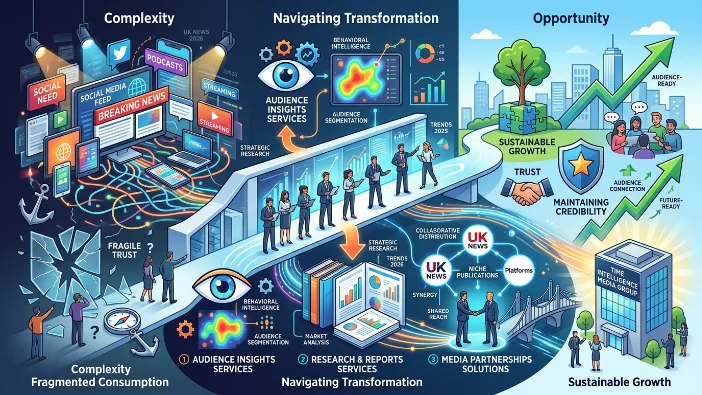
The 2026 UK news media environment is defined by complexity. Digital consumption is fragmented, trust is fragile, and competition for attention is intense. Yet within this complexity lies opportunity for organizations that can adapt intelligently.
Services such as Audience Insights Services, Research & Reports Services, and Media Partnerships Solutions play a central role in helping media organisations navigate this transformation. By combining behavioral intelligence, strategic research, and collaborative distribution models, publishers can build stronger connections with audiences while maintaining credibility.
In this evolving ecosystem, Time Intelligence Media Group represents a model of how media intelligence and strategic communication services can support sustainable growth in a rapidly changing digital landscape.



