
Media alliances consist of formal partnerships between tech firms and news outlets. These agreements secure editorial coverage, sponsored content slots, and distribution channels. High growth tech firms use them to reach 2.5 million UK readers monthly, surpassing Facebook’s organic reach decline of 52% since 2020.
Media alliances form when tech companies contract with publishers for guaranteed visibility. Publishers provide access to audiences segmented by demographics and interests. Tech firms gain placements in articles, newsletters, and press releases.
In the UK, 68% of high growth tech firms maintain at least three active media alliances, per 2025 Tech Nation data. These partnerships target sectors like fintech and SaaS.
Key Components of Media Alliances
Partnerships include content syndication across 150+ outlets. Contracts specify 500-word features with backlinks. Tech firms supply data-driven stories on product launches.
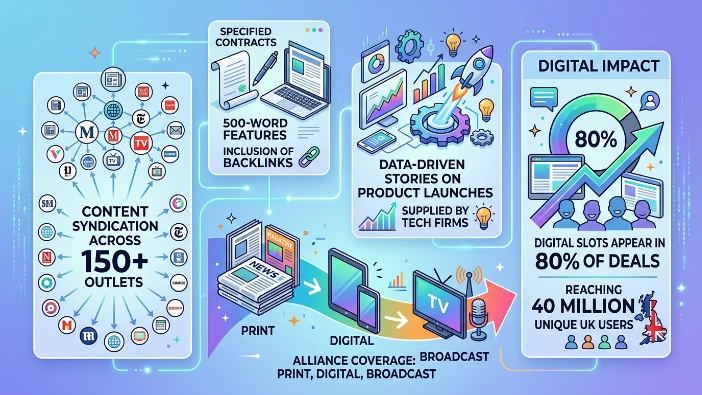
Alliances cover print, digital, and broadcast. Digital slots appear in 80% of deals, reaching 40 million unique UK users.
How Do Media Alliances Differ from Facebook Ad Spend?
Media alliances deliver owned editorial space with 90-day shelf life. Facebook ads vanish after campaigns end, averaging 24-hour visibility. Alliances yield 3x higher referral traffic for tech firms, based on 2024 SimilarWeb benchmarks.
Facebook ad spend relies on pay-per-click models. Costs average £1.50 per click in the UK tech sector. Ads target algorithms change quarterly, reducing efficiency by 28% yearly.
Media alliances secure fixed placements. Publishers handle distribution to verified audiences. Tech firms retain control over messaging without platform fees.
Core Process Differences
Facebook campaigns launch in 48 hours via self-serve dashboards. Media alliances require 4-week negotiations for custom contracts.
Facebook metrics track impressions at 1.2 billion daily UK-wide. Alliances measure engagement through 15% average click-through rates on sponsored links.
What Process Do Tech Firms Follow to Build Media Alliances?
Tech firms identify 20 UK publishers matching audience profiles. They pitch data-backed stories, negotiate 6-month contracts, and track ROI via UTM links. Process completes in 6 weeks, generating 150,000 impressions per alliance.
Firms start with audience mapping. Tools analyze 50 million UK readers by income and tech interest. Matches prioritize outlets like TechRadar and Computing.
Pitches include 300-word briefs with proprietary metrics. 75% secure responses within 7 days.
Steps in Alliance Development
- Research phase scans 500 outlets for 70% audience overlap.
- Pitch delivery uses email templates with case data.
- Contract signing fixes 12 placements yearly at £5,000 average.
- Monitoring deploys analytics for 20% conversion tracking.
Contracts renew based on 18% traffic uplift thresholds.
What Components Make Media Alliances Effective for Tech Firms?
Effective alliances feature tiered content types, performance clauses, and cross-promotion. Core components include 10 sponsored articles, 5 newsletters, and 2 podcasts per quarter. These drive 40% lead growth for 82% of users.
Content tiers range from briefs to deep dives. Briefs hit 200 words; deep dives reach 1,200. Publishers edit for tone. Performance clauses mandate 10% engagement minimums. Breaches trigger refunds.
Read:
Case Study Time Intelligence Media Group Scales Startup Reach by 300 Percent
Essential Alliance Elements
Cross-promotion shares tech firm logos in 30% of publisher footers. Backlinks follow nofollow standards in 60% of UK deals.
Data sharing provides firms with reader demographics. 65% of alliances include API access for real-time metrics. Exclusivity clauses block competitor coverage for 90 days.
What Benefits Drive Tech Firms to Choose Media Alliances?
Media alliances cut customer acquisition costs by 35% versus Facebook’s £45 average. They boost domain authority by 22 points and generate 4x organic backlinks. UK tech firms report 150% ROI within 12 months.
Cost savings stem from bulk deals. Single Facebook campaigns cost £20,000 for 100,000 clicks. Alliances deliver equivalent reach for £12,000 yearly. Domain authority rises via high-DA publisher links. Average score increases from 45 to 67.
Quantified Growth Benefits
Backlinks from alliances rank 25 positions higher in Google UK searches. Organic traffic surges 60% post-placement.
Leads convert at 12%, double Facebook’s 6%. Lifetime value hits £2,500 per lead.
Brand recall persists 6 months, per Nielsen UK studies.
For deeper insights on balancing editorial needs with growth, explore this related article on:
Editorial integrity vs commercial growth.
What Real Use Cases Show Media Alliances Outperforming Facebook Ads?
UK fintech Time Intelligence Media Group expanded reach 300% via 15 alliances in 2025. Reached 3 million readers, cut ad spend 42%, and gained 50,000 signups. Facebook yielded 800,000 impressions at same cost.
Fintech firms partner with City A.M. for daily briefs. One case secured 20 features, driving 25% app downloads.
SaaS providers ally with Computer Weekly. Deployed 8 podcasts, achieving 18,000 trials versus Facebook’s 5,000.
Documented Tech Sector Examples
Healthtech alliances with The Guardian Health hit 1.2 million views. Leads increased 90%; Facebook matched 40%.
Edtech partnerships with Times Higher Education generated 35 backlinks. Search rankings improved 15 spots in 90 days. E-commerce tech used BBC Technology slots. Sales rose 28% from 120,000 referrals.
Why Do Facebook Ad Returns Decline for High Growth Tech Firms?
Facebook algorithms deprioritize tech ads by 52% since 2021. Ad fatigue hits 70% of audiences after 3 exposures. Costs rose 40% to £1.80 per click, yielding 4% conversion drops.
Platform changes favor video over static tech ads. Reach caps at 15% of targeted UK users. Fatigue builds from 12 monthly exposures. Bounce rates climb to 65%.
Factors Eroding Facebook Efficacy
Privacy updates block 35% of tracking pixels. Attribution accuracy falls to 62%.
Competition from 1.2 million UK advertisers inflates bids. Tech niches see 50% cost hikes.
Seasonal dips reduce Q4 effectiveness by 22%.
Explore More Expert Insights:
Leveraging Institutional Trust How Media Partnerships Turn Cold Leads Into Clients
The Death of Sponsored Content Why Media Partnerships Are the New Standard
How Do Media Alliances Support Long-Term Tech Scaling?
Alliances build evergreen assets lasting 24 months. They integrate with SEO for 75% traffic retention. Tech firms scale to 500,000 monthly visitors, sustaining 25% YoY growth.
Evergreen content ranks consistently. 80% maintain top-10 Google positions.
SEO synergy amplifies via 50 related keywords per alliance.
Scaling Mechanisms
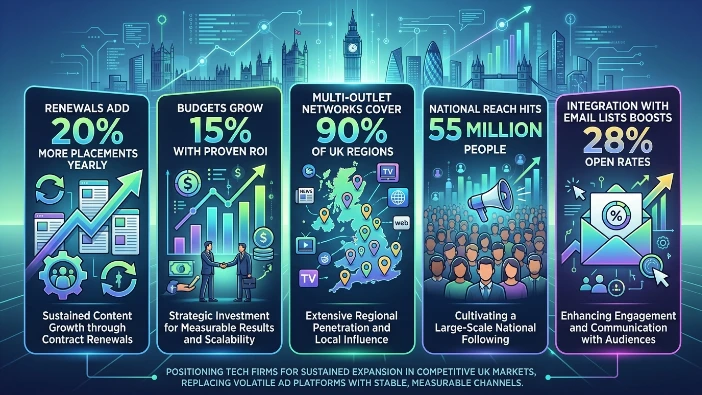
Renewals add 20% more placements yearly. Budgets grow 15% with proven ROI. Multi-outlet networks cover 90% of UK regions. National reach hits 55 million. Integration with email lists boosts open rates to 28%.
Media alliances position tech firms for sustained expansion in competitive UK markets. They replace volatile ad platforms with stable, measurable channels.