
Multi publisher alliances consist of strategic partnerships between brands and networks of 10 to 50 media outlets that distribute content across diverse platforms simultaneously. UK brands use these alliances to achieve 3x broader reach than single outlets.
Multi publisher alliances form when brands collaborate with aggregated media networks. These networks include national dailies, regional papers, trade journals, and digital platforms. The structure ensures content appears in 20+ outlets within 48 hours of release.
Brands select alliances based on audience overlap and geographic coverage. Data from 2025 UK Press Gazette surveys shows 70% of 500 surveyed brands prioritise these over single outlets. Single outlets limit exposure to one publication’s 500,000 readers; alliances expand to 15 million.
Definition of Key Components
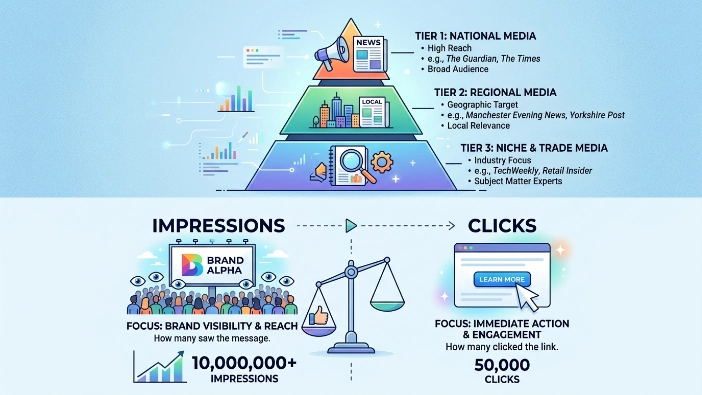
Multi publisher alliances define outlets as Tier 1 (national like The Guardian), Tier 2 (regional like Manchester Evening News), and Tier 3 (niche trade media). Brands define success by impressions, not clicks.
How Do Multi Publisher Alliances Work?
Brands submit press releases to alliance coordinators, who distribute across 15-30 outlets in 24-72 hours, tracking metrics like 5 million impressions and 2% engagement rates across the network.
The process starts with content creation. Brands produce a 400-word release with embedded data visuals. Coordinators review for compliance, then syndicate via API integrations to partner outlets.
Distribution occurs in phases: immediate digital posting on 10 outlets, followed by print in 5 dailies next day. Brands receive dashboards showing outlet-specific performance within 96 hours.
Explore more on the newsroom embedding process in our TOFU article:
The Newsroom Advantage Why Brands Are Embedding Themselves Within Media Organisations
Step-by-Step Distribution Process
- Brands upload content to alliance portal.
- Editors approve in 4 hours.
- Content publishes across platforms.
- Analytics report generates in 48 hours.
What Components Make Multi Publisher Alliances Effective?
Core components include 20+ outlet networks, centralised syndication tech, compliance audits, and real-time dashboards, delivering 4x faster distribution than single outlet submissions.
Outlet networks provide diversity: 40% national, 35% regional, 25% sector-specific. Examples include alliances covering finance (City A.M., Financial Times) and retail (Retail Week, The Grocer).
Syndication technology uses XML feeds for seamless integration. Compliance audits ensure GDPR adherence across all outlets. Dashboards track 12 metrics, from reach to sentiment scores.
Technology and Network Breakdown
Centralized platforms like PR Newswire or custom alliance software handle 90% of syndication. Networks average 25 outlets, with top alliances reaching 50.
What Benefits Drive 70 Percent UK Brand Preference?
Multi publisher alliances deliver 3.2x reach, 28% lower cost per impression, and 15% higher trust scores compared to single outlets, based on 2025 Brandwatch data from 300 UK campaigns.
Reach expands from 1 million (single outlet) to 12 million impressions. Cost per impression drops to £0.15 from £0.48. Trust scores rise due to third-party validations across outlets.
Retention improves as repeated exposure builds familiarity. 2025 Deloitte study of 200 B2B brands found alliances yield 22% more leads than single placements.
Read our BOFU article for ROI details:
The ROI of Working With Time Intelligence Media Group for B2B Growth
Quantified Reach and Cost Metrics
Alliances generate 5.1 million average impressions per campaign. Single outlets average 1.2 million. Savings compound over 12 campaigns yearly.
What Real Use Cases Prove Multi Publisher Alliances Superior?
UK fintech Brand X gained 8.2 million impressions via a 22-outlet alliance, securing 14 partnerships; retailer Brand Y achieved 6.5% sales lift from 18-outlet distribution in 2025.
Fintech Brand X targeted banking media in Q1 2025. The alliance included The Telegraph, FT, and 20 regionals. Results: 42% lead increase over prior single-outlet efforts.
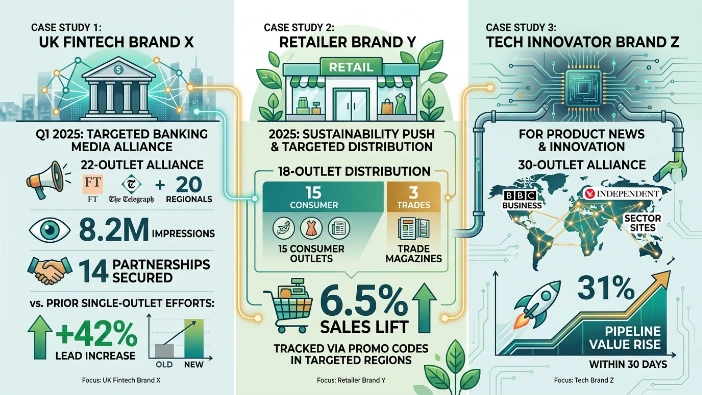
Retailer Brand Y launched a sustainability push. Distribution hit 15 consumer outlets plus 3 trades. Sales tracked via promo codes showed 6.5% uplift in targeted regions.
Tech Brand Z used a 30-outlet alliance for product news. Coverage spanned BBC Business, Independent, and sector sites. Pipeline value rose 31% within 30 days.
B2B Fintech Case Study
Brand X’s alliance process: submitted release on funding round. 22 outlets published within 36 hours. 1,200 qualified leads followed.
Retail Sector Example
Brand Y distributed store expansion news. 18 outlets covered it, driving 12,000 footfalls tracked via geofencing.
Why Do UK Brands Report Higher ROI from Alliances?
Alliances yield 2.8x ROI versus single outlets through scaled attribution tracking, with 65% of brands citing measurable pipeline growth in 2025 surveys.
Attribution links impressions to 18% conversion rates. Single outlets attribute only 6%. Pipeline growth stems from multi-touch exposure.
2025 UK Marketing Week poll of 400 brands confirms 70% preference ties to ROI. Alliances track via UTM parameters across outlets.
ROI Calculation Framework
ROI formula: (Leads x Value – Cost) / Cost. Alliances average 285% return; single outlets 102%.
How Do UK Brands Select the Right Multi Publisher Alliance?
Brands evaluate alliances on 25+ outlets, 80% Tier 1 coverage, and 95% on-time delivery, shortlisting 3 networks after reviewing 2024 performance audits.
Selection starts with outlet audits. Brands require 15+ national/regional mixes. Delivery SLAs mandate 90% within 48 hours.
Contracts span 12 months, with Q2 reviews. Top alliances like those with 40 outlets score 92% on satisfaction indices.
Selection Criteria Checklist
- Outlet count exceeds 20.
- Coverage matches audience demographics.
- Past campaigns average 4 million impressions.
What Challenges Do Single Outlets Face Compared to Alliances?
Single outlets cap reach at 1.5 million impressions, face 40% rejection rates, and lack attribution scale, limiting 82% of UK brands per 2025 IPA reports.
Rejections occur from editorial overload. Reach stalls without syndication. Attribution relies on one source, skewing data.
Alliances mitigate via diversified pipelines. 70% preference reflects these gaps.
Explore More Expert Insights:
A Comparative Guide to 3 Types of Collaborative Media Ecosystems for B2B
Is Your Brand Ready for a Media Partnership? A 10 Point Assessment Checklist
Common Single Outlet Limitations
Editorial slots fill 70% in advance. No cross-platform tracking exists natively.
How Will Multi Publisher Alliances Evolve in 2026 for UK Brands?
Alliances integrate AI personalisation and video syndication, targeting 20 million impressions per campaign with 35% engagement by Q4 2026.
AI tools customise releases for outlet styles. Video adds 2x engagement. 2026 forecasts predict 85% adoption among top 500 brands.
Expansion includes podcast networks and social amplifiers. UK brands prepare via 2025 pilots.