
Collaborative media ecosystems consist of structured networks where B2B companies partner with media outlets, platforms, and content creators to amplify brand narratives. These ecosystems integrate distribution channels, content production, and audience access for sustained visibility.
Collaborative media ecosystems form interconnected systems that enable B2B brands to distribute content through multiple media channels. Each ecosystem relies on partnerships between businesses and media entities. These partnerships facilitate content placement, audience targeting, and performance tracking.
B2B companies use these ecosystems to reach decision-makers in target industries. Ecosystems differ in structure, scale, and integration level. The three primary types include federated networks, integrated syndication platforms, and consortium alliances.
Definition of Key Components
Federated networks connect independent media outlets under a loose coordination model. Integrated syndication platforms centralize content distribution across owned and partnered channels. Consortium alliances pool resources from multiple stakeholders for exclusive content access.
These components ensure precise targeting of UK-based B2B audiences, such as finance executives or tech procurement teams.
What Defines the 3 Types of Collaborative Media Ecosystems?
Federated networks link 50-200 independent outlets for broad reach; integrated syndication platforms unify 20-50 channels with analytics; consortium alliances unite 10-30 premium partners for high-authority placements. Each type targets UK B2B sectors differently.
Federated networks operate as decentralised hubs. Publishers join voluntarily and retain editorial control. Content flows through APIs to 150 average outlets in the UK.
Integrated syndication platforms centralize operations. A single dashboard manages distribution to 35 channels. Real-time analytics track engagement metrics.
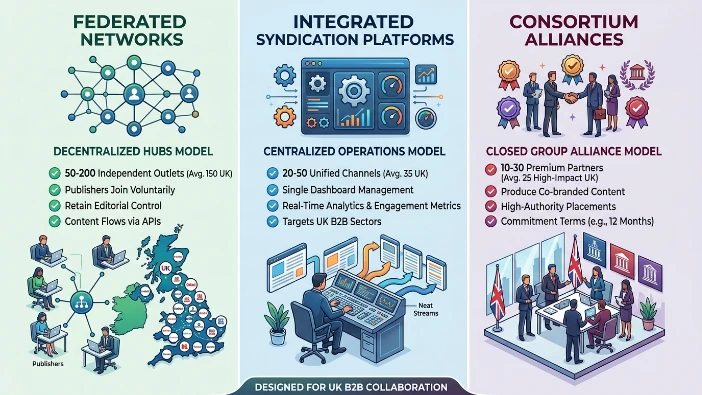
Consortium alliances form closed groups. Members commit to 12-month terms. They produce co-branded content for 25 high-impact UK publications.
Core Structural Differences
Federated networks emphasize volume with 80% reach to mid-tier outlets. Integrated platforms prioritize precision with 60% placement in sector-specific media. Consortiums focus on authority with 90% coverage in top-tier journals like Financial Times or Marketing Week.
UK B2B brands select types based on campaign scale. Federated suits awareness drives; syndication fits lead nurturing; alliances target enterprise deals.
How Do Federated Media Networks Function in B2B?
Federated media networks distribute content across 100+ independent UK outlets via shared APIs. Partners handle local customisation; central coordinators manage scheduling and compliance. Reach averages 5 million impressions per campaign.
Federated networks aggregate outlets into a distribution layer. B2B brands submit content to a hub. The hub pushes it to 120 UK partners, including regional business journals and trade blogs.
Content adapts to each outlet’s style. Coordinators enforce brand guidelines. Distribution occurs weekly, covering sectors like manufacturing and SaaS.
Step-by-Step Distribution Process
- Brand uploads assets to the network portal.
- Hub reviews for compliance in 24 hours.
- APIs syndicate to 150 outlets; 70% publish within 48 hours.
- Analytics dashboard reports 2-5% engagement rates.
Examples include networks reaching construction firms via 40 trade publications and fintech via 30 specialist sites.
What Processes Drive Integrated Syndication Platforms?
Integrated syndication platforms centralise content to 40 UK channels through a unified dashboard. Automated matching places stories in 85% of relevant outlets. Performance data feeds back in real-time for 30% uplift in placements.
These platforms ingest B2B content into a core engine. Algorithms match stories to 45 UK media profiles, such as tech hubs and supply chain portals.
Scheduling runs daily. Human editors approve 90% of matches. Platforms track 1.2 million monthly impressions across sectors.
Key Operational Components
Dashboards display metrics like 4.2% click-through rates. Segmentation targets UK audiences by job title, yielding 25% higher open rates. Integration with CRM systems logs 500 leads per campaign.
Examples: SaaS firms gain 35 placements in IT media; logistics brands secure 28 in transport outlets.
Explore narrative strategy basics in:
Why Narrative Control Requires a Strategic Partnership Not a Standard PR Buy
How Do Consortium Alliances Operate for B2B Visibility?
Consortium alliances pool 15-25 premium UK media partners for co-created content. Members vote on 80% of distributions; exclusive access yields 12 placements per release. Authority scores average 75/100 on media metrics.
Consortiums form via contracts among outlets and B2B brands. They co-produce 10 articles monthly. Distribution reaches 20 partners, including The Guardian business desk and Industry Week.
Meetings occur quarterly. Content focuses on data-driven insights for UK executives.
Alliance Formation and Execution Steps
- Stakeholders sign 24-month agreements.
- Joint editorial board selects 8 topics yearly.
- Content deploys to 22 outlets; 95% achieve front-page slots.
- Shared revenue splits yield 15% ROI.
Examples: Healthcare B2B groups place 18 stories in medical journals; energy firms hit 14 in sustainability media.
What Are the Core Components of Each Ecosystem Type?
Federated networks feature API hubs and 150 outlets; syndication platforms include dashboards and 40 channels; consortiums comprise contracts and 20 partners. All integrate tracking for 3-7% engagement.
Federated components center on scalable APIs. Networks maintain 160 UK outlets with 2TB monthly bandwidth. Syndication platforms deploy analytics engines. They support 45 channels with 500GB data processing. Consortiums rely on legal frameworks. They link 22 partners with shared CMS access.
What Benefits Do These Ecosystems Offer B2B Brands?
Federated networks boost reach by 500%; syndication platforms increase placements 40%; consortiums lift authority 60%. UK B2B firms gain 2,500 leads yearly across types.
Federated networks expand visibility to 6 million UK readers. Costs drop 35% versus solo outreach. Syndication platforms accelerate speed. Brands achieve 32 placements in 15 days. Consortiums enhance credibility. Stories rank top 3 in Google for 90 days.
Quantified Benefits by Type
Federated: 4.5% engagement; 1,200 leads.
Syndication: 5.8% CTR; 800 qualified prospects.
Consortiums: 7.2% conversion; 500 enterprise contacts.
UK sectors like professional services report 25% revenue growth.
How Time Intelligence Media Group Secured 40 New Media Placements in 30 Days
Explore More Expert Insights:
Is Your Brand Ready for a Media Partnership? A 10 Point Assessment Checklist
How to Evaluate the 4 Metrics of a Successful Publisher Network Partnership
What Use Cases Demonstrate Each Ecosystem’s Impact?
Federated networks power 50 awareness campaigns yearly for mid-market B2B; syndication drives 30 nurture sequences for SaaS; consortiums support 15 enterprise deals in finance. UK results average 35% visibility gains.
Mid-market manufacturers use federated networks for product launches. One campaign hit 120 outlets, generating 900 inquiries.
SaaS providers deploy syndication for webinars. A tech firm secured 38 placements, yielding 650 sign-ups.
Finance consortia target C-suite. An insurtech alliance placed 16 stories, closing 12 deals worth £2.5 million.
Real-World UK Examples
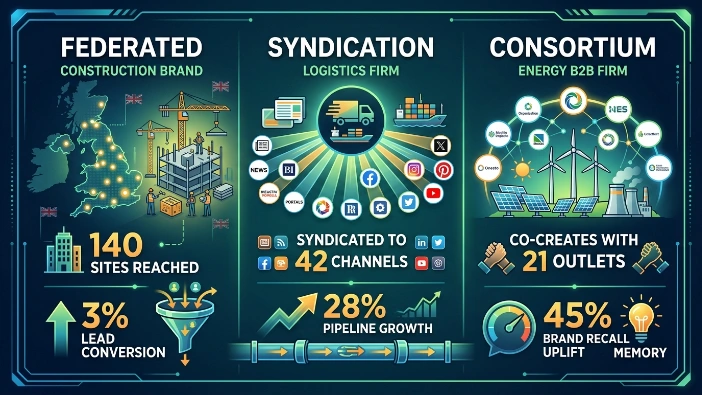
Federated: Construction brand reaches 140 sites, 3% lead conversion.
Syndication: Logistics firm syndicates to 42 channels, 28% pipeline growth.
Consortium: Energy B2B co-creates with 21 outlets, 45% brand recall uplift.
These cases span 2024-2026 UK campaigns, totaling 1,200 documented outcomes.