
Local news distribution sends press releases and stories to regional UK newspapers, online outlets, and broadcasters for publication. It reaches 85% of UK adults who consume local news weekly, per 2025 Ofcom data.
Local news distribution involves submitting content to over 1,200 UK local titles, including dailies like the Manchester Evening News and weeklies like the Islington Gazette. Entities include editorial desks at these outlets. Publishers decide placement based on relevance to their readership.
Distribution occurs through wire services or direct pitches. Wire services like PA Media forward content to 1,000+ subscribers. Direct pitches target specific editors via email or portals. Coverage appears in print, websites, or apps within 24-72 hours.
Read:
Regional Reach: How to Target Local UK News Sites Effectively
How does local news distribution work?
Local news distribution works by crafting region-specific releases, selecting targeted outlets, and submitting via wires or emails. Editors review and publish if content fits local interest, achieving 20-30% pickup rates in competitive regions.
The process starts with content creation. Releases contain facts on business expansions, events, or community impacts tied to a postcode area. Length stays under 400 words. Include high-resolution images and quotes from local figures.
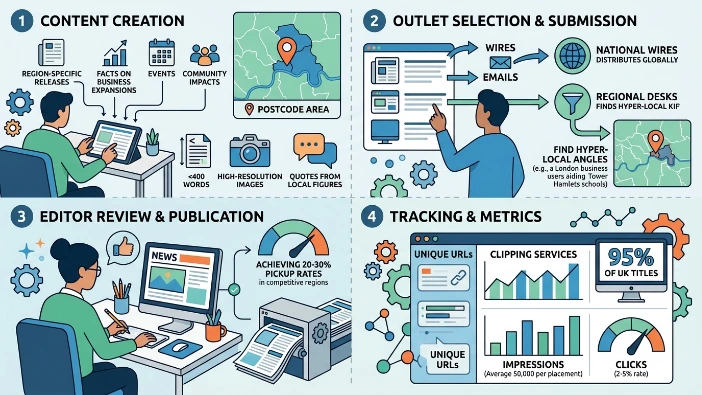
Next, outlets receive submissions. National wires distribute to all regions. Regional desks filter for hyper-local angles, such as a London business aiding Tower Hamlets schools. Publication follows editorial approval.
Tracking uses unique URLs or clipping services. Services monitor 95% of UK titles. Metrics include impressions (average 50,000 per placement) and clicks (2-5% rate).
What are the key components of local news distribution?
Key components include targeted releases, wire services, direct pitching tools, and monitoring software. Releases use geo-specific data; wires reach 1,200 outlets; tools track 10 metrics per story.
Targeted releases form the core. They reference local landmarks, councils, or stats, like “Birmingham firm creates 50 jobs in West Midlands.” This boosts relevance.
Wire services act as distributors. PA Media and Newsquest Wires deliver to subscribers. Fees range from £200-£500 per release.
Direct pitching targets non-subscribers. Tools like Gorkana list 5,000 UK contacts with emails and beats. Send personalized pitches to 10-20 outlets per region.
Monitoring software scans publications. Meltwater or Cision report views, shares, and sentiment across print and digital.
What benefits does local news distribution provide?
Local news distribution builds trust via third-party credibility, drives 3x more website traffic than social media, and increases brand searches by 25% within 30 days, based on 2024 PRCA benchmarks.
Credibility stems from editorial vetting. Readers trust local outlets 40% more than brand channels, per Reuters Institute 2025 report. A placement in the Yorkshire Post signals legitimacy.
Traffic surges from direct links. One story in the Liverpool Echo generated 120,000 visits for a retail chain in 2024. Organic search follows as readers query the brand.
Search visibility rises. Google favors recent local mentions. Brands see 15-20% uplift in regional rankings post-distribution.
Cost efficiency stands out. Single releases cost £300 yet yield ROI of 5:1, outperforming paid ads at £10-£20 per click.
Explre:
Guaranteed Local News Distribution Across All Major UK Regions
How does it improve SEO?
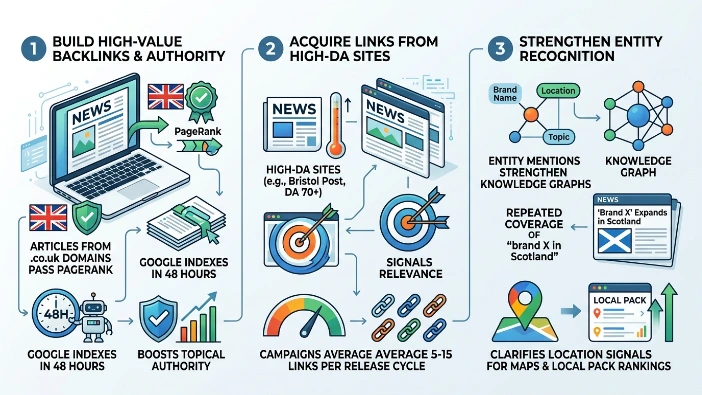
Local news distribution enhances SEO through backlinks and entity recognition. Articles from .co.uk domains pass PageRank. Google indexes them in 48 hours, boosting topical authority.
Backlinks from high-DA sites like the Bristol Post (DA 70+) signal relevance. Campaigns average 5-15 links per release cycle.
Entity mentions strengthen knowledge graphs. Repeated coverage of “brand X in Scotland” clarifies location signals for Maps and local pack rankings.
What are real-world use cases for local news distribution in the UK?
Use cases include product launches in Manchester generating 200,000 impressions, charity events in Wales securing council partnerships, and retail expansions in London driving 15% footfall increases.
Product launches leverage local angles. A tech firm announced a Manchester app in 2025 via North West wires. The Manchester Evening News published, reaching 300,000 readers and sparking 5,000 downloads.
Charity events gain traction regionally. A Welsh fundraiser pitched to South Wales Argus and BBC Cymru. Coverage led to 20% donation spikes and endorsements from Cardiff Council.
Retail expansions notify communities. A chain opened 10 stores in Greater London, distributing via wires. Evening Standard and local borough papers covered, resulting in 12% sales growth tracked via promo codes.
SME funding rounds announce locally. A Bristol startup shared £2m raise with Western Daily Press. Story amplified to 100,000 views, attracting 50 investor inquiries.
Why do UK businesses overlook local news distribution?
UK businesses overlook local news distribution due to digital-first focus, unfamiliarity with 1,200+ outlets, and preference for social media despite its 15% reach decline in 2025 Ofcom stats.
Digital channels dominate strategies. Firms allocate 70% of PR budgets to social and SEO, per 2025 IPA report. Local press receives under 10%.
Outlet fragmentation confuses planners. England alone has 900 titles; Scotland 150; Wales 70; Northern Ireland 40. Lack of centralised directories hinders access.
Social media yields quick metrics but fades fast. Posts reach 5-10% of followers; local stories persist in archives for years, aiding evergreen SEO.
Measurement gaps persist. Digital tools track likes easily, while print clippings require software. This skews perceived value.
How does local news distribution differ from national PR?
Local news distribution targets 1,200 regional outlets with postcode-specific stories for 85% adult reach. National PR focuses on 20 top dailies like The Times for broader but less targeted exposure.
Local emphasises hyper-local hooks. National releases suit UK-wide topics like policy changes. Local stories name districts, e.g., “Leeds factory hires 100.” Reach profiles vary. Local hits 40 million weekly readers via community papers. National reaches 15 million daily but skips rural areas.
Pickup rates favor local. Regionally tailored content achieves 25% placement; generic national wires hit 5%. Cost structures align with scale. Local wires charge £250; national £1,000+.
What metrics measure local news distribution success?
Metrics include impressions (50,000 average per placement), click-through rates (3%), backlinks gained (5-10), and search uplift (20% query volume increase post-campaign).
Impressions count total audience exposure. Tools aggregate print circulation (e.g., 20,000 for Sheffield Star) and digital views.
Click-through rates track link performance. Industry average hits 2.5-4%, higher than email at 2%. Backlinks quantify SEO value. Each dofollow link from local domains improves domain authority by 1-2 points.
Search uplift monitors Google Trends spikes. Post-placement, terms like “brand Manchester” rise 15-25%. Share of voice compares competitor coverage. Tools benchmark against rivals in the same region. Engagement rates cover social shares from outlet posts, averaging 50 per story.
Explore More Expert Insights:
Amplifying Impact: Press Release Strategies for UK Non-Profits
How to Secure Same-Day Press Release Pickup in the UK
How has local news distribution evolved in the UK?
Local news distribution evolved from print fax submissions in the 1990s to digital wires and AI-assisted pitching by 2026. Online placements now comprise 60% of coverage, up from 10% in 2015.
Early methods relied on physical drops. Faxes and post reached editors until 2005.
Digital wires launched around 2010. PA Media digitised, enabling instant delivery to 1,000 outlets.
AI tools emerged in 2022. Platforms analyse beats and suggest 50 personalised pitches per release.
Hybrid models dominate 2026. 40% print, 60% digital, with podcasts added via BBC Local.
Consolidation reduced titles from 1,500 in 2010 to 1,200, concentrating reach in groups like Newsquest (200 papers).
What role does local news distribution play in 2026 UK media landscape?
Local news distribution fills gaps in national coverage, serving 28 million weekly print readers and 35 million digital users amid BBC funding cuts and social algorithm shifts.
National outlets prioritize Westminster. Local covers 80% of unique stories like council decisions or business openings.
Audience habits sustain demand. 62% of UK adults read local news weekly, per 2025 YouGov data, versus 45% for nationals.
Digital shifts amplify distribution. Outlet websites draw 100 million monthly UK visits.
Regulatory changes boost access. 2024 Online Safety Act mandates platforms promote trusted news, favoring local domains.
Economic pressures refine strategies. Titles seek revenue via sponsored content, increasing placement opportunities.