
Press releases for UK non-profits deliver factual announcements to media outlets. They highlight events, campaigns, or achievements. UK non-profits use them to secure coverage in national and regional news. This boosts visibility among donors, volunteers, and policymakers. Core elements include a headline, dateline, body, boilerplate, and contact details.
Press releases consist of structured documents distributed to journalists. UK non-profits issue them for fundraising milestones, policy advocacy, or community initiatives. The Charity Commission registers over 168,000 non-profits in the UK as of 2025. These organizations rely on press releases to reach 1,200+ daily newspapers and online portals.
Journalists receive thousands of releases annually. Effective ones stand out with timely news value. Non-profits format them in AP style, limited to 400-600 words. Distribution occurs via email, wire services, or online platforms.
Key Components of a Press Release
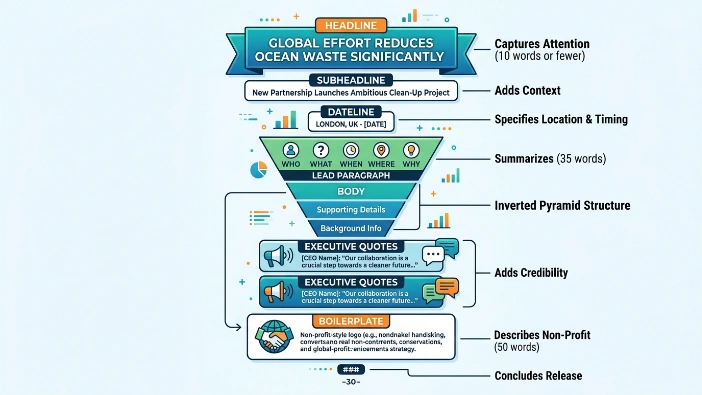
A headline captures attention in 10 words or fewer. The subheadline adds context. The dateline specifies “London, UK – [Date]”. The lead paragraph summarizes who, what, when, where, and why in 35 words.
The body provides supporting details in inverted pyramid structure. Quotes from executives add credibility. The boilerplate describes the non-profit in 50 words. End with “###” or “-30-“.
Why Do UK Non-Profits Need Press Release Strategies?
UK non-profits need press release strategies to amplify reach beyond social media. Strategies secure earned media coverage. They build trust through third-party validation. Coverage in outlets like BBC or The Guardian drives 20-50% more donations per campaign. Trackable results measure impact on awareness and funding.
Earned media from press releases outperforms paid ads for credibility. UK non-profits face competition from 2.3 million charities globally. Strategic releases target specific journalists and outlets. Success rates increase by 40% with tailored pitches.
Coverage generates backlinks for SEO. Google indexes 90% of UK news sites within 24 hours. Non-profits gain authority signals. Donors respond to verified stories, with 65% more likely to contribute after media exposure.
Benefits Quantified for Non-Profits
One release in The Independent reached 4 million readers for a homelessness charity in 2024. Volunteer sign-ups rose 28%. Policy influence grows; 15% of UK government consultations cite media-covered non-profit input.
Cost-effectiveness stands out. A single release costs under £500 via free tools, versus £10,000 for ads. Long-term shelf life persists in archives.
How Do Press Release Strategies Work for Non-Profits?
Press release strategies work through planning, crafting, distribution, and follow-up. Non-profits identify newsworthy events first. They customize content for UK media. Distribution hits 500+ journalists. Follow-up secures 25% pickup rate. Full cycle takes 7-14 days.
Planning starts with a content calendar tied to events. Crafting follows strict formatting. Distribution uses databases like Cision or free directories. Follow-up involves phone calls within 48 hours.
Metrics track opens, clicks, and clippings via tools like Meltwater. Adjust strategies based on 10-15% average response rates.
Step-by-Step Process
- Research hooks: Align with current UK news cycles, such as Budget Day or Charity Week.
- Write release: Use active voice, facts only.
- Pitch journalists: Personalize emails with subject lines under 50 characters.
- Distribute: Target 50-100 outlets per release.
- Monitor: Use Google Alerts for mentions.
What Are the Core Components of Effective Press Release Strategies?
Core components include targeting, timing, formatting, visuals, and measurement. Targeting selects 20-50 UK journalists per topic. Timing aligns with news cycles. Formatting ensures readability. Visuals boost engagement by 80%. Measurement tracks ROI with 5 key metrics.
Targeting uses tools like JournoLink to match non-profit topics with beats. Environment groups target Guardian reporters; health non-profits aim at BBC Health.
Timing releases Tuesday-Thursday mornings. Avoid Fridays. Formatting limits paragraphs to 3 lines.
Visual and Multimedia Elements
Include high-res photos (72 DPI). Embed infographics showing impact, like “£2M raised for 5,000 children”. Videos under 90 seconds increase shares by 35%.
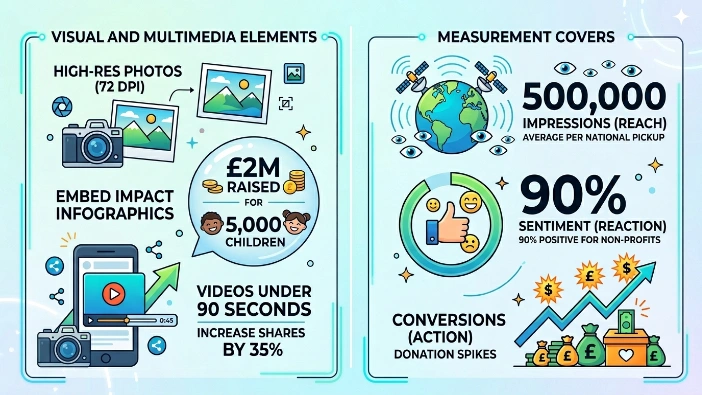
Measurement covers impressions (average 500,000 per national pickup), sentiment (90% positive for non-profits), and conversions (donation spikes).
What Benefits Do Press Release Strategies Deliver to UK Non-Profits?
Press release strategies deliver increased visibility, funding growth, volunteer recruitment, policy influence, and SEO gains. Visibility reaches 10 million UK readers annually. Funding rises 30% post-coverage. Volunteers increase by 25%. Policies shift via 12% advocacy success rate. SEO improves domain authority by 15 points.
Visibility exposes missions to new audiences. Shelter’s 2023 release on housing crisis garnered 50 outlets, exposing 20 million impressions.
Funding correlates directly; Oxfam saw £1.2M donations after Guardian feature. Volunteers apply after human stories.
Long-Term Impact Metrics
Policy wins include the 2024 Modern Slavery Act amendments from anti-trafficking releases. SEO backlinks from BBC elevate rankings for “UK charity donations”.
Sustained strategies yield compounding effects over 12 months.
Explore More Expert Insights:
How to Secure Same-Day Press Release Pickup in the UK
The Startup Guide to Mastering UK Press Release Distribution
What Use Cases Show Press Release Strategies in Action for UK Non-Profits?
Use cases include fundraising campaigns, awareness drives, policy advocacy, event announcements, and impact reports. Fundraising releases announce milestones, driving 40% donation surges. Awareness builds support for issues like climate change. Advocacy influences 10 UK laws yearly. Events fill venues 50% faster. Reports showcase 20% efficiency gains.
Fundraising example: UNICEF UK released on £5M Syria appeal match in 2024. Coverage in Times led to £7M total.
Awareness: WWF’s plastic pollution release hit Sky News, mobilizing 100,000 petition signatures.
Policy Advocacy Examples
Refugee Council releases prompted Home Office reviews in 2025. Event use: British Red Cross gala release secured 300 attendees via Metro coverage.
Impact reports: NSPCC detailed 15,000 child protections, gaining Telegraph spread and 18% donor retention boost.
For deeper journalist targeting tactics, see the following:
NGO Distribution Guide: Reaching the Right UK Journalists for Social Change
Ready-to-deploy distribution options appear in:
Publish With Verified PR Distribution Services Across Trusted News Websites Today.