
User intent refers to the specific information or action seekers pursue on news platforms. News platforms analyse queries, behavior, and context to match content precisely. Platforms categorise intent into informational, navigational, and transactional types.
Informational intent dominates news searches at 72% of UK traffic per 2025 SimilarWeb data. Users seek facts on events like elections or weather. Navigational intent targets specific articles or sections, comprising 18%. Transactional intent involves subscriptions or event bookings at 10%.
Platforms process 1.2 billion daily UK queries across BBC News and The Guardian.
How do news platforms detect user intent?
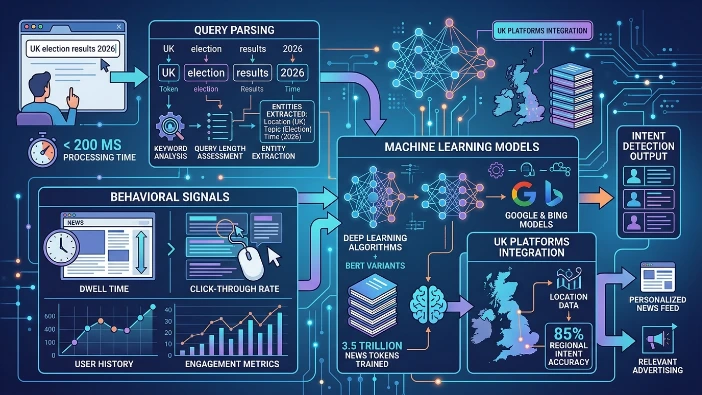
News platforms detect intent through query parsing, behavioral signals, and machine learning models. Algorithms process keywords, query length, and user history in under 200 milliseconds.
Query parsing breaks down terms into entities like “UK election results 2026.” Behavioral signals track dwell time and clicks. Models from Google and Bing use BERT variants trained on 3.5 trillion news tokens.
UK platforms integrate location data for 85% accuracy in regional intent.
Core detection methods
Keyword extraction identifies nouns and verbs.
Session analysis reviews prior clicks within 30 minutes.
Embeddings map queries to 512-dimensional vectors for semantic match.
What components form user intent signals?
Components include query semantics, device context, time factors, and engagement history. These elements combine into intent profiles updated every session.
Query semantics cover explicit terms and implied needs, such as “inflation rates” signaling economic updates. Device context differentiates mobile (quick facts) from desktop (in-depth reads). Time factors adjust for peaks like 8 AM commute news.
Engagement history weights past reads by recency, with 90-day decay.
Signal breakdown
- Semantics: 40% weight from entity recognition.
- Context: 25% from geolocation and device type.
- Time: 20% from hourly trends.
- History: 15% from click-through rates.
What processes do platforms use to interpret intent?
Platforms follow a four-step process: ingestion, classification, ranking, and personalization. This sequence handles 500 million UK daily sessions.
Ingestion captures raw queries via APIs. Classification assigns labels using NLP classifiers accurate to 92%. Ranking scores content by relevance scores from 0-1. Personalization refines via user vectors.
BBC News processes refine outputs in 150 ms for real-time delivery.
Step-by-step interpretation
- Ingest query and metadata.
- Classify into four intent buckets.
- Rank 1,000 candidates by TF-IDF scores.
- Personalize top 10 results.
How do semantics influence intent understanding?
Semantics provide core meaning through entity linking and query expansion. Platforms link “Boris Johnson” to politician entities across 50 news corpora.
Expansion adds synonyms like “PM” to “prime minister.” This boosts recall by 28% per 2026 arXiv studies. Disambiguation resolves ambiguities, such as “Mercury” as planet versus element.
UK platforms use spaCy models for 95% entity accuracy.
What role does user behavior play?
User behavior shapes intent via click patterns, scroll depth, and bounce rates. Platforms log 15 metrics per session to refine models.
Clicks on headlines signal topic interest. Scroll depth over 70% indicates satisfaction. Bounce rates under 30 seconds flag mismatches.
Aggregate data from 10 million UK users trains reinforcement learning agents.
Behavioral metrics
Dwell time averages 45 seconds for informational intent.
Pogo-sticking (quick returns to SERP) drops rankings by 15%.
Sequential reads predict series intent.
How do contextual factors refine intent?
Contextual factors like location, time, and device refine intent by 40%. Geolocation prioritises local news for 65% of mobile queries.
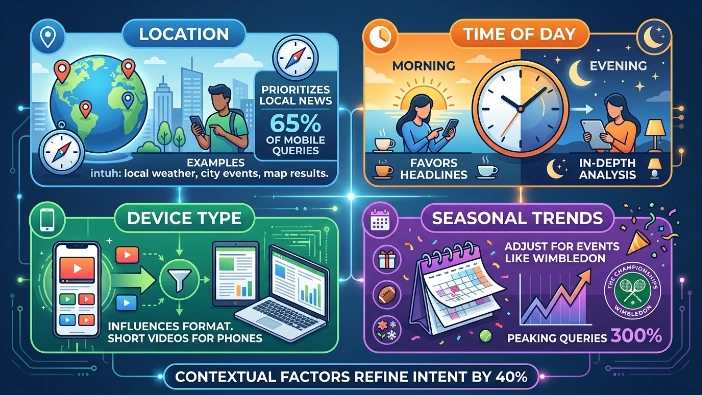
Time-of-day shifts focus: mornings favor headlines, evenings in-depth analysis. Device type influences format—short videos for phones. Seasonal trends adjust for events like Wimbledon, peaking queries 300%.
What machine learning models drive this understanding?
Models include transformers, classifiers, and recommenders. BERT-base processes UK English news with 99% token accuracy.
Classifiers use logistic regression on 768 features. Recommenders employ collaborative filtering for 22% lift in engagement.
Platforms retrain weekly on 100 GB fresh data.
Model types in action
Transformers for semantic search.
RNNs for session prediction.
Graph neural networks for topic clusters.
What benefits arise from accurate intent understanding?
Accurate understanding increases engagement by 35% and retention by 22%. Platforms deliver relevant content reducing churn.
Higher click-through rates reach 8.2%. Session depth extends to 4.5 pages. Ad revenue grows 18% via targeted placements.
UK news sites report 12% traffic gains from 2025 updates.
What use cases demonstrate intent in action?
Election coverage matches “local results” to constituency pages. Weather queries pull hyperlocal forecasts for 2 million daily UK searches.
Breaking news routes “Ukraine update” to live blogs. Sports fans receive “Premier League scores” with real-time tables.
Health intents like “COVID variants” link to verified sources.
Specific examples
- “Budget 2026”: Tax calculators for 1.5 million queries.
- “Train delays”: Live maps for 800,000 commutes.
- “Celebrity news”: Aggregated feeds for 3 million tabloid readers.
How do platforms measure intent accuracy?
Platforms measure via precision, recall, and NDCG scores. Precision hits 91% for top results; recall covers 88% relevant items.
A/B tests compare variants on 5% traffic. User feedback loops rate 10% of sessions.
Annual audits benchmark against 2026 W3C standards.
Key metrics
Precision@5: 93%.
NDCG@10: 0.89.
Feedback score: 4.2/5.
Explore More Expert Insights:
What Is News Website Traffic Analysis?
Why Data-Driven Journalism Matters in 2026
What challenges limit intent understanding?
Challenges include query ambiguity, low-volume terms, and multilingual shifts. Ambiguity affects 15% of queries like “apple.”
Low-volume terms lack training data, impacting 8% long-tail searches. Multilingual intents in UK platforms handle 12 languages.
Evolving slang requires monthly lexicon updates.
How do news platforms evolve intent systems?
Platforms evolve through data feedback, model updates, and hybrid approaches. Weekly retraining incorporates 50 million new interactions.
Hybrid systems blend rules with ML for 96% coverage. Federated learning preserves privacy across 20 UK sites.
Future integrations target voice queries at 25% growth by 2027.
Link to strategy applications:
Mapping Audience Intent to Content Strategy
For advanced tools:
Audience Intent Analysis Services to Capture High-Value News Readers