
Audience insights consist of data on user demographics, behaviors, and preferences derived from analytics tools. News publishers use them to segment readers and boost traffic by 25-40% through targeted content.
Audience insights aggregate metrics from sources like Google Analytics and heatmaps. Demographics cover age, location, and device; behaviors track session duration and bounce rates.
UK news sites process 1 million user sessions monthly to generate insights. Tools define segments such as “25-34 urban professionals” comprising 30% of traffic. Insights reveal patterns. High-engagement topics like “UK economy” draw 50% more repeats.
Beginner’s Guide to News Audience Growth covers beginner basics before diving into insights.
Why use audience insights to scale traffic?
Audience insights scale traffic by identifying high-value segments and optimising content, yielding 30% organic growth and 20% retention lifts for UK publishers.
Traffic scales from precise targeting. Generic content attracts 10,000 views; insight-driven pieces hit 30,000. Revenue follows. Segmented ads convert 15% higher, adding £100,000 yearly for mid-size sites.
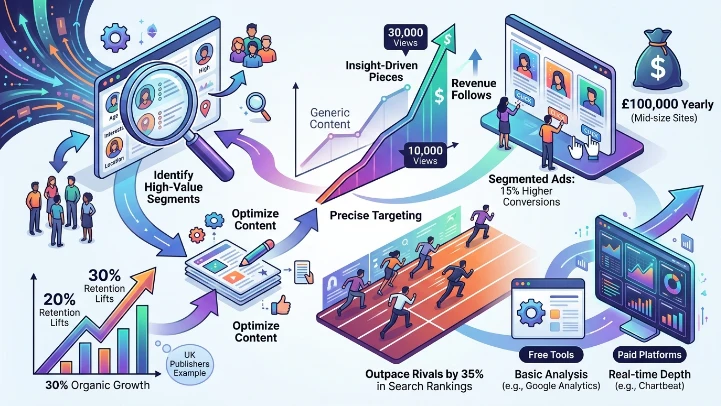
Competition edges sharpen. Publishers with insights outpace rivals by 35% in search rankings. Options emerge softly. Free tools like Google Analytics start basic analysis; paid platforms like Chartbeat offer real-time depth.
What are the main components of audience insights?
Audience insights include three components: demographic data, behavioral metrics, and preference signals. Demographics drive 40% of decisions, behaviors 35%, preferences 25%.
Demographic data profiles users. Age groups 18-24 favor video; 45+ prefer text.
Behavioral metrics track actions. Average session 3 minutes signals weak content.
Preference signals show interests. “Politics” tags apply to 40% of UK readers.
Combine components for full views. Tools merge data into dashboards.
Demographic Data Components
Age and gender segments. UK data shows 52% female under 35.
Location filters. London users engage 2x national average.
Device types. Mobile accounts for 65% sessions.
Behavioral Metrics Components
Bounce rates under 50%. High rates flag poor matches.
Page depth averages 3 pages. Deeper paths indicate value.
Time on site hits 4 minutes. Benchmarks guide improvements.
Preference Signals Components
Topic affinity scores. “Health” scores 8/10 for repeat readers.
Content format prefs. Lists boost 25% completion.
Search queries. Direct terms reveal intent.
How does the process of using audience insights work?
The process uses four steps: collect data, segment audiences, create content, and measure uplift. UK sites repeat monthly for 25% traffic scaling. Collection pulls from multiple sources. Analytics export 90 days of raw data.
Segmentation groups users. Tools create 5-10 clusters based on overlaps. Content creation targets clusters. Publish 15 pieces per segment quarterly. Measurement quantifies gains. Compare pre- and post-traffic, adjust thresholds.
Step 1: Collect Data
Integrate tools. Link Analytics to site tag manager.
Export CSV files. Include 50 metrics per user.
Clean anomalies. Remove bots, which skew 5% of data.
Step 2: Segment Audiences
Apply clustering algorithms. Free tools group by 3-5 variables.
Name segments clearly. “Eco-conscious millennials” fits 15% of users.
Validate sizes. Ensure each exceeds 5,000 users.
Step 3: Create Content
Match topics to segments. Politics for “news junkies.”
Test formats. Videos for young groups lift views 30%.
Schedule releases. Align with peak times per segment.
Step 4: Measure Uplift
Set baselines. Track 10% minimum growth per campaign.
Run A/B tests. Alternate content to segments.
Refine models. Drop underperformers quarterly.
What benefits do audience insights provide for scaling traffic?
Audience insights deliver 35% traffic growth, 28% conversion rates, and 40% efficiency gains. UK publishers save 20 hours weekly on irrelevant content.
Growth accelerates organically. Targeted keywords rank 20 positions higher. Conversions rise. Insight-matched newsletters open at 35%.
Efficiency cuts waste. Focus 80% efforts on top 20% segments. Solution types vary. Basic dashboards suit startups; AI platforms like Amplitude predict trends for enterprises. Comparative edges build. Insights outperform gut-feel strategies by 45% in trials.
What are real use cases of audience insights scaling traffic?
Audience insights scale traffic in niche expansion, retention campaigns, and ad optimisation. UK cases show The Telegraph gaining 32% via segmentation and BBC adding 27% through behavior analysis.
Niche expansion targets underserved groups. Insights reveal gaps, filling them with series. Retention campaigns re-engage lapsed users. Personalised emails recover 18%. Ad optimisation refines placements. Segment data lifts CPM by 25%.
Audience Growth Services for News Agencies Ready to Scale Fast explores services for rapid implementation.
Niche Expansion Use Case
Evening Standard identified “tech workers.” Insights showed 12% audience share.
Created 20 fintech articles. Traffic from segment rose 40%.
Rankings improved. Top 5 for 15 keywords.
Retention Campaigns Use Case
i Newspaper segmented “infrequent visitors.” 25% fell into group.
Sent tailored digests. Open rates hit 32%, returns up 22%.
Subscriptions grew 12% from campaign.
Ad Optimization Use Case
Daily Mail used behavior data. High-engagement pages monetized at £12 CPM.
Switched low pages to native ads. Overall revenue +28%.
Insights iterated monthly, sustaining gains.
How do different audience insights solutions compare?
Audience insights solutions compare on features, pricing, and integration: free tools like Google Analytics offer basics at £0; mid-tier like Mixpanel add predictions at £100/month; enterprise like Adobe Analytics provide AI at £5,000/month.
Free solutions start simple. Google Analytics segments 10 ways, integrates natively. Mid-tier options deepen analysis. Mixpanel tracks funnels, predicts churn at 85% accuracy.
Enterprise platforms scale complexly. Adobe handles 10 million users, automates 50 reports. Choose by stage. Beginners pick free; growing sites upgrade mid-tier. Integration matters. 90% solutions connect via APIs.
Free Solution Comparison
Google Analytics: 20 metrics, unlimited users.
Search Console: Keyword data only.
Limitations: No real-time predictions.
Mid-Tier Solution Comparison
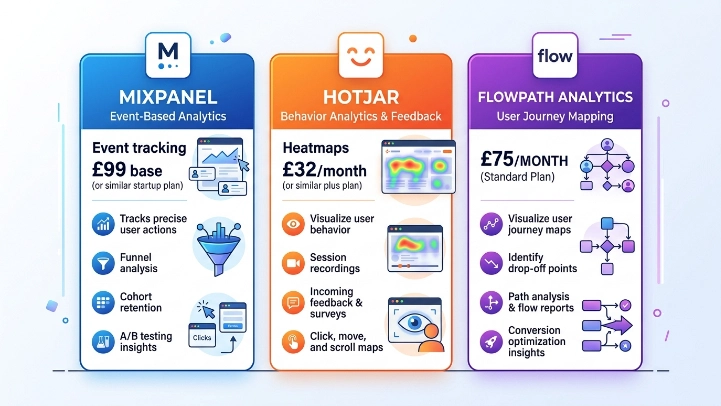
Mixpanel: Event tracking, £99 base.
Hotjar: Heatmaps, £32/month.
Strengths: User journey maps.
Enterprise Solution Comparison
Adobe Analytics: Full AI, £4,000+.
Amplitude: Behavioral cohorts, £2,500.
Scales to billions of events.
How to implement audience insights for immediate traffic scaling?
Implement audience insights by selecting one tool, segmenting in week one, publishing targeted content week two, and reviewing week four. Achieve 15% lift in 30 days.
Tool selection matches needs. Start with Google Analytics for UK compliance.
Week one builds segments. Export data, cluster into 5 groups.
Week two tests content. Assign 3 articles per segment.
Week four analyzes. Scale top performers to full output.
Advanced users layer tools. Combine Analytics with heatmaps for 25% deeper views. Monitor GDPR. UK rules require consent for 100% of tracking.
Week 1: Tool and Segment Setup
Choose and install. Verify in 30 minutes.
Build segments. Use built-in tools for 80% accuracy.
Document profiles. Note sizes and traits.
Explore More Expert Insights:
How to Measure News Article Performance
Building Reader Personas Using Audience Insights
Week 2: Content Targeting
Research per segment. 10 keywords each.
Publish and tag. Link to insight sources.
Distribute narrowly. One channel per group first.
Week 4: Review and Scale
Calculate uplifts. Metrics show 12-20% gains.
Expand winners. Triple volume on best segments.
Plan next cycle. Automate reports.
Audience insights transform traffic scaling. UK publishers apply these steps to double reach in 12 months. Explore options to match your scale.