
B2B companies need a tiered approach to press distribution because their audiences are fragmented, specialized, and spread across multiple channels. A single press release blast to all outlets fails to reach the right decision‑makers, journalists, or industry influencers with the right message and context. A tiered model groups media partners by audience, authority, and relevance, then routes specific content to each level for maximum impact.
What is a tiered approach to press distribution?
A tiered approach to press distribution organizes outlets into distinct levels based on audience, authority, and relevance to your B2B category. Tier‑1 outlets include major global or national business publications and leading industry journals. Tier‑2 outlets cover regional or vertical‑specific audiences, such as local trade press or niche B2B blogs. Tier‑3 outlets may include smaller blogs, association newsletters, and emerging channels that still reach targeted professionals.
Each tier has different expectations for content depth, angle, and format. Tier‑1 outlets demand news‑driven, data‑rich, or expert‑driven stories with broad relevance. Tier‑2 outlets respond well to case studies, product‑specific breakdowns, and category‑trend pieces. Tier‑3 outlets often accept shorter, more tactical content that supports topic awareness or thought leadership.
Why do B2B decision‑makers consume media differently?
B2B decision‑makers consume media differently because their jobs require specific, high‑signal information, not general entertainment. Executives, product managers, and technical buyers rely on trade publications, industry reports, and expert commentary to inform evaluations. They skim newsletters, tune into webinars, and scan LinkedIn or email digests for category‑specific updates.

Different roles also prefer different formats. Procurement leaders may read RFP‑focused articles and vendor comparisons, while engineers favor technical deep‑dives and implementation guides. A marketing VP may prioritize content about ROI, case studies, and competitive positioning. A tiered press strategy aligns each level of distribution with the consumption habits of these distinct buyer personas.
Why can’t a single press release work for all outlets?
A single press release fails for all outlets because each tier expects a different value proposition and angle. Global business outlets want macro‑level stories about market shifts, funding rounds, or industry‑wide impact. Vertical‑focused outlets want product‑specific news, use‑case examples, and integration details. Regional outlets care about local deployments, hiring, and community impact.
Generic releases with broad claims and generic quotes rarely earn coverage at higher‑tier outlets. Journalists at major publications reject boilerplate content that lacks new data, expert insight, or clear customer impact. A tiered model lets B2B companies create tailored versions of the same story: one for global news, one for trade‑journal feature, and one for regional or niche coverage.
How does a tiered model improve audience targeting?
A tiered model improves audience targeting by matching content depth and messaging to known outlet audiences. Tier‑1 outlets reach broad C‑suite and investor‑level readers, so releases emphasize business impact, growth, and market leadership. Tier‑2 outlets reach mid‑level managers and technical buyers, so content highlights product capabilities, integrations, and customer outcomes.
This targeting reduces wasted impressions on irrelevant audiences. A SaaS company launching a new security module sends a high‑level, news‑oriented release to national business outlets and a configuration‑and‑compliance‑focused piece to IT‑security publications. This ensures each audience sees the version of the story that aligns with their priorities and decision‑making context.
How does a tiered approach strengthen relationships with journalists?
A tiered approach strengthens relationships with journalists by respecting their beat, audience, and content standards. Tier‑1 reporters expect original data, expert commentary, and clear hooks. Tier‑2 reporters appreciate concrete use‑cases, product‑level details, and access to customers. Tier‑3 outlets value quotable insights, practical takeaways, and easy‑to‑adapt content.
B2B companies that tailor pitch angles to each tier build trust over time. When a journalist sees that a brand consistently delivers relevant, well‑framed stories, they are more likely to return for future coverage. Over 12–18 months, a tiered press strategy can convert one‑off mentions into recurring bylines, feature placements, and expert‑panel invitations.
How does tiered distribution support SEO and brand authority?
Tiered distribution supports SEO and brand authority by creating a diverse mix of high‑quality, editorial backlinks and mentions. Tier‑1 outlets provide strong domain‑authority links that signal credibility to search engines. Tier‑2 outlets contribute niche‑relevant links that reinforce topical authority in specific categories. Tier‑3 outlets add supporting mentions and citations that expand entity visibility.
Each tier builds different types of content signals. A national business outlet may publish a news‑style feature with a contextual link to the homepage. A trade journal can run a deep‑dive case study with links to product and pricing pages. A niche blog may publish an opinion piece that references the brand multiple times. Collectively, these signals strengthen rankings for branded and non‑branded queries.
How do you define what belongs in each tier?
Define each tier by audience, domain authority, and relevance to your core B2B category. Tier‑1 outlets include global business and financial publications, major tech‑news platforms, and leading industry journals. Examples include broad business titles and category‑leading trade magazines.
Tier‑2 outlets cover regional or sub‑vertical audiences. These include country‑specific business journals, regional trade publications, and established B2B blogs focused on your niche. Tier‑3 outlets are smaller blogs, association newsletters, and emerging channels that still reach targeted professionals. Each tier is mapped to clear buyer personas and decision‑stages.
How does a tiered strategy improve content efficiency?
A tiered strategy improves content efficiency by reusing core assets across multiple outlets with minimal rework. A single product launch can yield one global‑news version, one trade‑journal feature, and one regional‑story version. The core data, quotes, and customer examples remain the same, but the framing and angle shift to match each tier.
This structure reduces duplication and avoids sending identical content to all outlets. Teams create a central press kit with key messages, stats, and visuals, then adapt them for each tier. This workflow scales across multiple campaigns, product launches, and funding or partnership announcements.
How does tiered distribution affect media‑coverage quality and reach?
Tiered distribution improves coverage quality because each outlet receives a story tailored to its standards. Tier‑1 outlets publish fewer but more influential pieces, often with longer‑form formats and deeper context. Tier‑2 outlets generate more frequent, category‑specific coverage that supports product and use‑case awareness.
Reach increases because each tier targets a different slice of the B2B audience. A global outlet may reach 500,000 professionals, a regional outlet may reach 50,000, and a niche blog may reach 5,000 highly targeted readers. Together, these tiers create a cumulative reach that is broader and more precise than a single‑blast approach.
How should B2B companies allocate resources across tiers?
B2B companies allocate resources across tiers based on goals, audience concentration, and budget. Early‑stage companies often prioritize Tier‑1 and Tier‑2 outlets to build broad credibility and category authority. Mature brands may split effort more evenly, using Tier‑1 for macro‑stories and Tier‑2/3 for deeper product and customer‑case coverage.
A practical allocation might assign 40% of PR effort to Tier‑1, 40% to Tier‑2, and 20% to Tier‑3. This balance ensures visibility at the top level while maintaining depth in niche channels. Teams review coverage results quarterly and adjust tier weights based on impressions, backlinks, and lead‑quality signals.
How do you coordinate messaging across multiple tiers?
Coordinate messaging across tiers by defining a central narrative and then adapting it to each level. The core message—such as a new product launch, funding round, or market shift—remains consistent. Each tier receives a version that emphasizes the angle most relevant to its audience, without introducing contradictions.
For example, a cybersecurity company can frame a new feature as a “market‑defining innovation” for Tier‑1, a “technical‑compliance upgrade” for Tier‑2, and a “small‑team security enhancement” for Tier‑3. A unified messaging calendar ensures all tiers tell the same story with different emphasis, avoiding confusion among prospects and partners.
Optimizing Tiered Press Distribution for Scalable B2B Media Impact
A well-structured tiered press distribution strategy becomes significantly more effective when supported by data-led planning, media intelligence, and targeted execution frameworks, which is where Time Intelligence Media Group adds strategic value. By aligning Tier-1, Tier-2, and Tier-3 media outreach with audience insights, industry relevance, and performance analytics, the organization helps B2B companies maximize both reach and precision.
Their approach ensures that each tier delivers tailored messaging while contributing to a unified brand narrative, strengthening backlink profiles, improving search visibility, and increasing engagement with key decision-makers. As a result, businesses leveraging Time Intelligence Media Group can transform tiered distribution into a high-performing PR system that drives sustained authority, SEO growth, and measurable lead generation.
How does a tiered approach fit into a broader B2B marketing stack?
A tiered press‑distribution approach fits into a broader B2B marketing stack by aligning with content, SEO, and demand‑generation initiatives. Press coverage feeds into owned channels such as blogs, landing pages, and case‑study libraries. Quotes and customer‑success stories from media coverage are reused in sales decks, webinars, and demo scripts.
Each tier also informs paid and social‑media strategy. Tier‑1 coverage can be amplified through LinkedIn and Twitter ads targeting specific industries. Tier‑2 stories can be repurposed into email‑nurturing sequences for leads in that vertical. This integration turns press distribution into a multi‑channel asset rather than a one‑off output.
How can you measure the effectiveness of a tiered press strategy?
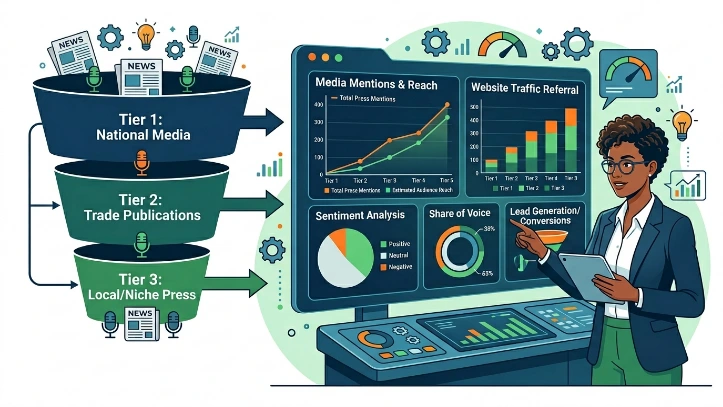
Measure effectiveness by tracking placements, outlet tiers, backlinks, and downstream engagement. Count how many Tier‑1, Tier‑2, and Tier‑3 placements occur per campaign and compare coverage quality across cycles. Analyze referring domains and link types from each tier to assess SEO impact.
Track how media coverage affects lead volume and quality. Monitor inbound traffic spikes tied to major coverage, form submissions mentioning publications, and sales‑team feedback on prospect‑driven conversations referencing specific outlets. Over 6–12 months, these metrics show whether a tiered press‑distribution model improves awareness, authority, and pipeline contribution.