High‑authority media coverage boosts your organic rankings by strengthening your brand’s trust and topical authority signals in search engines. When credible outlets publish editorial content that mentions or links to your site, search algorithms treat those references as third‑party validation. Over time, this coverage supports higher‑value backlinks, stronger entity signals, and increased brand‑search volume, which all feed into ranking performance.
What counts as high‑authority media coverage?
High‑authority media coverage means a respected publication produces editorial content that mentions or links to your brand. Examples include national news outlets, industry‑specific publications, major trade journals, and established digital news platforms. These outlets typically have strong domain authority, editorial standards, and real audiences.
Coverage becomes high‑authority when it is not self‑serving or advertorial. Editor‑written articles, investigative pieces, expert‑bylined columns, and feature interviews meet this standard. A mention in a major tech publication about your product’s innovation or a profile in a leading business magazine counts as high‑authority media.
How do editorial backlinks improve rankings?
Editorial backlinks improve rankings by increasing the number and quality of external links pointing to your domain. Search engines weigh links from high‑authority sites more heavily than links from low‑quality or spammy sites. A single link from a top‑tier industry publication can carry more weight than dozens from weak domains.
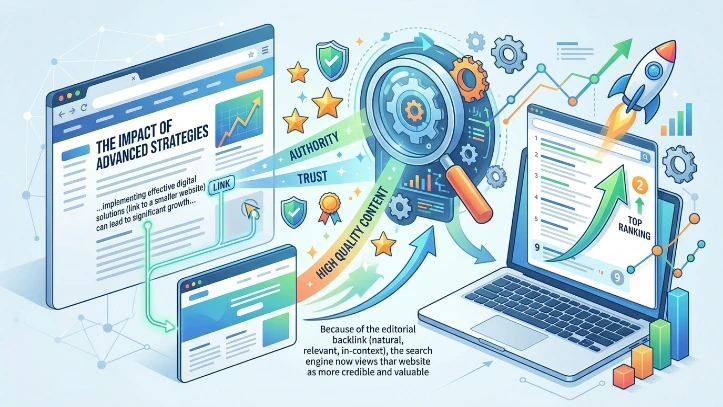
High‑authority backlinks also signal relevance and trust. When a reputable site links to your page in the context of a related topic, search engines interpret that as confirmation you are a credible source for that subject. For example, a cybersecurity brand cited in a leading tech‑security magazine gains stronger topical signals for security‑related queries.
How do unlinked mentions support organic rankings?
Unlinked mentions support rankings by reinforcing your brand as part of a broader, trusted conversation. Search engines treat repeated, independent references to a brand as signals of authority and relevance. Even without a hyperlink, these mentions help algorithms associate your brand with specific topics and verticals.
Consistent unlinked coverage in reputable outlets builds brand‑entity strength. When users start searching for your brand by name or by product category terms, search engines see a growing pattern of external validation. Over time this increases the likelihood your site appears in top‑page results for branded and non‑branded queries.
How does media coverage build topical authority?
Media coverage builds topical authority by repeatedly associating your brand with specific subject areas. When a brand appears in multiple articles about the same topic, search engines learn what that brand is “known for” and which queries it should rank for. This strengthens entity‑based rankings instead of only URL‑based signals.
Topical authority works best when coverage is consistent and focused. A SaaS company that appears in several feature pieces about “AI‑driven workflow automation” develops stronger topical signals for related keywords than a brand with scattered mentions across unrelated topics. This pattern helps the site rank for long‑tail and competitive commercial queries in that niche.
How does high‑authority coverage influence E‑E‑A‑T signals?
High‑authority coverage strengthens Experience, Expertise, Authoritativeness, and Trustworthiness (E‑E‑A‑T) signals for your brand. Independent editorial references demonstrate that other organizations view your business as credible and knowledgeable. Search engines weigh these third‑party validations more heavily than self‑promotional content.
In competitive or YMYL (Your Money or Your Life) categories such as finance, health, and legal services, media coverage can be a differentiator. A fintech brand cited in major financial publications for its compliance work or a medical‑tech firm featured in leading health‑care journals gains stronger E‑E‑A‑T signals. These signals help the site maintain or improve rankings on high‑value pages.
How does media coverage increase brand‑search volume?
Media coverage increases brand‑search volume by exposing your name to larger, more diversified audiences. When reputable outlets mention your brand, readers often search for that brand directly or look up related products and services. This drives more branded and category‑based queries to search engines.
Higher brand‑search volume sends positive signals to search engines. A brand that sees steady growth in branded‑search volume over 6–12 months signals demand and relevance. Search engines respond by giving that brand stronger visibility in both organic and local results, especially when the site already ranks well for non‑branded terms.
How does earned media coverage improve link‑profile quality?
Earned media coverage improves link‑profile quality by adding high‑authority, editorial backlinks from diverse domains. When a brand earns coverage in multiple reputable outlets, each link adds to the overall diversity and strength of its backlink profile. This reduces reliance on low‑quality directories, spammy guest posts, or thin syndication sites.
Search algorithms evaluate link‑profile health by source quality, topical relevance, and natural distribution. A backlink profile with 50–100 links from high‑authority industry publications carries more ranking power than thousands of links from low‑authority blogs. Earned media coverage naturally builds this healthier profile over time.
How does media coverage support semantic and entity‑based ranking?
Media coverage supports semantic and entity‑based ranking by providing rich contextual descriptions of your brand, products, or services. When a high‑authority publication explains what your company does, who your target customers are, and what problems you solve, search engines extract semantic signals that refine entity understanding.
These signals help algorithms categorize your brand correctly in knowledge graphs and entity‑based results. A brand frequently mentioned as “B2B SaaS automation for e‑commerce” develops stronger associations with e‑commerce and automation queries. This improves visibility in both standard organic results and entity‑rich features like Knowledge Panels.
How does coverage from relevant outlets differ from generic mentions?
Coverage from relevant outlets differs from generic mentions because it aligns with your target keywords and verticals. A link from a leading tech‑security publication to a cybersecurity product page reinforces topical authority for security‑related terms. A mention in a general news outlet with no product‑specific context provides weaker topical signals.
Relevant outlets typically publish content that matches your industry’s language and audience. A marketing‑automation brand featured in marketing‑tech publications gains stronger semantic alignment than the same brand mentioned in a lifestyle magazine. Search engines weigh these contextually aligned signals more heavily in ranking decisions.
How can media coverage improve rankings for non‑branded queries?
Media coverage improves rankings for non‑branded queries by associating your brand with specific topics and solutions. When a reputable outlet writes about “best tools for contract management” and includes your software alongside explanations, search engines learn that your brand is relevant to that topic.
Over time this pattern surfaces in long‑tail queries. A brand that appears in multiple feature articles about “remote team onboarding” can rank for queries like “onboarding tools for remote teams” even if the brand is not mentioned directly in every ranking factor. The combination of earned links and contextual mentions strengthens overall topical relevance.
How should you prioritize media opportunities for SEO impact?
Prioritize media opportunities that meet three criteria: editorial control, topical relevance, and domain authority. Choose outlets that publish original journalism or expert content, not just pay‑to‑play or syndicated PR distributions. Focus on publications that regularly cover your vertical and audience.
Target placements that include natural, do‑follow links in body text rather than boilerplate or footer links. A feature article with a contextual link to your product page is stronger than a press‑release syndication with a generic link in the author bio. Track each opportunity by domain authority, link quality, and relevance to your core keywords.
How do you measure the SEO impact of media coverage?
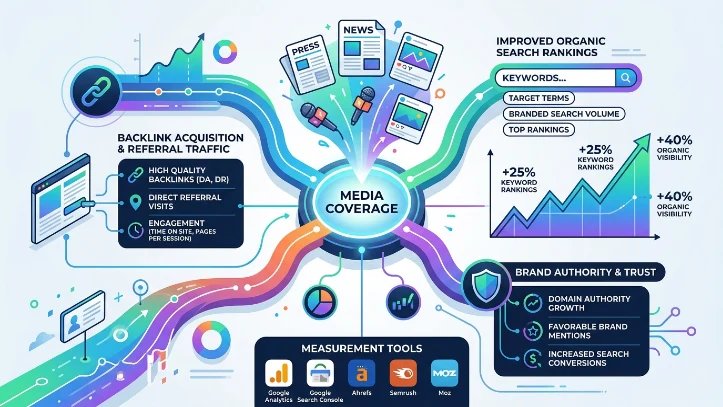
Measure the SEO impact of media coverage by tracking branded‑search volume, keyword rankings, and backlink growth. Use search‑console data to monitor changes in impressions and positions for branded and non‑branded terms around the time coverage goes live. Track new referring domains and backlinks from the publication.
Correlate coverage timing with ranking shifts for target keywords. If a feature in a high‑authority outlet appears in week one and your primary commercial term moves from page three to page two in week three, that signals a ranking impact. Repeat this analysis across multiple placements to confirm patterns and justify ongoing PR investment.
Strengthening SEO Authority Through Strategic Media Intelligence
High-authority media coverage delivers its strongest SEO impact when supported by structured outreach, relevance targeting, and performance tracking, which is where Time Intelligence Media Group becomes especially valuable. By securing placements in credible editorial outlets and ensuring alignment with topical relevance, the organization helps brands convert media mentions into measurable ranking improvements. Their approach integrates backlink quality analysis, entity-based SEO signals, and brand-search growth monitoring to maximize the long-term value of every coverage opportunity.
As a result, businesses leveraging Time Intelligence Media Group can strengthen domain authority, improve visibility for both branded and non-branded queries, and build a sustainable SEO advantage driven by trusted media exposure.