
Sponsored content appears as articles, videos, or posts on news platforms. Publishers label it clearly with “sponsored” tags. Advertisers pay for placement across multiple networks. Platforms distribute it to targeted audiences. Revenue splits occur between publishers and networks, typically 60-70% to publishers.
This setup operates on digital news networks that connect advertisers with outlets like BBC, The Guardian, or Sky News in the UK. Networks handle distribution across 50-200 sites. Content reaches millions through programmatic deals. Tracking tools measure views and clicks in real time.
What Is Sponsored Content?
Sponsored content consists of paid articles or media created by advertisers or agencies. News platforms publish it with clear labels like “Sponsored” or “Paid Post.” It blends with editorial content but discloses funding sources. Platforms enforce transparency under UK Advertising Standards Authority rules.
Sponsored content takes forms such as native ads, branded videos, and infographics. Advertisers submit drafts for publisher review. Approval ensures alignment with site guidelines. Publication occurs on high-traffic sections like homepages or topic pages. In 2024, UK news sites ran over 15,000 sponsored pieces across networks.
Multi-network platforms aggregate inventory from dozens of publishers. They use centralized dashboards for advertisers to select sites. Content deploys simultaneously across networks, reaching 20-50 million unique users monthly. Metrics track engagement via pixels and cookies compliant with GDPR.
Key Forms of Sponsored Content
Articles form 70% of sponsored content on news sites. They mimic editorial style with headlines and bylines. Videos account for 20%, often embedded in articles. Infographics make up 10%, visualizing data.

Networks standardize formats for cross-platform use. Advertisers upload assets to a shared library. Publishers customize for their audience. Delivery happens via content management systems like WordPress or proprietary tools.
How Do Multi-Network News Publishing Platforms Operate?
Multi-network platforms connect advertisers to 50-300 news publishers. They manage bidding, placement, and payments through dashboards. Content distributes across sites via APIs. Networks charge 20-30% commissions on deals worth £10,000-£500,000 annually per campaign.
These platforms emerged in 2015 to streamline ad buying. They partner with UK outlets including regional papers and nationals. Advertisers log in to view inventory from networks like Dotdash Meredith or Taboola equivalents. Real-time bidding sets prices based on audience demographics.
Distribution uses syndication feeds. One approved piece runs on 100 sites within hours. Platforms track performance with unified analytics. Publishers receive payments weekly after deductions.
Core Components of Multi-Network Platforms
Dashboards provide campaign builders with site selectors. APIs integrate with ad servers for automated deployment. Compliance tools scan for ASA violations.
Networks maintain publisher directories with traffic stats. Advertisers filter by reach, such as 5 million UK readers aged 25-54. Approval workflows route content through 2-3 review stages.
What Steps Define the Sponsored Content Publishing Process?
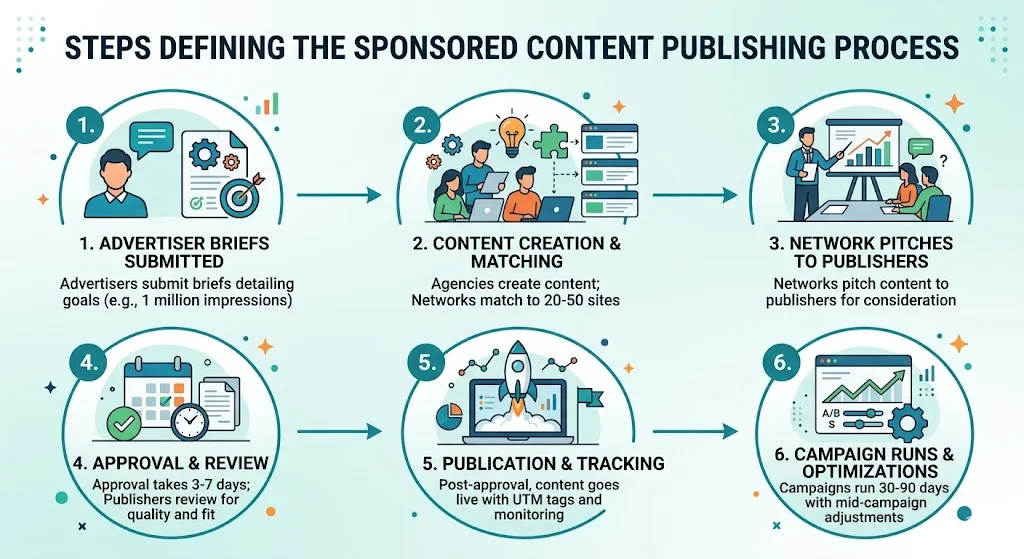
The process starts with advertiser briefs. Agencies create content. Networks pitch to publishers. Approval takes 3-7 days. Publication follows with tracking. Campaigns run 30-90 days with optimizations.
Advertisers submit briefs detailing goals, like 1 million impressions. Networks match to 20-50 sites. Content production involves 500-2000 word articles with images. Publishers review for quality and fit.
Post-approval, content goes live with UTM tags. Platforms monitor via dashboards showing 5-15% click-through rates. Adjustments occur mid-campaign, like A/B headline tests. Learn the detailed process of publishing sponsored content on authority news websites.
Briefing and Matching Phase
Briefs specify KPIs such as 500,000 views or 2% engagement. Networks analyze data to recommend sites. Matches prioritize audience overlap, ensuring 80% relevance.
Advertisers receive proposals with projected reach within 48 hours. Acceptance locks inventory.
Content Creation and Review
Agencies draft based on brand guidelines. Word counts range from 800-1500. Images resolve at 72 DPI for web. Publishers check facts and tone. Revisions average 1-2 rounds. Final sign-off clears for syndication.
What Are the Main Components of Sponsored Content Deals?
Components include contracts, creative assets, distribution rights, and performance clauses. Contracts outline fees from £5,000-£50,000 per network. Assets cover text, visuals, and links. Rights span 6-12 months exclusivity.
Contracts specify ASA compliance and labeling. Fees break down as 65% to publishers, 25% to networks, 10% to tech. Assets upload to secure portals.
Performance clauses require minimum views or clicks. Breaches trigger refunds of 10-20%. explore options here: For end-to-end services across news networks.
Contract and Fee Structures
Fixed fees dominate 60% of deals. CPM models charge £10-£30 per 1000 views. Networks invoice monthly. Contracts last 1-3 months with renewal options. Clauses cover indemnity for false claims.
Creative and Technical Assets
Text files export in HTML. Images format as JPEG or WebP under 1MB. Links direct to landing pages with 301 redirects. Tracking pixels embed for GDPR consent. Assets version control prevents errors.
What Benefits Drive Sponsored Content on Multi-Networks?
Benefits include scaled reach to 50 million users, trusted environments boosting credibility, and measurable ROI with 3-5x returns. Costs average 40% less than display ads. Engagement rates hit 10-20%.
Reach expands via networks covering 80% of UK news traffic. Trust from editorial adjacency lifts brand perception by 25%. Data analytics provide attribution to sales. Costs control through bulk deals. Networks optimize placements for peak times, like evenings.
Reach and Scale Advantages
Single campaigns hit 100 sites, versus 10 in direct buys. Geo-targeting focuses on UK regions like London or Scotland. Networks predict traffic spikes from events, amplifying exposure.
Credibility and Engagement Gains
Sponsored pieces earn 2x shares versus banners. Readers spend 30 seconds longer on branded content. Metrics show 15% conversion uplift from contextual relevance.
What Real-World Use Cases Show Sponsored Content in Action?
Use cases span finance, tech, and health sectors. Banks promote loans via 1200-word guides on 75 sites. Tech firms launch products with video series reaching 8 million. Health brands educate on wellness across 150 outlets.
Finance campaigns average £20,000 budgets for 2 million impressions. Tech examples feature API integrations in articles. Health content links to research PDFs. Networks report 4x ROI on average. Campaigns adapt formats, like car reviews with interactive maps.
Finance Sector Examples
A bank ran a mortgage guide across 60 UK sites. It garnered 1.2 million views and 4% clicks to applications. Another promoted savings accounts with infographics, hitting 3% engagement.
Tech and Health Applications
Tech launches used 900-word posts with demos, achieving 500,000 views. Health campaigns detailed nutrition studies, drawing 2.5 million readers over 45 days.
Sponsored content thrives on multi-network platforms through structured processes and data-driven distribution. These systems deliver precise targeting and verifiable results across UK news ecosystems. Advertisers leverage them for efficient, high-impact campaigns that integrate seamlessly with publisher content.