
Data driven publishing turns sponsored content into a measurable, repeatable performance channel. It uses live tracking, central dashboards, and automated insights to show exactly how each sponsored article, video, or series performs. This approach supports UK marketers who need to prove ROI, improve efficiency, and scale campaigns confidently.
The phrase “track and optimise” means you monitor every impression, click, engagement, and conversion in real time, then adjust spending, targeting, and creative based on that data. “Data driven publishing” refers to a platform that hosts or distributes sponsored content while enforcing structured tracking, label compliance, and consistent measurement across publishers. This combination reduces guesswork and aligns content with business goals.
What are the core components of a data driven publishing system?
A data driven publishing system includes four main components: a content management layer, a tracking and measurement layer, an analytics and insights layer, and an optimisation engine. The content management layer handles article and video uploads, approval workflows, and placement rules. It ensures every sponsored asset is tagged correctly and distributed according to publisher standards.
The tracking layer captures impressions, clicks, and user actions via pixels, cookies, or server‑side methods. The analytics layer aggregates this data, applies attribution models, and produces dashboards that show performance by publisher, audience segment, and creative. The optimisation engine uses rules or machine‑learning signals to adjust bids, budgets, and targeting in real time, shifting spend toward higher‑performing elements.
How do you set performance goals for sponsored content in this system?
Setting performance goals starts with defining clear, measurable objectives for each campaign. UK marketers specify whether the priority is brand awareness, engagement, lead generation, or direct sales. Each objective maps to specific KPIs such as impressions, viewability, time on page, click‑through rate, conversion rate, cost per lead, or return on ad spend.
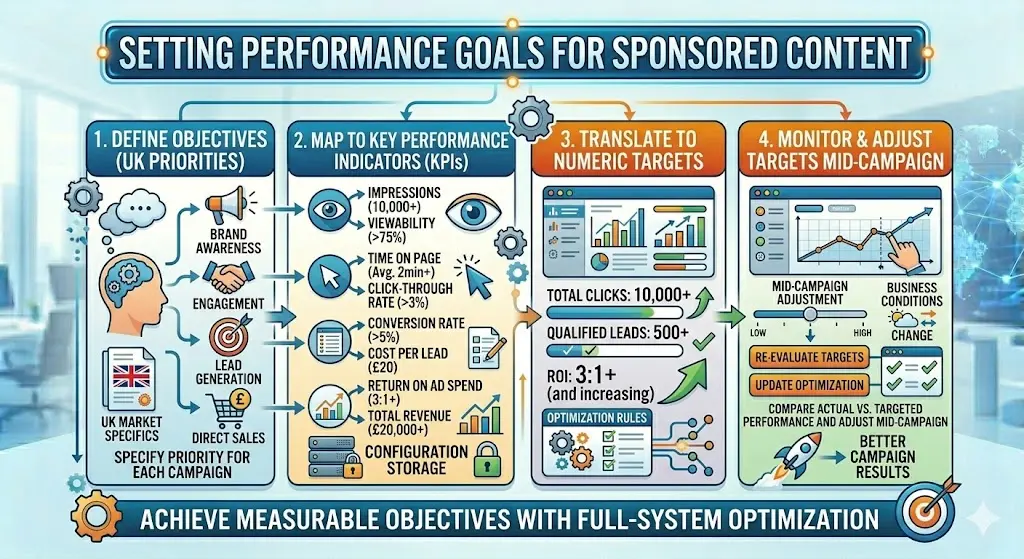
The platform translates these KPIs into numeric targets, for example 10,000 clicks, 500 qualified leads, or a 3:1 return on ad spend. These targets are stored in the campaign configuration so that the system can automatically compare actual performance against them. Marketers can adjust targets mid‑campaign if business conditions change, and the platform updates optimisation rules accordingly.
How does real‑time tracking work for sponsored content campaigns?
Real‑time tracking means that every impression, click, and user action appears in the platform within seconds or minutes of occurring. The system receives data from publisher tags, server‑side integrations, and ad servers, then normalises it into a common structure. This allows marketers to check live dashboards during campaign runtime instead of waiting for daily or weekly exports.
The platform enforces data‑quality checks, such as validating that impressions come from human users and not bots. It also reconciles numbers across different sources, flagging mismatches for manual review. For UK campaigns, this real‑time visibility supports rapid decisions, such as pausing low‑performing placements or increasing budget on high‑performing publishers.
What key metrics does a data driven publishing system monitor?
A data driven publishing system monitors a standardised set of metrics for each sponsored content campaign. At the top level, it tracks impressions and unique reach across all publishers. It then records engagement metrics such as click‑through rate, time on page, scroll depth, and video completion rates for each asset.
At the conversion level, the system captures form submissions, trial sign‑ups, demo requests, and e‑commerce purchases linked to the sponsored content. It also calculates cost‑related metrics such as cost per impression, cost per click, cost per lead, and return on ad spend. These metrics are available by publisher, audience segment, device, and creative format so that marketers can compare performance accurately.
How does the platform turn raw data into actionable insights?
The platform transforms raw tracking data into insights by applying segmentation, benchmarking, and statistical tests. It breaks performance down by publisher, placement, audience demographics, device type, and creative design. This segmentation reveals which combinations drive the strongest engagement and conversions.
The system compares current results against historical averages and industry benchmarks to highlight underperforming or outperforming elements. It can run A/B tests automatically, showing which headlines, images, or layouts deliver higher click‑through rates or longer time on page. These insights are presented in dashboards and reports that marketers use to refine future campaigns and optimisation rules.
How does automated optimisation improve sponsored content performance?
Automated optimisation uses rules and machine‑learning signals to adjust campaigns without manual intervention. The platform can increase or decrease budgets for specific publishers, placements, or audience segments based on real‑time performance. It can also pause underperforming creatives and rotate in higher‑performing variants.
For example, if a particular combination of publisher, audience, and creative format consistently delivers below‑target engagement, the system can reduce its share of spend. At the same time, it can shift more budget to segments that exceed thresholds such as 3% click‑through rate or 20% lead‑conversion rate. This continuous adjustment improves overall campaign efficiency and ROI.
What role does attribution play in data driven sponsored content?
Attribution in data driven publishing assigns credit to each touchpoint that contributed to a conversion. The system applies consistent attribution models, such as last‑click, first‑click, or multi‑touch, across all publishers and channels. This allows marketers to see how sponsored content interacts with other marketing efforts such as search ads, social posts, and email campaigns.
For UK marketers, unified attribution avoids the problem of double‑counting or invisibility caused by disconnected tools. The platform can show assisted conversions, where sponsored content helped move a user down the funnel even if it did not receive the final click. This fuller view supports more accurate budget allocation and a balanced understanding of sponsored content’s impact.
How does data driven publishing support UK compliance and transparency?
Data driven publishing helps UK marketers comply with advertising standards and data‑protection rules by enforcing clear labelling and auditable tracking. Each sponsored asset is tagged as “sponsored” in the platform, and placement rules ensure it appears in the correct sections of publisher sites. The system maintains logs of where each piece ran, for how long, and to which audience segments. For an overview of underlying performance trends across sponsored content, see Is There Reliable Data Showing Performance Trends of Sponsored Content Campaigns Today?.
From a data‑privacy perspective, the platform supports GDPR‑compliant tracking methods such as server‑side tagging and consent‑based identifiers. It provides transparency by showing which data is collected, how it is used, and how it is stored. This compliance layer reduces regulatory risk and builds trust with both publishers and audiences.
How can you use historical data to plan future sponsored content campaigns?
Historical data from previous campaigns becomes a planning resource for future sponsored content. The platform stores performance records for each article, publisher, audience segment, and creative format, allowing marketers to identify patterns and repeatable strategies. For example, a financial services brand might see that long‑form articles on investment themes consistently outperform short news‑style pieces.
Marketers can use this data to forecast impressions, engagements, and conversions for new campaigns based on budget and planned placements. They can also set realistic KPIs by referencing historical averages and top‑quartile performance. Over time, this historical library turns ad hoc campaigns into a structured, data‑driven content strategy.
How does this approach improve ROI on sponsored content budgets?
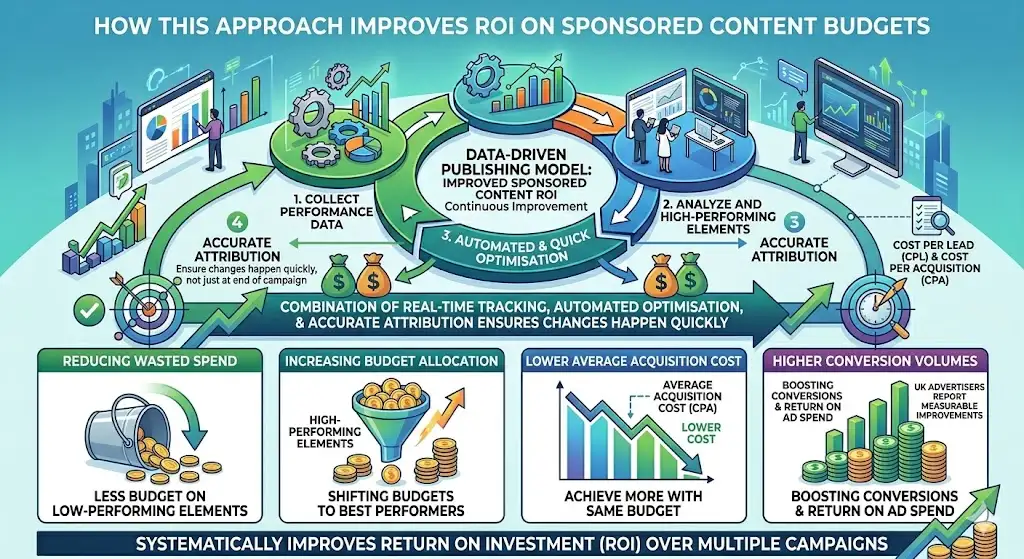
This approach improves ROI by reducing wasted spend and increasing the share of budget allocated to high‑performing elements. Marketers see exactly which publishers, placements, audiences, and creatives deliver the best cost per lead or cost per acquisition. They can shift budgets away from low‑return combinations and into those that consistently exceed targets.
The combination of real‑time tracking, automated optimisation, and accurate attribution ensures that changes happen quickly rather than at the end of a campaign. This responsiveness leads to higher conversion volumes and lower average acquisition costs. Over multiple campaigns, many UK advertisers report measurable improvements in return on ad spend when using a data driven publishing model.
What steps should you take to start using data driven publishing?
To start using data driven publishing, marketers first define their sponsored content objectives and choose appropriate KPIs. They then map their existing publishers and audience segments into the platform, ensuring tagging and tracking standards are met. The platform administrator configures campaign templates, attribution models, and dashboards aligned with the business.
Next, marketers launch a pilot campaign with a defined budget and measurement period. They monitor performance closely, review initial insights, and refine targeting, creative, and optimisation rules. After validating the workflow and results, they scale to additional brands, publishers, or verticals while maintaining consistent measurement practices. For deeper guidance on interpreting sponsored content metrics, read How to Analyse Sponsored Content Performance Metrics for Better Campaign Results?.