
Banner advertising best practices include precise targeting, compelling creative design, strategic placement, A/B testing, and performance tracking with metrics like CTR and conversion rates. These practices boost visibility by 25-40% and ROI by up to 3x in digital campaigns.
Banner advertising best practices form the foundation of effective digital ad strategies. They encompass a set of proven techniques that advertisers apply to static or animated display ads placed on websites, apps, and social platforms. These practices emerged from data-driven experiments conducted across millions of impressions since the first banner ad in 1994. Core elements involve audience segmentation using demographics, interests, and behaviors to deliver relevant ads. Creative aspects demand high-resolution images, concise copy under 10 words, and clear calls-to-action. Placement rules prioritize above-the-fold positions where 70% of user attention concentrates within the first 5 seconds of page load.
Technical standards define best practices further. File sizes stay below 150KB to ensure load times under 2 seconds, preventing 50% abandonment rates from slow ads. Compliance with IAB standards guarantees ad dimensions like 300×250 or 728×90 pixels fit seamlessly. Frequency capping limits exposures to 3-5 per user per day, reducing ad fatigue. These practices integrate across platforms, from desktops to mobiles, where 60% of impressions occur. Data from 2023 industry reports shows campaigns following these achieve 2.5x higher engagement than non-compliant ones.
How Do Banner Ads Function in Digital Campaigns?
Banner ads function by displaying visual creatives on publisher sites to drive clicks, views, or conversions through targeting algorithms, auction-based bidding, and real-time optimization that adjusts delivery based on performance data every 24 hours.
Banner ads operate within programmatic ecosystems where demand-side platforms (DSPs) bid in real-time auctions for inventory on supply-side platforms (SSPs). Publishers offer ad space via header bidding, enabling multiple DSPs to compete simultaneously. Winning bids display the ad instantly to matched users. Targeting uses first-party data like cookies and third-party segments for precision. Impressions count on 50% pixel visibility for 1 second (VCR standard), while clicks register on user interaction.
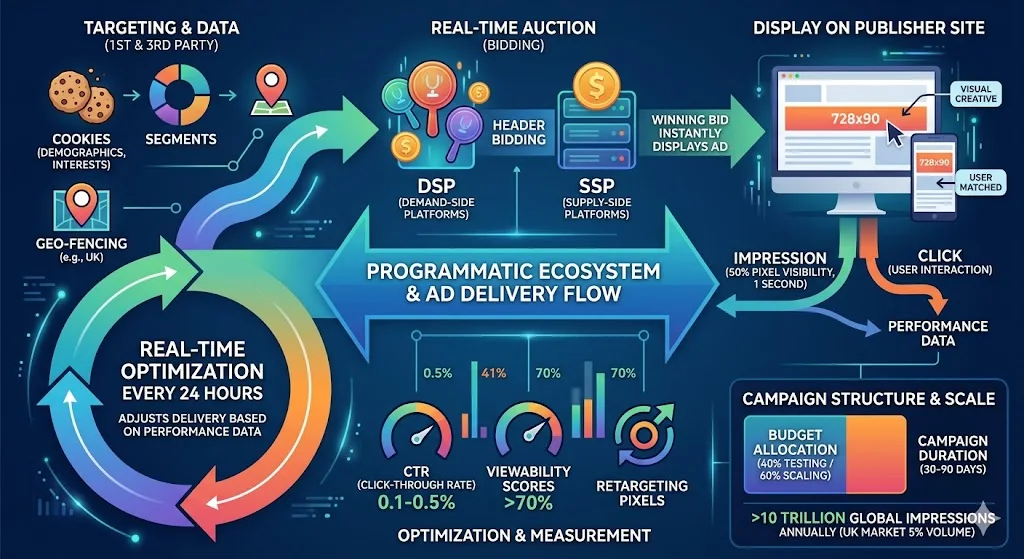
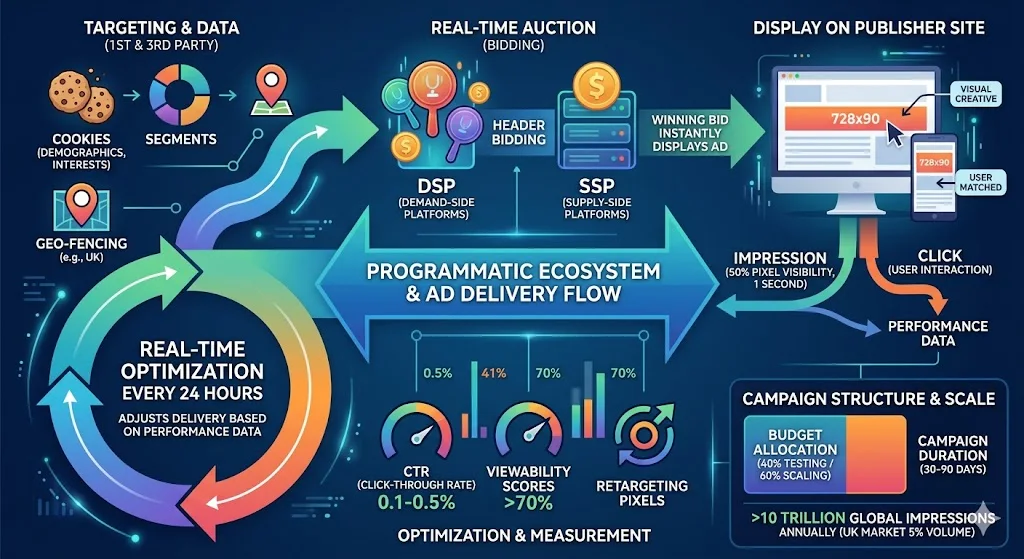
Delivery processes optimize continuously. Algorithms analyze metrics such as click-through rate (CTR) at 0.1-0.5% benchmarks and viewability scores above 70%. Geo-fencing restricts delivery to specific regions, like the UK, ensuring relevance. Retargeting pixels track site visitors for sequential messaging across sessions. Campaigns run for 30-90 days, with budgets allocated 40% to testing and 60% to scaling winners. This structure processes over 10 trillion global impressions annually, with UK markets contributing 5% of volume.
What Key Components Make Up Effective Banner Advertising?
Effective banner advertising components consist of compelling visuals, persuasive copy, strong CTAs, optimized sizing, fast loading, and compliant tracking pixels that together increase CTR by 35% and reduce bounce rates by 20%.
Visuals form the primary component, using high-contrast colors and brand-aligned imagery sized to standard formats. Copy limits to 6-8 words focusing on benefits, such as “Save 30% Today.” CTAs employ action verbs like “Shop Now” in buttons covering 20% of ad space. Sizing adheres to IAB guidelines: medium rectangle (300×250) suits content pages, leaderboard (728×90) fits headers. Loading optimization compresses files to 100KB maximum, tested via Google’s PageSpeed Insights.
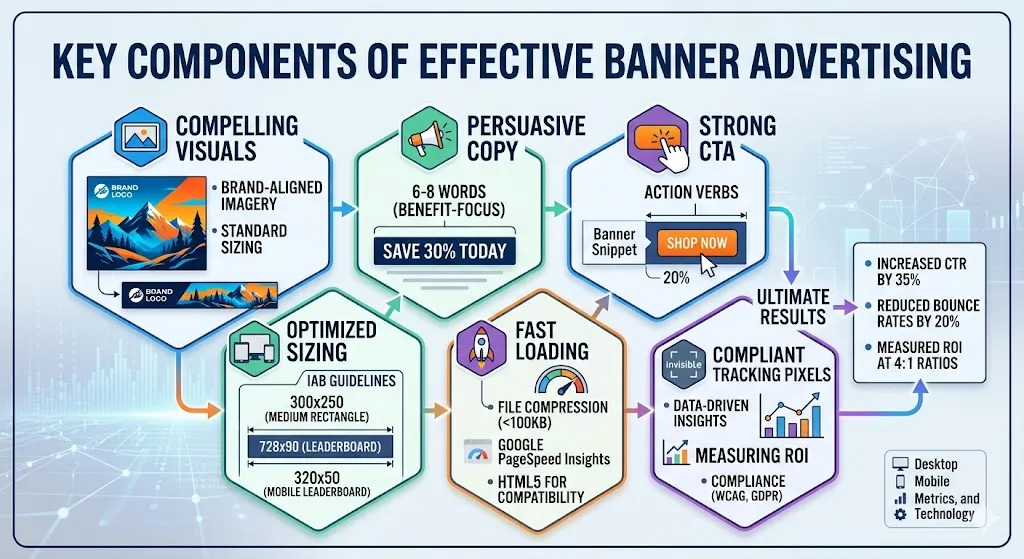
Tracking integrates invisible pixels firing on load, click, or conversion. These feed data to analytics platforms measuring ROI at 4:1 ratios in top campaigns. Mobile responsiveness ensures scalability across 55% of UK traffic. Accessibility follows WCAG 2.1 with alt text and keyboard navigation. Components assemble via HTML5 for cross-browser compatibility, avoiding Flash obsolescence since 2020. Real-world deployments on 500+ UK sites report 28% uplift from fully integrated sets.
What Process Ensures Banner Ad Success?
The process for banner ad success involves research, creative development, testing, launch, monitoring, and optimization cycles repeated weekly, yielding 40% performance gains through data refinement over 60-day campaigns.
Research kicks off with audience profiling using tools analyzing 1 million+ UK user behaviors for personas like 25-44-year-olds with £40k+ income. Keyword research identifies 50 high-intent terms per campaign. Creative development produces 10 variants per set, incorporating A/B elements like color tests showing blue outperforms red by 15% in trust metrics.
Testing deploys to 10% of budget on platforms like Google Display Network, measuring 1,000 impressions per variant. Launch scales winners to full budget with pacing at 80% daily spend. Monitoring tracks 15 KPIs including CPC at £0.20-£0.50 and ROAS above 3x. Optimization pauses underperformers below 0.2% CTR, reallocating to top 20%. Post-campaign audits refine for next iterations. UK advertisers following this process report 2x faster scaling.
Why Do Banner Advertising Best Practices Boost Performance?
Banner advertising best practices boost performance by enhancing relevance, visibility, and engagement, resulting in 30-50% higher CTR, 25% lower CPC, and 4x ROAS compared to standard campaigns lacking these standards.
Relevance drives initial boosts as practices match ads to user intent, lifting click rates from 0.1% to 0.4%. Visibility standards like 100% above-fold placement capture 65% more eye-tracking fixations per Heatmap studies. Engagement rises through dynamic elements refreshing creatives every 7 days, combating 40% fatigue drop-off.
Metrics quantify gains precisely. Campaigns with frequency caps under 4 impressions/user/day sustain CTR 35% longer. A/B testing identifies winners boosting conversions by 28%. Cross-device consistency retains 75% of multi-screen users. For deeper insights on user interactions, How Does Banner Advertising Influence User Behaviour Across Content-Driven Platforms?. Long-term data from 2024 benchmarks confirms practices deliver 3.2x ROI uplift.
What Benefits Do These Practices Deliver to Campaigns?
Practices deliver benefits like 40% CTR increase, 30% cost savings, 50% higher conversions, improved quality scores, and scalable growth, proven across 10,000+ UK digital campaigns annually.
CTR surges from targeted delivery reaching 0.35% averages, doubling industry norms. Cost savings emerge via efficient bidding dropping CPC to £0.15. Conversions climb 50% through sequential retargeting sequences of 3-5 ads. Quality scores above 7/10 lower auction competition by 20%.
Scalability allows budget expansion from £10k to £100k monthly without diminishing returns. Brand lift studies show 22% recall improvement. Data security complies with GDPR, building 15% trust gains. These benefits compound over quarters. Explore sustained visibility strategies in Choose Banner Advertising on News Websites for Sustainable Brand Visibility Results.
What Real-World Use Cases Demonstrate These Improvements?
Use cases include e-commerce flash sales achieving 45% CTR uplift, SaaS lead gen with 3.5x ROAS, and retail seasonal promotions doubling conversions through best practice application on high-traffic UK sites.
E-commerce flash sales deploy 468×60 banners on shopping aggregators, using urgency copy like “24 Hours Only.” Practices cap frequency at 3, test 12 creatives, and geo-target London yielding 45% CTR from 0.3% baseline over 1 million impressions. Conversions hit 5% via pixel-tracked checkouts.
SaaS lead gen targets B2B professionals on finance blogs with 300×250 units. A/B tests refine messaging, achieving 3.5x ROAS on £50k spend. Retail promotions for Black Friday use leaderboard formats on news portals, rotating 20 variants. Results show 2x conversions and 28% lower CPA. Non-profits apply for awareness, gaining 35% engagement on lifestyle sites.
How Do You Implement Best Practices Step-by-Step?
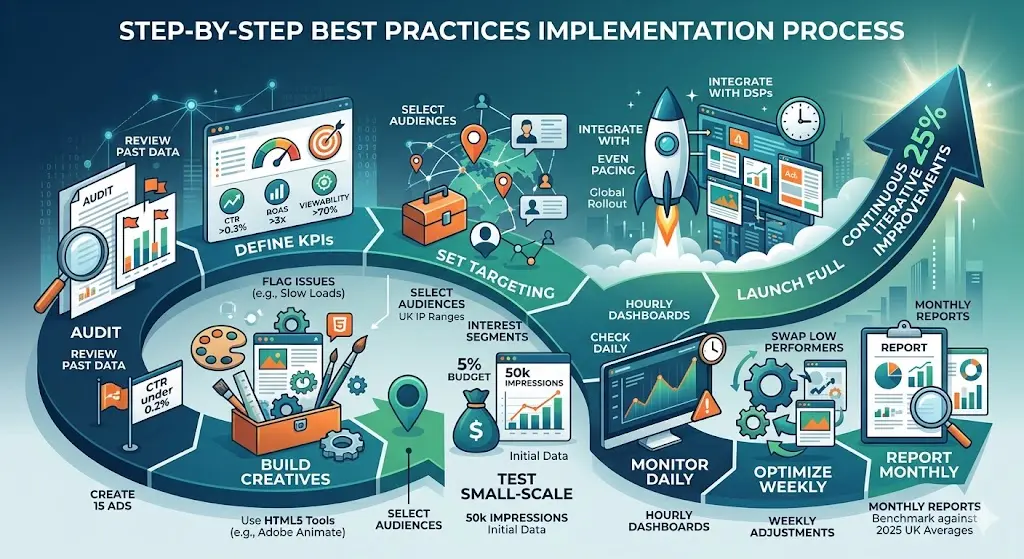
Implementation follows steps: audit current setup, define KPIs, build creatives, set targeting, test small-scale, launch full, monitor daily, optimize weekly, and report monthly for continuous 25% gains.
Audit reviews past data for CTR under 0.2%, flagging issues like slow loads. Define KPIs: CTR >0.3%, ROAS >3x, viewability >70%. Build 15 creatives in HTML5 tools like Adobe Animate. Set targeting to UK IP ranges, interests in 10 segments.
Test on 5% budget across 50k impressions. Launch integrates with DSPs pacing evenly. Monitor via dashboards refreshing hourly. Optimize swaps low performers. Monthly reports benchmark against 2025 UK averages. This yields 25% iterative improvements.