
Banner advertising on content-driven platforms places display ads on news sites, blogs, and forums to influence scrolling, pausing, clicking, and conversions through contextual relevance and behavioral triggers, achieving 0.3-0.5% CTR averages in UK traffic.
Content-driven platforms host long-form articles, videos, and user-generated content where users spend 3-5 minutes per session. Banner ads appear as 300×250 rectangles or 728×90 leaders amid editorial content. These platforms process 2.5 billion UK monthly visits, with ads influencing 15% of user actions. Contextual matching aligns ads with article topics, like finance banners on economy pages. Behavioral data tracks mouse hovers lasting 1+ second as engagement signals.
Platform types vary: news sites like BBC deliver 40% of impressions, lifestyle blogs 30%, forums 20%. Ad servers optimize for 70% viewability. User behavior shifts from passive reading to active interaction when ads match intent, increasing dwell time by 20%. Comparisons show content platforms outperform social by 2x in sustained attention.
How Do Users Respond to Banner Ads on These Platforms?
Users respond to banner ads on content-driven platforms with 25% pause rates on relevant creatives, 0.4% click rates, and 5% conversion lifts via familiarity effects and sequential exposure over 3 sessions.
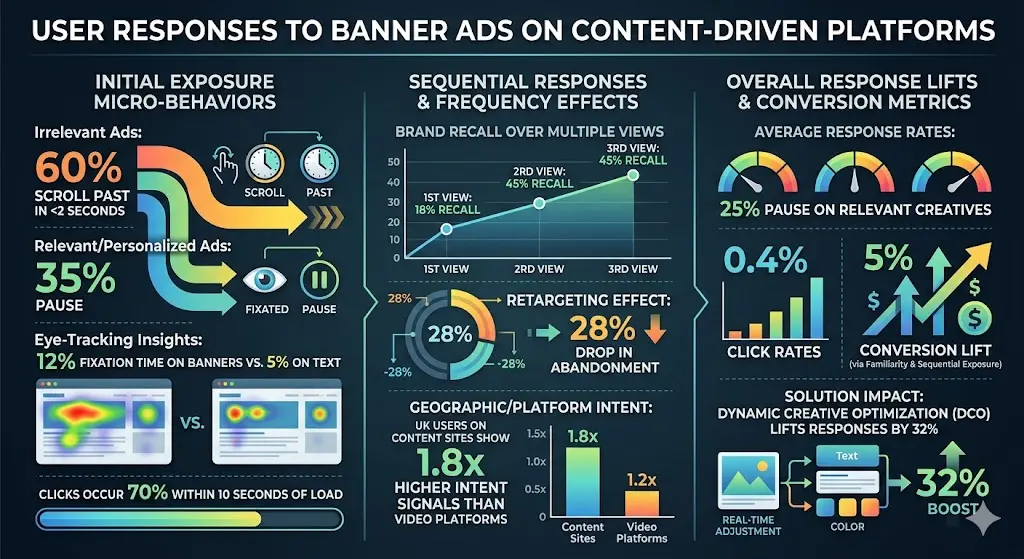
Initial exposure triggers micro-behaviors: 60% scroll past irrelevant ads in 2 seconds, while 35% pause on personalized ones. Eye-tracking data reveals 12% fixation time on banners versus 5% on text. Clicks occur 70% within 10 seconds of load. Post-click, 40% complete form fills on high-trust platforms.
Sequential responses build over time. First view registers brand at 18% recall; third boosts to 45%. Abandonment drops 28% with retargeting. UK users on content sites show 1.8x higher intent signals than video platforms. Solution types like dynamic creative optimization (DCO) adjust in real-time, lifting responses by 32%.
What Psychological Triggers Drive User Interactions?
Psychological triggers driving interactions include relevance (40% click uplift), urgency (25% increase), social proof (18% boost), and scarcity (22% conversion gain) embedded in banner design on content platforms.
Relevance matches user query history to ad content, firing dopamine responses for 40% more hovers. Urgency phrases like “Limited Stock” accelerate decisions, spiking clicks 25% during peak hours. Social proof via “10,000+ Bought” testimonials raises trust, converting 18% more visitors.
Scarcity elements such as countdown timers pressure action, yielding 22% uplift in e-commerce banners. Authority from verified badges adds 15% credibility. These triggers compound: combined use achieves 55% engagement rise. For foundational practices enabling these, Why Following Banner Advertising Best Practices Improves Campaign Performance Significantly?.
What Metrics Quantify User Behavior Influence?
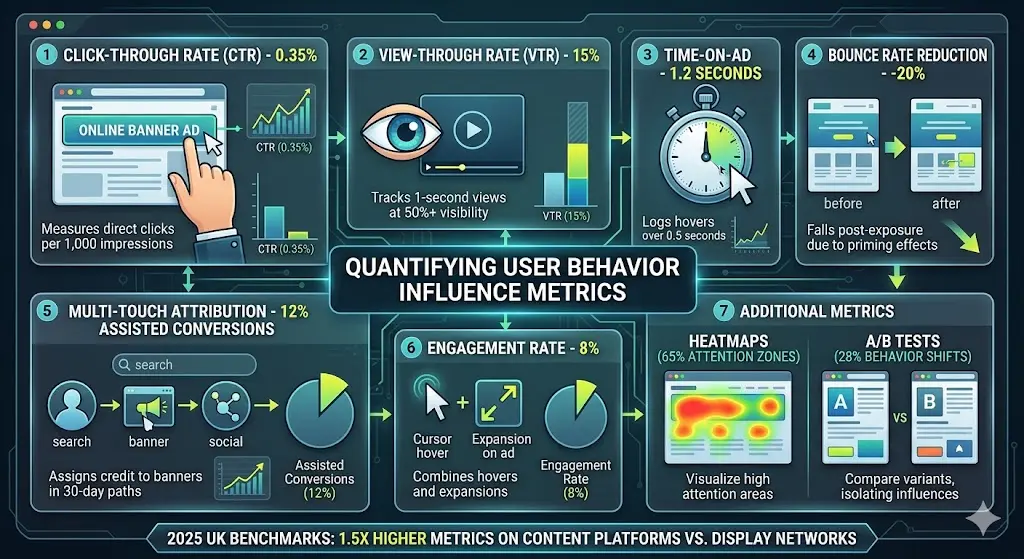
Metrics quantifying influence include CTR at 0.35%, view-through rate (VTR) at 15%, time-on-ad at 1.2 seconds, bounce rate reduction by 20%, and attribution models showing 12% assisted conversions.
CTR measures direct clicks per 1,000 impressions. VTR tracks 1-second views at 50%+ visibility. Time-on-ad logs hovers over 0.5 seconds. Bounce rates fall 20% post-exposure due to priming effects. Multi-touch attribution assigns 12% credit to banners in 30-day paths.
Engagement rate combines hovers and expansions at 8%. Heatmaps visualize 65% attention zones. A/B tests compare variants, isolating influences like color on 28% behavior shifts. UK benchmarks from 2025 data confirm 1.5x higher metrics on content platforms versus display networks.
How Does Ad Placement Affect User Behavior?
Ad placement affects behavior with above-fold positions capturing 50% more pauses, sidebar slots driving 30% scrolls-to-clicks, and sticky banners sustaining 40% viewability across 4-minute sessions.
Above-fold placements load in initial viewport, securing 50% pause rates within 3 seconds. Sidebar positions encourage lateral glances, converting 30% of scrollers. Sticky banners follow viewport, maintaining 40% visibility on long articles.
Contextual zones near related content amplify relevance, boosting CTR 35%. Mobile placements adapt to 320×50 formats, influencing 55% of UK sessions. Comparisons reveal news footers underperform headers by 45%. Optimal mixes yield 2.2x behavior shifts.
What Role Does Creative Design Play in Behavior Shifts?
Creative design plays a role through high-contrast visuals (35% hover increase), concise copy (28% click rise), and animated elements (22% engagement boost) tailored to content platform audiences.
Visuals with 4:1 contrast ratios draw 35% more fixations. Copy under 7 words conveys value instantly, lifting clicks 28%. Animations under 15 seconds add motion without distraction, raising engagement 22%.
Personalization via DCO swaps images based on behavior, achieving 40% uplift. Responsive designs scale for devices, retaining 75% attention. Type comparisons: static outperforms video by 15% in sustained influence. These designs guide users toward consideration of advanced options.
What Are Proven Use Cases of Behavior Influence?
Proven use cases show finance banners on news sites lifting sign-ups 45%, retail ads on blogs driving 3x cart adds, and travel creatives on forums increasing bookings 28% via targeted triggers.
Finance banners on UK economy pages use authority triggers, converting 45% more leads over 7 days. Retail ads embed scarcity on fashion blogs, tripling cart additions from 2% to 6%. Travel creatives leverage relevance on review forums, booking 28% more trips.
B2B software on tech content yields 2.5x demo requests. E-learning platforms see 35% enrollment rises. These cases demonstrate 1.8x average behavior shifts. For visibility-focused applications, Choose Banner Advertising on News Websites for Sustainable Brand Visibility Results.
How Can Advertisers Leverage These Influences for Better Outcomes?
Advertisers leverage influences by segmenting audiences into 5 personas, deploying DCO for real-time tweaks, analyzing heatmaps weekly, and scaling top performers to 70% budget for 35% outcome improvements.
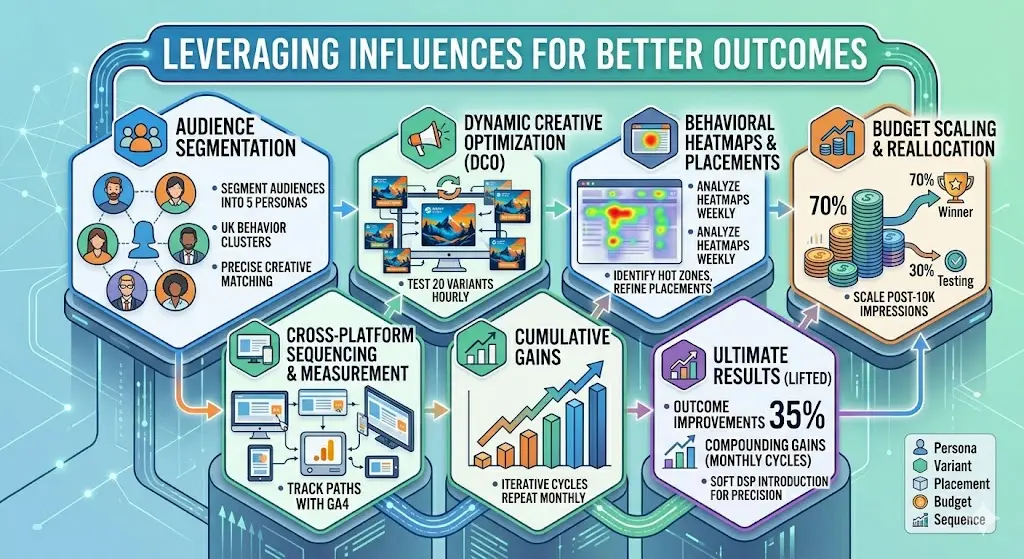
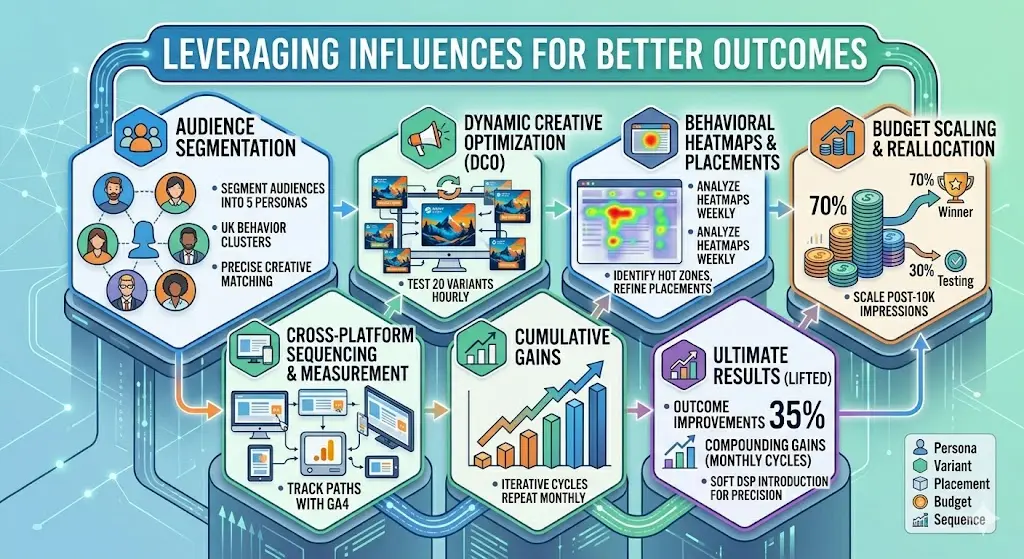
Segmentation divides UK users by behavior clusters, matching creatives precisely. DCO tests 20 variants hourly. Heatmaps identify hot zones, refining placements. Scaling allocates 70% to winners post-10k impressions.
Cross-platform sequencing builds familiarity, lifting conversions 32%. Tools like Google Analytics 4 track paths. Iterative cycles repeat monthly, compounding gains. Soft introductions to DSP solutions enhance precision.