
Banner blindness occurs when users ignore banner ads, reducing visibility to under 20% on digital platforms, as eyes skip graphical elements during content scans.
Banner blindness describes the phenomenon where online users overlook banner ads amid page content. Studies from Nielsen Norman Group record view rates below 14% for standard banners. Businesses face this challenge because users train focus on text and navigation. Digital publishing platforms exacerbate it with dense layouts.
Solutions emerge through native ad formats that blend with content. These formats achieve 50% higher visibility. Businesses test blended designs to counter blindness. Programmatic tools adjust creatives based on engagement data.
How Does Design Influence Banner Blindness?
Poor designs with stock images or generic text trigger blindness. Vibrant, relevant visuals increase notice by 30%. UK businesses report better results with localized imagery. A/B testing refines elements like color contrast.
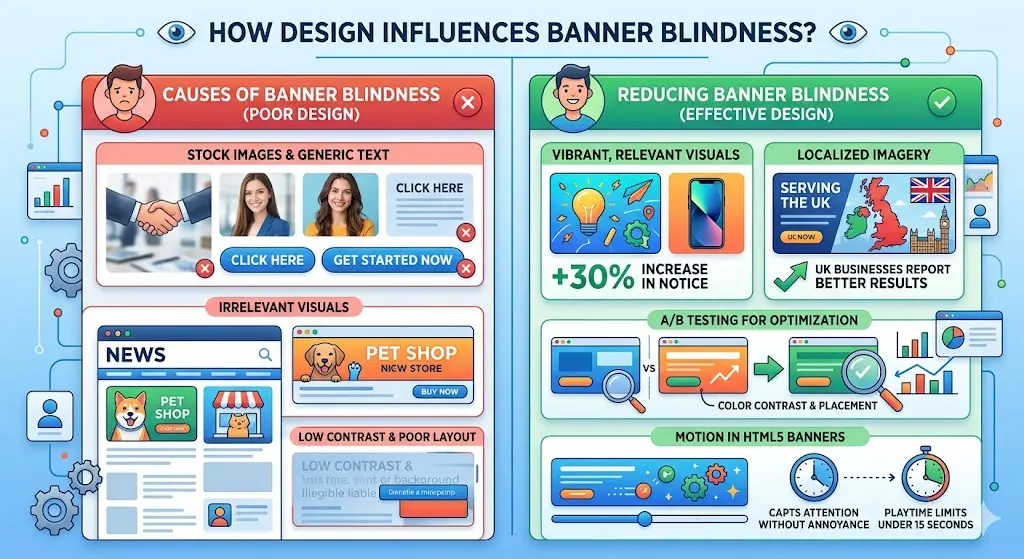
Motion in HTML5 banners captures attention without annoyance. Limits keep playtime under 15 seconds. Need basics on cost factors first? What Factors Influence Banner Advertising Costs Across Digital Publishing Platforms Today?
Why Do Low Click-Through Rates Plague Banner Campaigns?
Low click-through rates average 0.05-0.1% for display banners, stemming from irrelevant targeting and ad fatigue on high-traffic sites.
Click-through rates measure clicks per impression. Banner campaigns average 0.08% CTR industry-wide, per Google benchmarks. Businesses struggle as users develop ad fatigue after repeated exposures. Platforms serve 10-20 impressions per user weekly, dropping effectiveness.
Optimization strategies include frequency capping at 5 exposures daily. Dynamic creative optimization swaps underperforming ads. UK marketers see CTR lifts of 25% with personalization engines.
What Causes Ad Fatigue in Audiences?
Ad fatigue builds from identical creatives across sessions. Rotation schedules refresh content every 3 days. Audience segmentation prevents overexposure. Data platforms track fatigue signals like declining CTRs.
Relevance scoring matches ads to user behavior, boosting rates by 40%.
How Does Ad Fraud Undermine Banner Campaign ROI?
Ad fraud inflates impressions by 20-30% via bots and fake traffic, costing businesses $35 billion globally in 2023, eroding true performance metrics.
Ad fraud encompasses bot traffic, impression laundering, and domain spoofing. Invalid traffic comprises 22% of digital display, according to Integral Ad Science. Businesses lose budgets to non-human views. UK regulations from ASA demand fraud verification.
Fraud detection tools like DoubleVerify scan for anomalies. Certified vendors filter 95% of bad inventory. Post-campaign audits recover 10-15% of spends.
What Types of Ad Fraud Affect Banners Most?
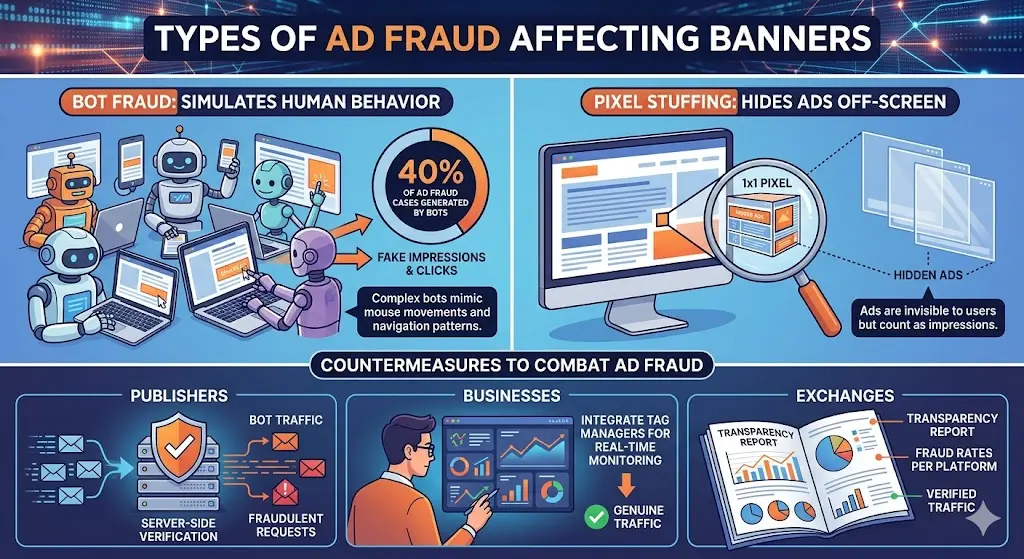
Bot fraud simulates human behavior, generating 40% of fraud cases. Pixel stuffing hides ads off-screen. Publishers combat with server-side verification. Businesses integrate tag managers for real-time monitoring.
Transparency reports from exchanges reveal fraud rates per platform.
Why Is Viewability a Persistent Challenge for Banners?
Viewability challenges result in only 68% of banner impressions qualifying as viewable, due to page scrolling and ad blockers reducing effective delivery.
Viewability requires 50% ad pixels visible for 1 second. MRC standards show display averages 65-70%. Businesses contend with mobile scrolling burying ads. Ad blockers affect 30% of UK traffic.
Solutions involve above-the-fold placements and anti-blocker tech. Viewability-focused DSPs guarantee 80% rates. Sticky ads maintain position during scrolls.
How Do Ad Blockers Impact Campaign Delivery?
Ad blockers prevent 42% of banner loads on desktops. Mobile rates hit 25%. Consent management platforms comply with GDPR while serving alternatives. Businesses negotiate block-proof formats.
Server-side ad insertion bypasses blockers on 70% of inventory.
What Targeting Limitations Hinder Banner Effectiveness?
Targeting limitations restrict reach to 40-50% of ideal audiences due to cookie deprecation and privacy laws like GDPR, fragmenting data pools.
Targeting uses cookies, device IDs, and contextual signals. Third-party cookies phase out by 2024, impacting 70% of retargeting. UK businesses navigate GDPR consent requirements. Data silos across platforms reduce precision.
First-party data strategies build owned audiences. Contextual targeting matches content keywords, achieving 2x ROAS. Clean rooms enable secure data sharing.
Why Is Retargeting Losing Effectiveness?
Cookie restrictions block cross-site tracking for 50% of users. Sequential messaging adapts via server-side tracking. Lookalike modeling expands pools using 1st-party seeds. Privacy sandboxes test cohort-based alternatives.
How Does Creative Fatigue Affect Banner Performance?
Creative fatigue sets in from overexposure. CTR halves after 50,000 serves. Businesses rotate 10+ variants per campaign. Automated engines test 100 creatives weekly.
Dynamic assembly swaps headlines and images based on performance. UK e-commerce uses user-generated content refreshes.
What Strategies Combat Creative Wear-Out?
A/B testing pits variants head-to-head. Multivariate tests analyze 20 elements. Heatmap tools identify fatigue zones. Refresh cycles every 7-10 days sustain engagement.
User feedback loops inform iterations.
Ready for proven growth tactics: Get Measurable Growth With Banner Advertising Across High Traffic News Websites
Why Do Attribution Gaps Complicate Banner Measurement?
Attribution gaps attribute only 15-20% of conversions to banners due to multi-touch journeys and cookie limits, obscuring true impact.
Attribution models credit touchpoints in paths averaging 7 interactions. Last-click undervalues awareness banners. Businesses adopt data-driven models weighting early touches. Cross-device tracking bridges 30% gaps.
MMPs like AppsFlyer stitch signals. Incrementality tests isolate lift at 25%.
How Do Multi-Channel Paths Challenge Measurement?
Paths span search, social, and email. Multi-touch models distribute credit proportionally. UK analytics platforms integrate signals for 360 views. uplift studies run holdouts measuring incremental sales.
What Budget Allocation Issues Arise in Banner Campaigns?
Budget allocation issues waste 30% on low performers without pacing controls, leading to early exhaustion on competitive platforms.
Pacing distributes spends evenly over durations. Manual bids overspend day one. Automated rules cap daily limits at 20%. UK campaigns adjust for peak hours. Portfolio bidding balances across formats. Forecasting tools predict 95% accuracy.
Why Does Overspending Occur Frequently?
Competitive auctions spike costs midday. Bid shading reduces by 10-15%. Floor prices protect margins. Real-time dashboards alert anomalies. Seasonal adjustments scale budgets 2x in Q4.
How Do Technical Integrations Challenge Banner Setup?
Technical integrations delay launches by 2-4 weeks due to tag mismatches and platform SDKs, complicating cross-device delivery.
Integrations link advertisers to SSPs via APIs. Tag firing issues affect 25% of setups. Floodlight or server pixels track events. UK compliance adds consent layers.
Pre-built templates speed deployment by 50%. QA checklists verify 100% functionality.
What Common Tech Glitches Disrupt Campaigns?
Latency over 200ms drops fill rates 15%. CORS errors block cross-domain calls. Responsive creatives adapt to 10+ breakpoints.
Debug consoles resolve 80% issues pre-launch.
Why Is Scaling Banner Campaigns Difficult?
Scaling challenges cap growth at 3x initial budgets due to premium inventory shortages and rising CPMs on high-traffic sites.
Scaling demands more inventory matching quality. CPMs rise 40% at volume. Private marketplaces reserve slots. Yield management optimizes fills. Layered strategies combine open auctions with direct buys. Performance plateaus trigger diversification.
How Does Inventory Exhaustion Limit Expansion?
Premium slots fill 90% via direct deals. Programmatic guarantees 70% scale. Forecasting secures forward contracts. Hybrid approaches blend channels for 5x growth.