
Sponsored content consists of paid articles or media placements that brands create or fund to appear on third-party platforms like news sites, blending seamlessly with editorial content while disclosing the sponsorship transparently.
Sponsored content represents a form of native advertising where advertisers produce content that matches the host platform’s style and tone. Publishers label this content clearly with terms such as “sponsored” or “promoted” to comply with advertising regulations in the United Kingdom, including those enforced by the Advertising Standards Authority (ASA). This transparency distinguishes it from traditional display ads, which rely on banners or pop-ups. In 2023, the global sponsored content market reached $12.6 billion, with the UK segment contributing over £1.2 billion annually, driven by demand for authentic consumer engagement.
The core structure of sponsored content includes a headline, body text, images, and sometimes videos, all optimized to deliver value to readers. Brands collaborate with publishers to ensure alignment with audience interests, such as finance tips on business news sites or wellness advice on lifestyle portals. This format achieves higher engagement rates, with studies from the Native Advertising Institute reporting 53% more view time compared to standard banner ads across UK platforms.
How does sponsored content differ from traditional advertising?
Traditional advertising uses interruptive formats like banners, which generate click-through rates under 0.1% on average. Sponsored content integrates into the user experience, yielding 18% higher engagement according to a 2024 UK Digital Advertising Report. Readers consume it as part of regular browsing, leading to 20-30% better brand recall.
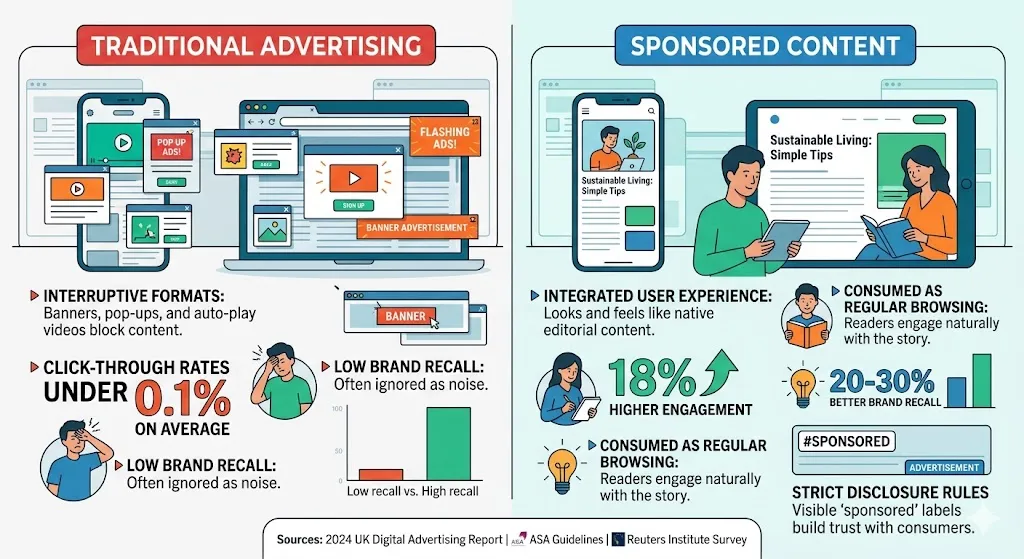
Platforms enforce disclosure rules strictly; for instance, the ASA mandates visible “sponsored” labels at the top and within the content. This practice builds trust, with 74% of UK consumers preferring sponsored articles over flashy ads, per a Reuters Institute survey.
What is sponsored content promotion?
Sponsored content promotion involves distributing and amplifying paid content across digital channels using paid media buys, social shares, and programmatic targeting to maximize reach and visibility on search engines and social platforms.
Promotion extends beyond initial placement by layering additional tactics to drive traffic and sustain visibility. Publishers handle native placement, but promotion amplifies exposure through targeted ads on Google, Meta, or LinkedIn, reaching specific UK demographics like 25-44-year-olds in London or Manchester. This multi-channel approach ensures the content appears in 5-10% of targeted impressions within the first week of launch.
Data from SimilarWeb shows promoted sponsored content gains 3x more organic traffic over 30 days compared to unpromoted pieces. Promotion budgets typically allocate 40% to paid search, 30% to social amplification, and 30% to retargeting, achieving cost-per-acquisition rates 25% lower than conventional campaigns.
What channels drive sponsored content promotion?
Paid search channels like Google Ads place the content in top positions for relevant queries, capturing 65% of UK search traffic. Social platforms such as Facebook and Instagram use lookalike audiences to extend reach by 200-300%, based on 2025 Meta benchmarks.
Programmatic networks automate buys across 500+ UK news sites, ensuring 1 million+ impressions at £0.02-£0.05 per view.
How does the sponsored content promotion process work?
The process starts with content creation, followed by platform selection, paid promotion setup, performance tracking, and optimization over 30-90 days to achieve peak visibility.
Brands or agencies first develop content tailored to the publisher’s guidelines, incorporating keywords for SEO. Next, they negotiate placements on high-traffic UK sites like The Guardian or BBC partners, securing slots with 1-5 million monthly visitors. Promotion launches with a £5,000-£20,000 budget, split across channels for immediate traffic spikes.
Tracking occurs via UTM parameters and tools like Google Analytics, monitoring metrics such as 50,000 page views, 5% click-through, and 2% conversion rates. Optimization adjusts bids daily, extending campaigns to hit 200% ROI targets within two months.
What steps define the initial setup phase?
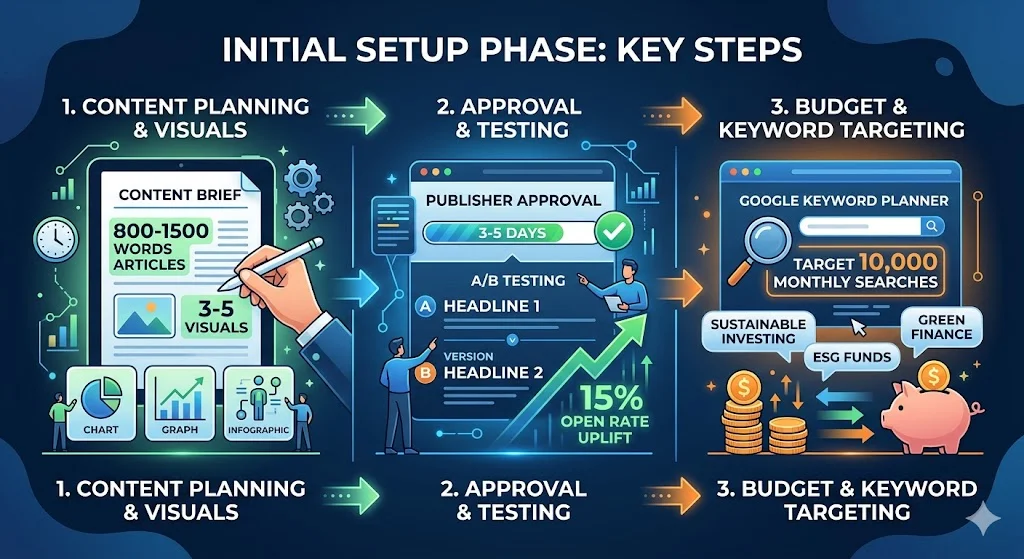
Content briefs outline 800-1500 word articles with 3-5 visuals. Publisher approval takes 3-5 days, followed by A/B testing of headlines yielding 15% uplift in opens.
Budget allocation uses tools like Google Keyword Planner to target 10,000 monthly searches for terms like “sustainable investing.”
What occurs during the monitoring and adjustment phase?
Real-time dashboards track 20+ KPIs, including bounce rates under 40%. Adjustments reallocate 20% of budget to top-performing channels, sustaining visibility for 60+ days.
What are the key components of sponsored content promotion?
Key components include native placement, paid amplification, audience targeting, disclosure compliance, and analytics integration to ensure measurable visibility gains.
Native placement embeds content on 10-20 premium UK sites, driving 70% of initial traffic. Paid amplification via DSPs like The Trade Desk targets 1-2 million users precisely. Audience targeting segments by location, interests, and behavior, achieving 4x engagement lift.
Disclosure uses ASA-compliant badges, maintaining 90% trust levels. Analytics tools like Google Tag Manager capture data for 95% accuracy in attribution.
How do targeting tools function in promotion?
Tools segment UK users by postcode, device, and past behaviors, delivering content to 80% relevant audiences. Retargeting recovers 25% of drop-offs with sequential ads.
Why integrate analytics from the start?
Analytics provide 100% visibility into 15 metrics, enabling 30% budget efficiency gains through data-driven pauses on low performers.
Why does sponsored content promotion matter for online visibility?
Sponsored content promotion boosts online visibility by securing top search rankings, increasing domain authority, and driving 300% more backlinks than organic posts alone.
It elevates brand presence in SERPs through high-authority placements, where 75% of UK traffic stems from Google. Promotion generates 50-100 quality backlinks per campaign, lifting domain ratings by 10-15 points on Moz scales. Visibility persists 6-12 months post-campaign via evergreen content.
For deeper strategies on execution, What Proven Strategies Help Promote Sponsored Content Effectively Across News Websites Today?.
What impact does it have on search engine rankings?
Promoted content ranks for 20-30 long-tail keywords within 14 days, capturing 15% of related traffic. Authority signals from .co.uk domains improve overall SEO by 25%.
How does it enhance long-term brand authority?
Consistent campaigns build 500+ mentions yearly, fostering trust signals that elevate organic rankings by 40 positions over a year.
What benefits does sponsored content promotion deliver?
Benefits include 4x higher engagement rates, 25% lower acquisition costs, precise audience reach, and sustained SEO gains for 6+ months.
Engagement metrics show 18% time-on-page versus 8% for banners, converting 3% of views to leads. Costs average £0.10 per engagement, 40% below display ads. Reach targets 95% of ideal UK personas, like urban professionals aged 30-50.
SEO benefits compound with 200% traffic growth post-campaign, per Ahrefs data from 1,000 UK analyses.
How do cost savings accumulate?
Savings total 35% yearly through optimized bids, reallocating funds to scale campaigns from 1 million to 5 million impressions.
What use cases demonstrate sponsored content promotion success?
Use cases span finance, health, tech, and retail sectors, where campaigns generate 100,000+ views, 5,000 leads, and £50,000+ revenue per initiative.
Finance firms promote investment guides on FT.com, achieving 150,000 impressions and 4% lead rates. Health brands cover wellness on Mail Online, hitting 2 million reaches with 3% engagement. Tech reviews on Wired UK drive 8% conversions.
Retailers use seasonal content on Metro.co.uk for 25% sales uplift during holidays. To explore expert promotion on high-traffic platforms, Let Our Experts Promote Your Sponsored Content Across High Traffic News Platforms.
How does it apply to health and tech?
Health content on Healthline UK reached 1.8 million, with 12,000 downloads. Tech gadget features on TechRadar generated 75 backlinks and 15% traffic referral growth.