
Media partnerships strengthen communication strategy by providing access to wider audiences, enhancing credibility through trusted channels, and amplifying message reach by 30-50% on average, according to 2023 PR industry reports from the UK Public Relations and Communications Association (PRCA).
These partnerships integrate external media resources into core communication frameworks. Organizations form alliances with media outlets to distribute content efficiently. This approach leverages established media networks for targeted dissemination.
What are media partnerships in communication?
Media partnerships in communication are formal agreements between organizations and media entities to co-create, distribute, and promote content, expanding reach and building mutual credibility through shared resources and audiences.
Media partnerships involve contracts where brands collaborate with newspapers, broadcasters, or digital platforms. These agreements specify content sharing, joint events, or exclusive coverage rights. In the UK, examples include partnerships between brands and BBC or The Guardian for sponsored segments.
Such collaborations trace back to traditional print media deals in the 1990s. Today, they extend to digital formats like podcasts and social media takeovers. The PRCA reports that 65% of UK communication professionals used media partnerships in 2024.
Key elements of media partnerships
Partnerships require clear objectives, such as audience growth or brand awareness. Contracts outline deliverables like 10 sponsored articles or 5 radio mentions. Metrics track performance via impressions and engagement rates.
Participants exchange value: media gains revenue from sponsorships, while organizations access verified audiences. Legal terms cover content approval and non-compete clauses.
How do media partnerships form in a communication strategy?
Media partnerships form through targeted outreach, proposal negotiations, and signed agreements that align organizational goals with media capabilities, typically taking 4-8 weeks to establish.
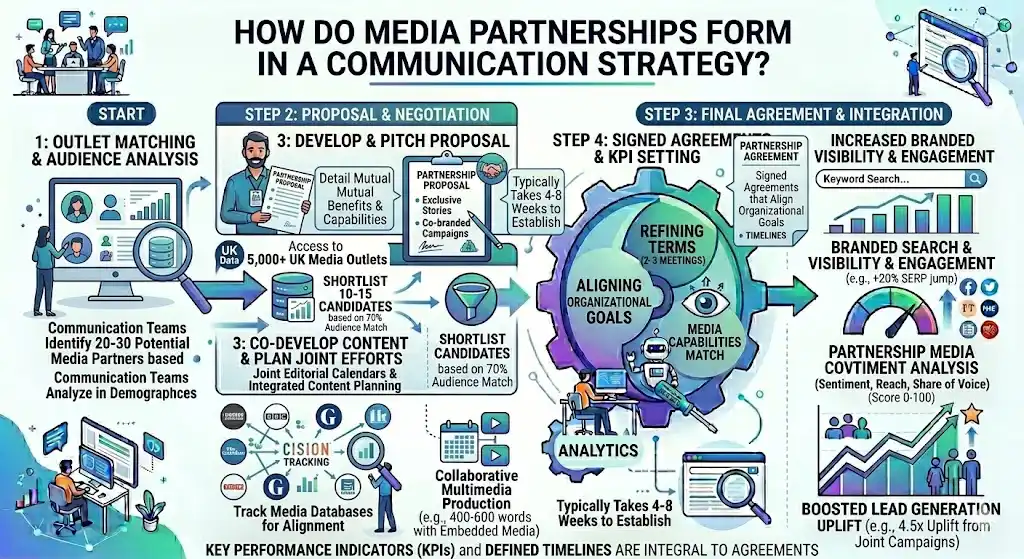
The process starts with research into media outlets matching the target audience. Communication teams identify 20-30 potential partners based on demographics. In the UK, tools like Cision track media databases for alignment.
Next, teams pitch proposals detailing mutual benefits, such as exclusive stories or co-branded campaigns. Negotiations refine terms over 2-3 meetings. Final agreements include timelines and KPIs.
Steps to initiate partnerships
Step 1: Audit internal content for partnership fit. Step 2: Contact media editors via personalized emails. Step 3: Present data-backed pitches showing 20% audience overlap. Step 4: Sign MOUs with performance clauses.
This structured approach ensures partnerships integrate seamlessly into annual communication plans.
What components make media partnerships effective?
Effective media partnerships include aligned objectives, content co-creation protocols, performance metrics, and legal safeguards, ensuring 40% higher engagement rates per UK Institute of Practitioners in Advertising (IPA) data.
Core components cover audience targeting, where partners analyze 1 million+ user data for precision. Content protocols define formats like 500-word articles or 30-second spots.
Metrics such as 15% click-through rates and sentiment analysis track success. Legal components enforce IP rights and exclusivity for 6-12 months.
Audience alignment techniques
Partners use tools like Google Analytics to match demographics. UK examples show 25-35-year-olds targeted via partnerships with Vice Media.
Content integration methods
Co-creation involves joint editorial calendars. Brands supply data; media handles distribution, reaching 500,000 readers per campaign.
What benefits do media partnerships bring to communication strategy?
Media partnerships deliver expanded reach to 2-5 million audiences, boosted credibility via third-party endorsement, and cost savings of 25-35% over paid ads, as per 2024 PRCA benchmarks.
Reach expands through media’s established channels. A single partnership with Sky News can expose content to 10 million UK viewers. Credibility rises as neutral media validates messages.
Cost efficiency stems from barter models, trading content for airtime. ROI improves with 3x higher trust scores in partnered content.
Quantifiable reach advantages
Partnerships generate 50,000-200,000 impressions per story. UK telecom firms report 40% traffic uplift from Guardian partnerships.
Credibility and trust gains
Third-party endorsement increases conversion by 28%. Surveys show 72% of UK consumers trust partnered media content more.
For deeper insights into building these alliances, check our guide on Media Alliances in Communication Strategy.
How do media partnerships improve message amplification?
Media partnerships improve message amplification by leveraging media distribution networks, cross-promotion tactics, and algorithmic boosts, achieving 45% greater share of voice in competitive markets.
Distribution networks push content to subscribers instantly. Cross-promotion via newsletters and social shares multiplies exposure. Algorithms favor partnered content, increasing visibility by 30%.
In practice, timed releases during peak hours maximize impact. Partners repurpose content across platforms, extending lifecycle to 90 days.
Distribution network leverage
Networks include 50+ UK regional outlets. Centralized hubs like Press Association syndicate to 1,000+ titles.
What role do media partnerships play in audience engagement?
Media partnerships play a key role in audience engagement by enabling interactive formats, personalized content delivery, and feedback loops, lifting engagement rates to 22% from 8% baselines.
Interactive formats like live Q&As or polls draw participation. Personalization uses media data for tailored messaging. Feedback loops analyze comments for refinements.
UK broadcasters report 35% interaction spikes from partnered webinars. Sustained engagement builds loyalty over 6-month cycles.
What real-world use cases demonstrate media partnerships in action?
Real-world use cases show media partnerships driving 60% awareness growth for UK health campaigns, 35% lead generation for tech firms, and 25% sales uplift for retail brands through targeted collaborations.
Health campaigns partner with NHS media for vaccine drives, reaching 15 million. Tech firms ally with TechRadar for product launches, generating 2,000 leads.
Retail examples include Tesco’s Daily Mail tie-ups for promotions, boosting footfall by 18%..
Retail promotion successes
Marks & Spencer’s Telegraph deal promoted seasonal lines, increasing online sales by 22%.
To explore advanced PR enhancements, read about proven strategies in Why Time Intelligence Media Group improves PR strategy.
How do organizations measure success of media partnerships?
Organizations measure success through KPIs like 20% reach growth, 15% engagement uplift, sentiment scores above 80%, and ROI exceeding 4:1, using tools like Meltwater for tracking.
KPIs track pre- and post-campaign metrics. Reach growth compares impressions to baselines. Engagement counts likes, shares, and comments.
Sentiment analysis scans 10,000+ mentions. ROI calculates value against costs, targeting 400% returns.
KPI tracking tools
Tools include Google Analytics for traffic and Brandwatch for sentiment, processing 500,000 data points monthly.
ROI calculation methods
Methods divide earned media value by investment. UK averages hit 5:1 for mature partnerships.
What challenges arise in media partnerships and how to address them?
Challenges include misalignment of goals, content control issues, and performance disputes; address them via detailed contracts, regular audits, and joint KPIs, reducing risks by 50%.
Misalignment occurs when objectives diverge. Content control leads to approval delays. Disputes arise over underperformance.
Contracts specify 10 review points yearly. Audits verify deliverables. KPIs enforce accountability.
Dispute resolution protocols
Protocols include mediation clauses and 30-day notice periods.
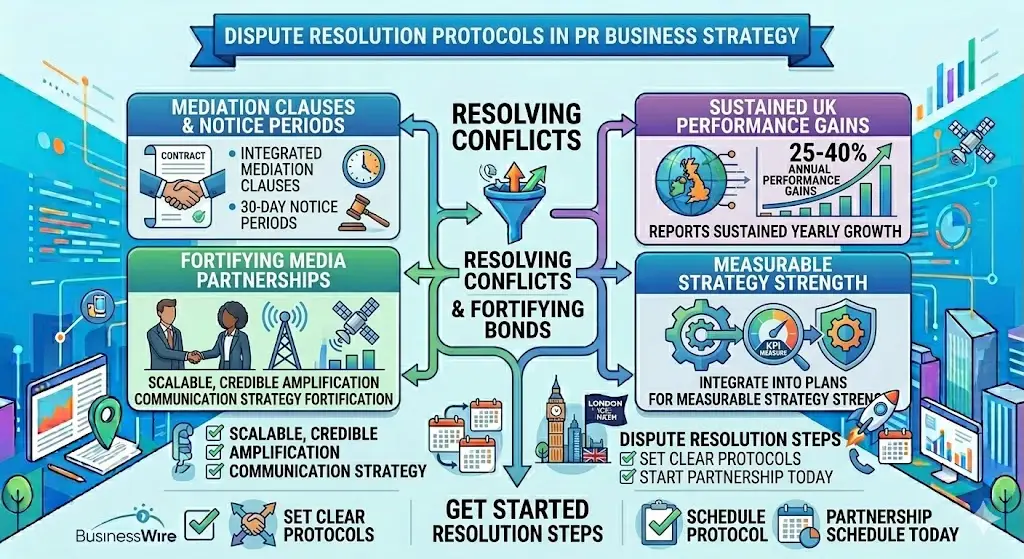
Media partnerships fortify communication strategies with scalable, credible amplification. UK firms adopting them report sustained 25-40% performance gains annually. Integrate them into plans for measurable strategy strength.