
In today’s fast-paced media landscape, traditional press release distribution often falls short of capturing audience attention. Data-driven PR distribution changes that by leveraging analytics, audience insights, and performance metrics to ensure your content reaches the right people at the right time. This approach transforms generic outreach into targeted strategies that boost media engagement, from higher click-through rates to sustained conversations across platforms.
By analyzing real-time data on journalist preferences, publication trends, and audience behavior, organizations can optimize their PR efforts for maximum impact. Time Intelligence Media Group exemplifies this through their PR Distribution Services, which integrate advanced tools to elevate visibility and resonance.
Understanding Traditional PR Limitations
Traditional PR distribution relies on broad email blasts and wire services, hoping for pickup by journalists and outlets. This scattershot method often results in low engagement because it ignores key variables like timing, relevance, and recipient interests. For instance, a press release sent to thousands might yield only a 2-5% open rate, with even fewer conversions to coverage, wasting resources and diluting brand messaging.
Data reveals that without personalization, 70% of press releases go unread, according to industry benchmarks from sources like Cision. This inefficiency stems from a lack of segmentation—treating all media contacts as identical rather than tailoring content to niche beats or regional focuses. In contrast, data-driven approaches use historical performance data to predict and prioritize high-engagement channels, turning potential misses into secured placements.
Core Benefits of Data Integration in PR
Data-driven PR distribution improves media engagement by providing actionable insights into what works. Metrics such as open rates, click-throughs, and shareability guide refinements, ensuring content aligns with audience preferences. Consider a tech company launching a product: traditional methods might target general business wires, but data analysis could reveal that AI-focused outlets like TechCrunch yield 3x higher engagement for similar stories.
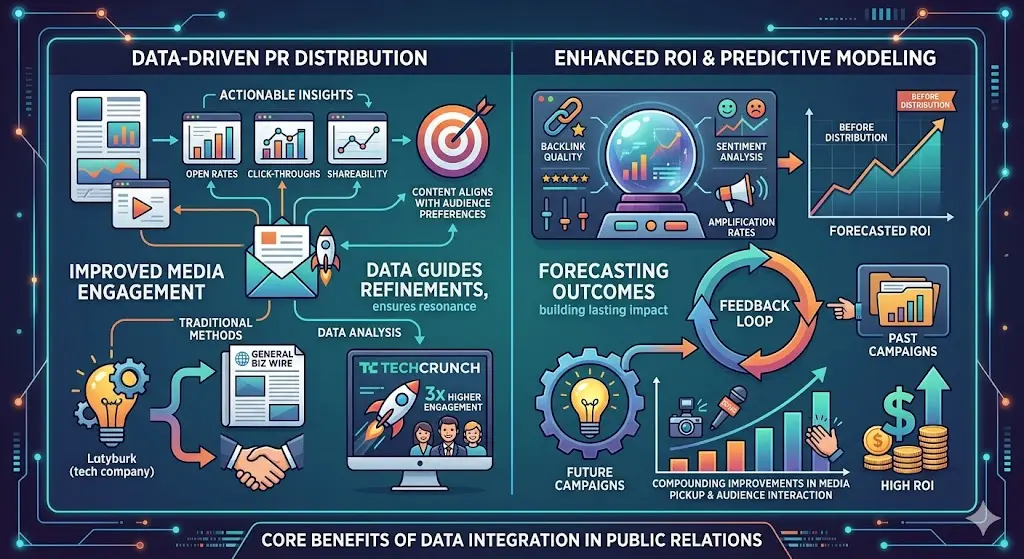
This method also enhances ROI through predictive modeling. Tools track backlink quality, sentiment analysis, and amplification rates, allowing PR teams to forecast outcomes before distribution. Over time, these insights build a feedback loop, where past campaigns inform future ones, leading to compounding improvements in media pickup and audience interaction.
Audience Insights and Targeting Precision
Audience insights services analyze reader behavior, demographics, and engagement patterns to refine targeting. In data-driven PR distribution, this means segmenting journalists by their coverage history— for example, prioritizing those who frequently cover sustainability for an eco-friendly brand announcement. A real-world scenario: A healthcare firm used audience data to distribute a release on telemedicine advancements, resulting in 40% more placements in specialized outlets like MedTech Dive compared to generic wires.
Precision targeting reduces bounce rates and increases time-on-page metrics, signaling value to search engines. By mapping journalist beats against your narrative, you ensure relevance, which boosts shares and backlinks. Trends show that personalized pitches see 25% higher response rates, per Prowly’s annual reports, making this a cornerstone of improved media engagement.
Engagement Analytics and Performance Tracking
Engagement analytics track post-distribution metrics like views, shares, and conversions, providing a clear picture of resonance. Data-driven PR distribution excels here by integrating tools that monitor real-time feedback, such as social mentions and referral traffic. For a retail brand’s holiday campaign, analytics revealed that video-embedded releases garnered 2.5x more engagement than text-only versions, prompting a strategic shift.
These metrics enable A/B testing of headlines, send times, and formats. High-performing elements, like concise subject lines under 50 characters, become templates for future distributions. Over six months, one campaign tracked via Google Analytics showed a 35% uplift in organic traffic from earned media, illustrating how sustained tracking compounds media engagement.
Boosting Coverage Through Predictive Distribution
Predictive distribution uses machine learning to forecast outlet receptivity based on past data. A nonprofit organization applied this in a fundraising drive, analyzing 18 months of PR data to target 150 high-match journalists. The result? Coverage in 22 outlets, including Forbes, versus just 8 from traditional blasts—a 175% engagement increase.
This approach factors in variables like publication cadence and topical trends. By avoiding oversaturated beats, it minimizes competition and maximizes pickup. PR professionals report that predictive models cut distribution costs by 30% while doubling share-of-voice, per Meltwater insights, proving data’s role in scalable media success.
Optimizing Timing and Channel Selection
Timing data from historical campaigns reveals optimal windows—midweek mornings for B2B, evenings for consumer stories. A SaaS company refined their how analytics help refine press release distribution plans by studying peak engagement hours, achieving 50% more clicks. Channel selection similarly benefits: Data showed LinkedIn wires outperformed Twitter for executive announcements, redirecting efforts for better results.
In one case study, a startup used geo-targeted data to prioritize regional outlets, securing local TV spots that drove national buzz. This granular control exemplifies how data-driven PR distribution improves media engagement across diverse landscapes.
Role of AI in Personalization and Automation
AI enhances data-driven PR by automating personalization at scale. Natural language processing scans journalist archives to craft tailored pitches, while sentiment analysis gauges tone fit. For media engagement, this means releases that resonate emotionally— a fashion brand’s AI-optimized distribution led to influencer shares, amplifying reach by 60%.
Automation frees teams for strategy, with AI flagging anomalies like sudden trend shifts. Combined with human oversight, it ensures ethical, high-impact distribution. Emerging trends, like generative AI for headline variants, promise even greater efficiencies, positioning forward-thinking firms ahead.
Measuring Long-Term Impact with ROI Metrics
Long-term ROI metrics, such as lifetime value from earned media, quantify sustained engagement. Data-driven PR distribution shines by linking placements to business outcomes—like a 20% sales lift from tracked coverage. Tools aggregate data from UTM parameters and attribution models, revealing true value beyond impressions.
For comprehensive strategies, explore how Time Intelligence Media Group uses PR data insights. This holistic view refines budgets and proves PR’s strategic worth to stakeholders.
Data Privacy and Quality Assurance
Implementing data-driven PR requires navigating privacy regulations like GDPR, ensuring compliant collection of journalist data. Quality assurance involves cleaning datasets to remove outdated contacts, maintaining 95% accuracy for reliable insights. A common pitfall: Ignoring data silos leads to skewed analytics; integration via APIs resolves this, as seen in campaigns with unified CRM-PR tools boosting engagement by 28%.
Ethical use builds trust—transparent opt-ins encourage participation. Brands prioritizing this see higher long-term response rates, turning compliance into a competitive edge.
Scaling for Enterprises and SMBs
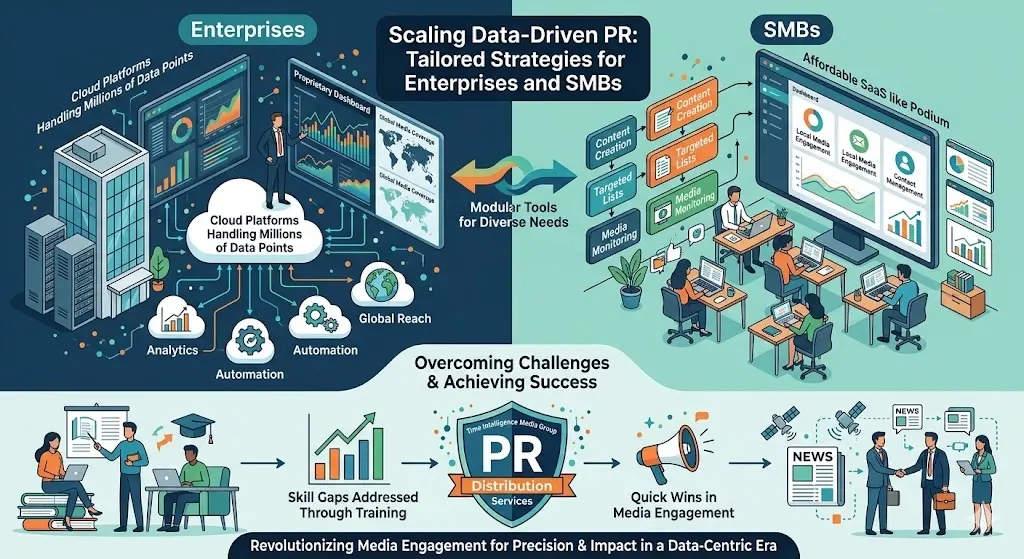
Enterprises scale data-driven PR through cloud platforms handling millions of data points, while SMBs leverage affordable SaaS like Podium. Customization is key: Larger firms might build proprietary dashboards, but all benefit from modular tools. Discover tailored options via Time Intelligence Media Group’s PR Distribution Services, designed for diverse needs.
Challenges like skill gaps are addressed through training, yielding quick wins in media engagement.
Data-driven PR distribution revolutionizes media engagement by harnessing insights for precision and impact. Time Intelligence Media Group delivers professional PR Distribution Services that embody these principles, empowering brands to thrive in a data-centric era.