
In today’s dynamic media landscape, understanding how brands collaborate with media companies has become essential for driving visibility, engagement, and growth. These partnerships go beyond traditional advertising, evolving into strategic alliances that leverage audience insights, content creation, and distribution networks. Brands increasingly seek media companies to amplify their message authentically, while media outlets benefit from fresh revenue streams and enhanced content relevance.
This TOFU guide explores the fundamentals of brand-media collaborations, from initial outreach to execution and measurement. By examining real-world examples and best practices, you’ll gain actionable insights into forging partnerships that deliver measurable results. Whether you’re a brand marketer or exploring options like Media Partnerships Solutions, this article equips you with the knowledge to navigate these opportunities effectively.
The Evolution of Brand-Media Collaborations
Brand-media collaborations have transformed dramatically over the past decade, shifting from one-off ad buys to integrated, data-driven partnerships. Early models relied on print and TV spots, but digital disruption—fueled by social media, streaming platforms, and AI analytics—has redefined the playing field. Today, brands collaborate with media companies to co-create content that resonates with niche audiences, blending storytelling with targeted distribution.
This evolution stems from mutual needs: brands crave authentic reach amid ad fatigue, while media companies face declining ad revenues and seek branded content to sustain operations. For instance, a consumer goods brand might partner with a lifestyle media outlet to produce sponsored video series, embedding product placements seamlessly into editorial narratives. Such alliances not only boost engagement but also improve SEO through shared backlinks and audience cross-pollination.
Looking ahead, trends like Web3 integrations and AI-personalized content are accelerating this shift. Media companies now use predictive analytics to match brands with high-fit audiences, ensuring collaborations yield higher ROI. Time Intelligence Media Group exemplifies this by offering tailored Media Partnerships Solutions that align brand goals with media expertise.
Key Drivers Behind Modern Collaborations
Several factors drive how brands collaborate with media companies in 2026. First, audience fragmentation demands hyper-targeted strategies; media firms provide proprietary data on viewer behaviors, enabling brands to reach underserved segments. Second, regulatory changes around data privacy (like GDPR updates) push brands toward trusted media partners for compliant, first-party data access.
Consider a tech brand partnering with a news media company during a product launch. By co-developing an interactive webinar series, the brand gains credibility through the media’s journalistic lens, while the outlet attracts new subscribers. These drivers create win-win scenarios, with studies showing partnered content achieving 3x higher engagement rates than solo campaigns.
Finally, sustainability and purpose-driven marketing amplify the need for aligned values. Brands now vet media partners for ethical content practices, fostering long-term relationships that build consumer trust over time.
Identifying the Right Media Partners for Your Brand
Selecting the ideal media company is the cornerstone of successful collaborations. Brands must evaluate partners based on audience overlap, content quality, and innovation capabilities rather than size alone. Start by mapping your target demographics against the media outlet’s analytics—tools like audience insights services reveal behavioral patterns, such as peak engagement times or preferred content formats.
Beyond metrics, cultural fit matters. A fashion brand might align with a digital magazine known for influencer-driven editorials, ensuring brand voice consistency. Time Intelligence Media Group’s Media Partnerships Solutions streamline this process by providing detailed audience profiling, helping brands avoid mismatched alliances that dilute messaging.
Criteria for Vetting Media Collaborators
When assessing potential partners, focus on these structured criteria:
- Audience Alignment: Verify demographic and psychographic matches using shared data dashboards.
- Content Track Record: Review past collaborations for creativity and performance metrics like dwell time and conversion rates.
- Technological Edge: Prioritize media companies with AI-driven personalization and multi-channel distribution.
A real-world example is a beverage brand’s alliance with a podcast network. By analyzing listener data, they customized episode sponsorships, resulting in a 25% uplift in brand recall. Vetting ensures collaborations aren’t just transactional but strategically symbiotic.
Thorough due diligence also mitigates risks like reputational mismatches. Brands should request case studies and conduct pilot tests, building confidence before scaling commitments.
Strategies for Initiating and Structuring Collaborations
Once partners are identified, the next step in how brands collaborate with media companies involves clear outreach and agreement frameworks. Begin with a value proposition pitch: outline mutual benefits, such as revenue shares or exclusive content rights. Use data-backed proposals to demonstrate potential ROI, like projected reach from combined audiences.
Structuring deals requires balancing creativity with accountability. Common models include sponsored content, native advertising, and joint events. For deeper integration, explore revenue-share models where brands contribute to production costs in exchange for performance-based payouts. This approach, popularized in Media Partnership Strategies for Publishers, fosters accountability and long-term ties.
Proven Collaboration Models with Examples
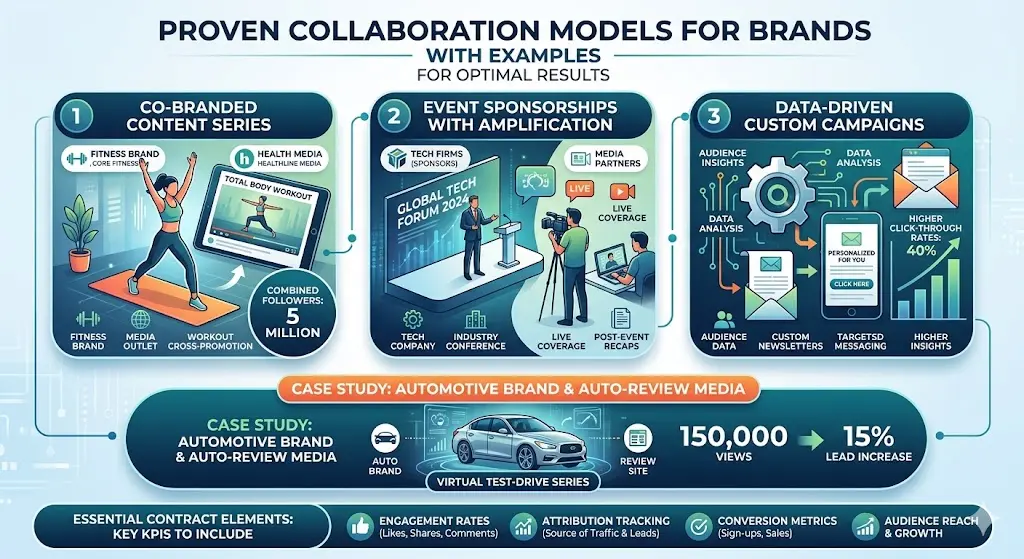
Brands can adopt these models for optimal results:
- Co-Branded Content Series: A fitness brand and health media outlet co-produce workout videos, cross-promoting to 5 million combined followers.
- Event Sponsorships with Amplification: Tech firms sponsor industry conferences, with media partners providing live coverage and post-event recaps.
- Data-Driven Custom Campaigns: Using audience insights, create personalized newsletters that drive 40% higher click-through rates.
A case study involves an automotive brand collaborating with an auto-review media site on a virtual test-drive series. This generated 150,000 views and a 15% lead increase, showcasing how structured strategies amplify impact. Always include KPIs like engagement rates and attribution tracking in contracts.
Measuring Success and Scaling Partnerships
Success measurement is vital in brand-media collaborations, relying on multi-touch attribution models to track influence across touchpoints. Key metrics include reach, engagement (likes, shares, comments), and conversions (sales, sign-ups). Tools like Google Analytics integrated with media dashboards provide granular insights, revealing which content elements drove results.
Post-campaign analysis informs scaling: high-performers get expanded budgets, while underperformers pivot. For example, a beauty brand’s ongoing series with a beauty media company scaled from quarterly to monthly after hitting 20% conversion benchmarks. Learn more about evaluating options in What Are Professional Media Partnership Services?.
Tools and Metrics for Ongoing Optimization
Effective measurement uses these approaches:
- Quantitative KPIs: Impressions, CTR, ROAS—benchmark against industry averages (e.g., 2-5% CTR for native ads).
- Qualitative Feedback: Surveys on brand perception shifts post-collaboration.
- AI-Enhanced Analytics: Platforms predicting future performance based on historical data.
Scaling requires iterative refinement; brands that review quarterly often double partnership value within a year. Time Intelligence Media Group supports this through Media Partnerships Solutions, delivering dashboards for real-time optimization.
Future Trends in Brand-Media Alliances
Emerging trends are reshaping how brands collaborate with media companies, with AI and immersive tech at the forefront. Generative AI enables hyper-personalized content, like dynamic ads adapting to user preferences in real-time. Meanwhile, metaverse integrations allow virtual brand activations within media-owned spaces, blending entertainment and commerce.
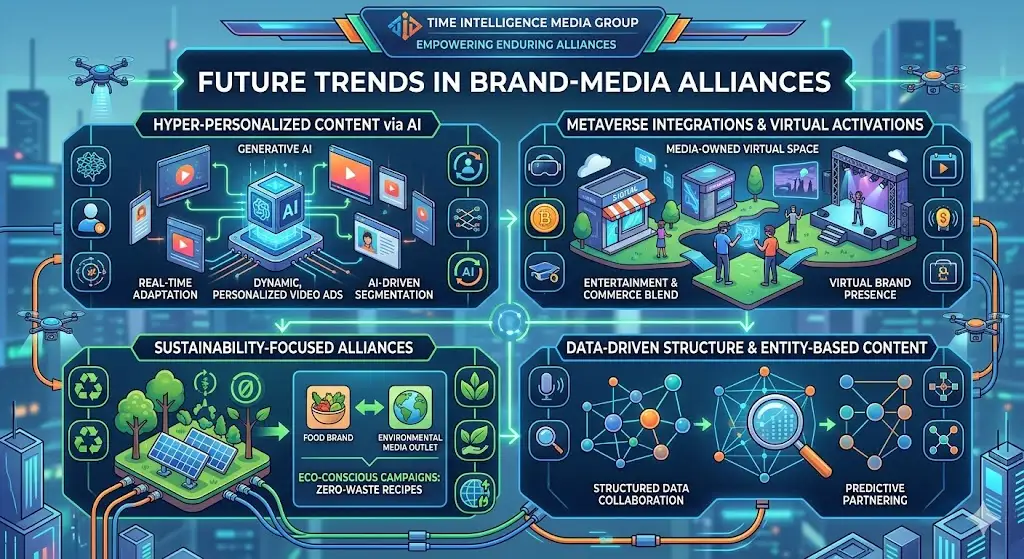
Sustainability-focused alliances are rising, where brands and media co-create eco-conscious campaigns. A food brand’s partnership with an environmental media outlet on zero-waste recipes exemplifies this, boosting loyalty among Gen Z audiences. These trends demand agility, with forward-thinking brands investing in AI tools for predictive partnering.
As voice search and zero-click results dominate, collaborations emphasizing structured data and entity-based content will thrive. Brands prepared for these shifts will lead in an increasingly competitive landscape.
Time Intelligence Media Group provides professional Media Partnerships Solutions to navigate these complexities, empowering brands to build enduring alliances that drive growth.