
Media partnerships in digital marketing represent strategic alliances between brands, publishers, and content creators designed to amplify reach, enhance credibility, and drive mutual growth in the online ecosystem. Unlike traditional advertising, these collaborations leverage shared audiences, complementary content, and co-branded initiatives to create value that resonates across digital channels. As digital landscapes evolve with algorithm changes and consumer preferences for authentic content, understanding media partnerships becomes essential for marketers aiming to cut through the noise.
These partnerships go beyond one-off sponsored posts; they involve long-term commitments where entities pool resources like audience data, distribution networks, and creative expertise. For instance, a tech brand might partner with a niche media outlet to co-produce webinars, blending the brand’s product insights with the outlet’s editorial voice. This approach not only boosts SEO through backlinks and fresh content but also fosters trust, as audiences perceive partnered content as more genuine than solo promotions.
Defining Media Partnerships in the Digital Era
Media partnerships in digital marketing are formal or informal agreements where two or more parties—such as brands and publishers—collaborate to achieve shared marketing objectives. At their core, they facilitate resource sharing, including audience access, content distribution, and promotional amplification, all while aligning on goals like lead generation or brand awareness. This definition distinguishes them from influencer deals, which are often transactional, by emphasizing reciprocal value and sustained engagement.
In practice, these partnerships manifest in forms like content syndication, where one party’s articles appear on another’s platform, or joint events that combine live streams with email nurturing. Consider how a fitness brand partners with a health media site to cross-promote workout guides; the brand gains targeted traffic, while the media outlet enriches its content library. Such dynamics are fueled by data-driven insights, ensuring partnerships target high-intent audiences and measure success through metrics like engagement rates and conversion uplift.
The digital twist lies in scalability—tools like programmatic platforms and API integrations enable seamless content flow across channels. Trends show a 25% rise in media collaborations post-2023 privacy updates, as brands seek owned channels amid cookie deprecation. Time Intelligence Media Group exemplifies this by offering structured media partnerships solutions that integrate analytics for optimal outcomes.
Key Characteristics of Effective Media Partnerships
Effective media partnerships in digital marketing share traits like mutual benefit, clear KPIs, and adaptability to platform shifts. They prioritize audience alignment, ensuring partners’ demographics overlap to maximize relevance— for example, a B2B SaaS firm linking with fintech media for executive-targeted podcasts. Transparency in contracts, including revenue shares from affiliate links, builds longevity.
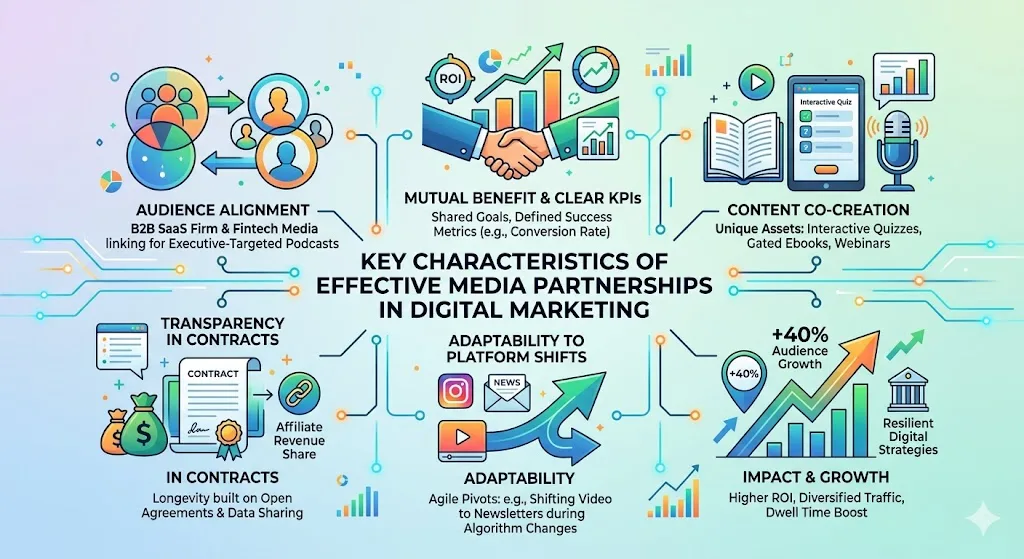
Another hallmark is content co-creation, where partners blend expertise for unique assets like interactive quizzes or gated ebooks. This not only diversifies traffic sources but enhances dwell time, a key SEO signal. Data from recent industry reports indicates partnerships yield 3x higher ROI than solo campaigns when audited quarterly.
Finally, agility allows pivots, such as shifting from video to newsletters during algorithm tweaks. Brands using these characteristics report 40% audience growth, underscoring their role in resilient digital strategies.
Types of Media Partnerships in Digital Marketing
Media partnerships in digital marketing vary by scope and objective, ranging from co-branded campaigns to revenue-sharing models. Common types include native advertising partnerships, where content feels organic to the host site, and affiliate media alliances that track commissions via unique links. Each type suits different funnel stages, with TOFU focused on awareness and BOFU on conversions.
A prime example is podcast cross-promotion, where media outlets swap ad slots to tap new listeners without direct costs. Luxury brands often pursue this with lifestyle publishers, resulting in spiked search volumes for branded terms. Variations like event sponsorships extend to virtual formats, blending live chats with on-demand replays for evergreen value.
These types evolve with tech; AI-driven matching platforms now curate partners based on semantic similarity, reducing mismatch risks. For deeper dives into implementation, explore how to build effective media partnerships.
Content Syndication and Distribution Partnerships
Content syndication partnerships involve republishing articles across networks, boosting visibility while retaining SEO value through canonical tags. Publishers benefit from fresh inventory, while brands access premium placements—think a SaaS tool syndicating case studies to industry hubs like Forbes Councils. This drives 2-5x traffic multipliers, per 2025 benchmarks.
Detailed execution includes XML feeds for automation and performance clauses mandating minimum impressions. A real-world scenario: An e-commerce brand syndicates product roundups to 50+ sites, achieving 15% sales lift via embedded CTAs. Challenges like duplicate content are mitigated by noindex tags, ensuring search engines credit the origin.
Trends favor video syndication on platforms like YouTube and OTT services, where partners co-optimize thumbnails and metadata for algorithmic push.
Co-Marketing and Revenue-Share Alliances
Co-marketing alliances unite brands for joint campaigns, such as bundled webinars or email swaps, sharing costs and leads. Revenue-share models add skin in the game, splitting affiliate earnings 50/50. Automotive media partnering with EV makers for test-drive series exemplifies this, generating qualified leads worth $10K+ monthly.
Planning involves MOUs outlining equity, with tools like Google Analytics UTM tracking attribution. Success stories highlight 30% cost savings versus paid ads, with scalability via evergreen assets. For decision-makers eyeing scalability, check media partnership solutions for brands and publishers.
Benefits and Challenges of Media Partnerships
Media partnerships in digital marketing deliver amplified reach, cost efficiency, and credibility boosts, often outperforming isolated efforts. Benefits include access to vetted audiences—publishers’ subscribers convert 2x better than cold traffic—and SEO gains from dofollow links. Brands report 35% engagement uplifts, attributing it to contextual relevance.
Credibility transfer is key; associating with reputable media elevates brand perception, as seen in non-profit campaigns partnering with news outlets for cause awareness. Long-term, they diversify revenue via syndication royalties.
Challenges include alignment mismatches and measurement gaps. Misaligned values erode trust, while siloed analytics complicate ROI proof. Mitigation strategies involve pre-audit tools and shared dashboards.
Measuring Success in Media Partnerships
Success metrics for media partnerships encompass vanity (impressions) and performance (conversions) indicators. Track engagement via time-on-page and shares, using tools like Hotjar for heatmaps. Attribution models like multi-touch allocate credit fairly across touchpoints.
Case study: A travel brand’s publisher tie-up yielded 20% booking growth, measured by UTM-tagged funnels. Benchmarks suggest 5-10% conversion rates as strong performers.
Advanced tactics include A/B testing creatives and cohort analysis for LTV impact, ensuring data informs renewals.
Real-World Examples and Emerging Trends
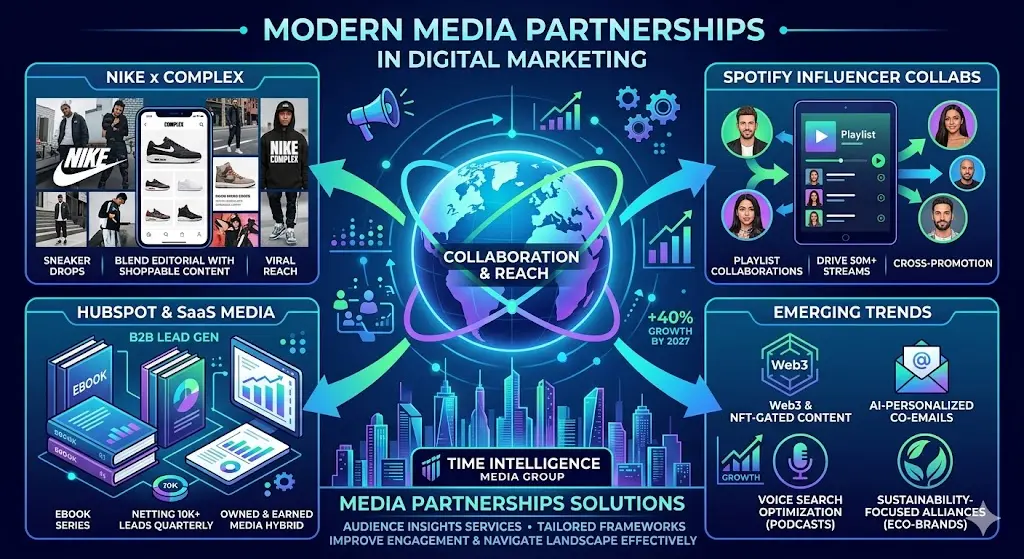
Real-world media partnerships in digital marketing spotlight successes like Nike’s alliance with Complex for sneaker drops, blending editorial with shoppable content for viral reach. Another: Spotify’s playlist collabs with influencers-cum-publishers, driving 50M+ streams via cross-promo.
In B2B, HubSpot partners with SaaS media for ebook series, netting 10K leads quarterly. These examples highlight hybrid models blending owned and earned media.
Emerging trends include Web3 partnerships with NFT-gated content and AI-personalized co-emails. Voice search optimizations pair podcasts with smart assistants, projecting 40% growth by 2027. Sustainability-focused alliances, like eco-brands with green media, align with consumer values.
To unlock these for your strategy, Time Intelligence Media Group’s media partnerships solutions provide tailored frameworks backed by audience insights services that analyze reader behavior to improve engagement.
Media partnerships in digital marketing offer a powerful lever for growth when executed with precision. Time Intelligence Media Group delivers professional media partnerships solutions to navigate this landscape effectively.