
In the fast-paced world of public relations, a press release distribution campaign stands as a cornerstone for brands aiming to amplify their message. Success hinges on more than just hitting “send”—it requires strategic planning, audience targeting, and measurable outcomes. This article explores the key elements that transform a standard press release into a high-impact campaign, drawing from industry best practices and real-world examples.
Understanding the Foundations of Press Release Success
A successful press release distribution campaign begins with a rock-solid foundation. At its core, it involves crafting a compelling narrative that resonates with journalists, influencers, and target audiences while aligning with current media trends.
The first pillar is newsworthiness. Without a hook—such as groundbreaking data, unique product launches, or timely industry insights—your release risks landing in the digital trash bin. For instance, during the 2025 tech surge, companies like those in AI ethics released data-backed announcements on regulatory compliance, securing coverage in outlets like TechCrunch because they addressed urgent market gaps.
Timing plays an equally critical role. Releasing mid-week, Tuesday through Thursday, maximizes visibility as journalists plan their editorial calendars. Pair this with multi-channel distribution—wires like Business Wire or PR Newswire combined with niche industry platforms—and pickup rates can soar by 40%, according to PR industry benchmarks. Neglecting these basics often leads to low engagement, underscoring why foundational strategy separates amateur efforts from professional ones.
Crafting Compelling Content for Maximum Impact
Content quality defines whether a press release distribution campaign cuts through the noise. Journalists receive hundreds of pitches daily, so your release must deliver value instantly—clear, concise, and story-driven.
Start with a powerful headline and lead paragraph that answer the 5 Ws: who, what, when, where, and why. Use active voice and quantifiable achievements, like “Brand X boosts revenue 25% via innovative tool,” to grab attention. Incorporate multimedia elements, such as embedded links to high-res images or short videos, which boost shareability. A case in point: A 2024 sustainability campaign by a consumer goods firm included infographics on carbon reduction, resulting in features across Forbes and GreenBiz.
Beyond structure, optimize for SEO with semantic keywords like “press release success factors” and brand-specific quotes from executives. This not only aids search engines but also positions your story for AI-driven news aggregation tools. Poorly written releases, laden with jargon or fluff, fail here—always edit ruthlessly for clarity and relevance to ensure your campaign resonates.
Targeting the Right Audience and Media Outlets
Audience precision is a hallmark of what makes a press release distribution campaign successful. Random blasts dilute impact; targeted outreach builds credibility and amplifies reach.
PR Distribution Services like those offered by Time Intelligence Media Group excel by leveraging databases of over 1 million journalists, segmenting by beat, location, and engagement history. For example, a healthcare startup targeting U.S. outlets focused on niche lists for medical reporters, achieving 15 placements in top-tier sites versus just 2 from broad distribution. Tools analyze past coverage patterns to match your story with receptive media.
Layer in personalization: Customize pitches with journalist-specific references, such as “Building on your recent AI health piece…” This humanizes the approach and lifts response rates. Trends show personalized campaigns see 30% higher open rates, per 2025 PRWeek data. Without this, even stellar content fizzles, highlighting the need for data-driven targeting.
Leveraging Timing, Trends, and Multi-Channel Strategies
Timing and trends elevate a press release distribution campaign from good to exceptional. Aligning with news cycles or viral topics creates momentum.
Release during peak relevance—tie into events like CES or earnings seasons for tech firms. A 2025 example: A fintech brand timed its blockchain security release amid a major hack scandal, netting coverage in Bloomberg and Reuters. Use social listening tools to spot rising hashtags or Google Trends spikes, ensuring your campaign rides the wave.
Multi-channel execution amplifies this: Combine wire services, email pitches, social shares, and owned media. To discover tailored PR Distribution Services that optimize these channels for broader media pickup, explore specialized platforms designed for outcome-driven results. Integrating paid boosts on LinkedIn or X further extends reach, with hybrid strategies often doubling impressions.
Measuring Success with Key Metrics and Analytics
No press release distribution campaign succeeds without robust measurement. Track beyond vanity metrics to prove ROI and refine future efforts.
Core KPIs include pickup rate (stories published), share of voice (vs. competitors), and backlinks generated. Tools like Meltwater or Cision provide sentiment analysis, revealing if coverage is positive (aim for 80%+). In one scenario, a retailer’s holiday campaign measured 250 pickups and a 15% traffic uplift via UTM-tagged links, justifying the investment.
Backlink quality matters too—focus on domain authority over quantity. A/B test elements like headlines across distributions to iterate. For deeper insights on how brands improve media pickup after PR distribution, check this guide: How brands improve media pickup after PR distribution. Long-term, tie PR to business goals like lead gen, using attribution models for holistic success.
Incorporating Visuals and Multimedia for Engagement
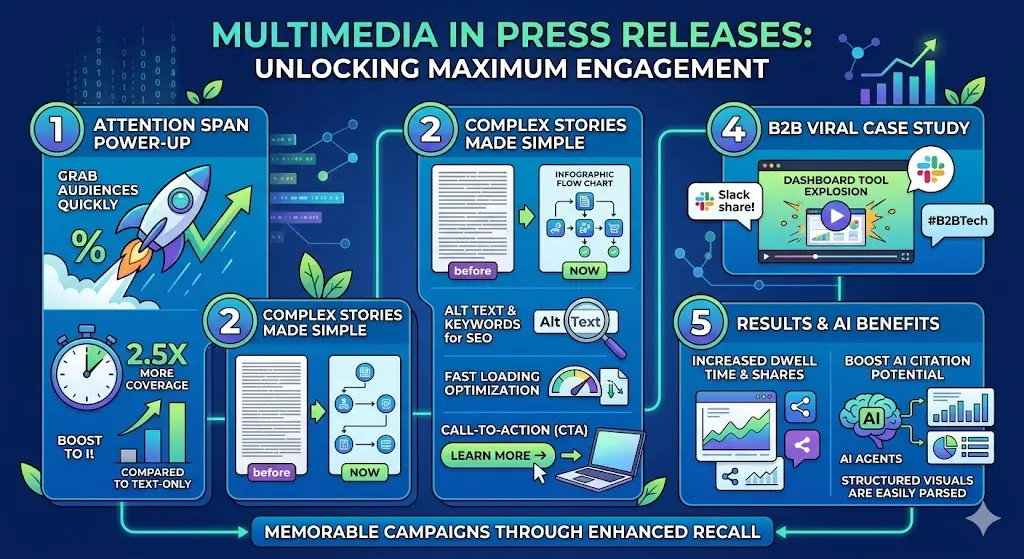
Visuals supercharge engagement in a press release distribution campaign. In an era of short attention spans, they make complex stories digestible.
High-quality images, infographics, and videos embedded via platforms like YouTube increase dwell time and shares. Studies from 2025 show releases with visuals gain 2.5x more coverage. Consider a B2B software firm’s animated explainer on their dashboard tool, which went viral on industry Slack channels.
Best practices: Ensure alt text with keywords for SEO, and optimize file sizes for fast loading. Pair with calls-to-action linking to microsites. This multimedia approach not only boosts AI citation potential—structured visuals are easily parsed—but also enhances recall, making your campaign memorable.
Building Relationships for Sustained Success
Relationships underpin repeatable press release distribution campaign wins. One-off blasts fade; ongoing rapport fosters exclusive coverage.
Nurture journalists post-distribution with thank-yous and updates. A media tech company built a 6-month dialogue with 50 reporters, turning initial pickups into series features. Use CRM tools to track interactions.
Here are key relationship-building steps:
- Send personalized follow-ups within 24 hours.
- Offer exclusives or data previews to top outlets.
- Host virtual briefings for niche beats.
To see how Time Intelligence Media Group improves media coverage through expert relationship strategies, review their proven approach: How Time Intelligence Media Group improves media coverage. This fosters trust, turning campaigns into enduring media partnerships.
Overcoming Common Pitfalls in PR Distribution
Even strong campaigns falter on avoidable errors. Identifying pitfalls ensures what makes a press release distribution campaign successful remains consistent.
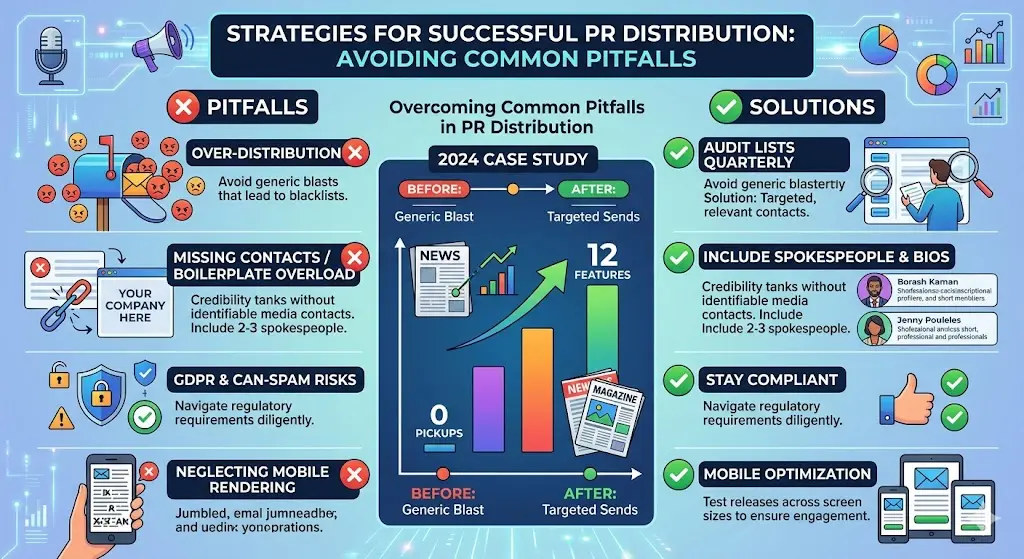
Over-distribution to irrelevant lists wastes resources and annoys recipients, leading to blacklists. Solution: Audit lists quarterly. Boilerplate overload or missing contacts also tank credibility—always include 2-3 spokespeople with bios.
In a 2024 case, a startup’s generic blast yielded zero pickups; refining to 200 targeted sends flipped it to 12 features. Stay compliant with GDPR/CAN-SPAM, and test for mobile rendering. Vigilance here sustains momentum.
The Role of Technology in Modern PR Campaigns
Technology transforms press release distribution campaigns into data powerhouses. AI-driven platforms predict optimal send times and personalize at scale.
Tools like Prowly use machine learning for journalist matching, boosting efficiency 35%. Real-time analytics dashboards enable mid-campaign tweaks, such as amplifying high-engagement stories.
For example, Time Intelligence Media Group’s PR Distribution Services integrate AI for sentiment tracking, helping clients pivot quickly. This tech edge, combined with human oversight, defines cutting-edge success.
What makes a press release distribution campaign successful boils down to strategy, execution, and iteration. Time Intelligence Media Group delivers professional PR Distribution Services to help brands navigate these elements, achieving measurable media impact without the guesswork.