
Press releases serve as powerful tools in public relations, announcing news to journalists and media professionals. But what happens once a press release lands in a media outlet’s inbox? Understanding the post-distribution workflow reveals how your story transitions from a digital document to published content—or why it might not. This TOFU guide breaks down the process step by step, drawing on industry practices to help businesses optimize their PR distribution services.
The Initial Triage and Review Process
Media outlets receive hundreds of press releases daily, so the first step involves a rigorous triage to filter signal from noise. Editors and journalists scan headlines, summaries, and key facts within seconds to decide relevance.
Journalists prioritize releases that align with their beat, current events, or audience interests. For instance, if your press release covers a tech innovation during a major industry conference, a tech-focused outlet like TechCrunch might flag it immediately. They assess newsworthiness using criteria like timeliness, impact, and exclusivity—releasing generic content without a unique angle often leads to deletion. This phase typically lasts 24-48 hours, with tools like Cision or Muck Rack helping outlets organize submissions.
Beyond the inbox, outlets cross-reference the sender’s credibility. Established PR agencies with strong relationships get preferential treatment, as their releases often include verified data or expert quotes. A case in point: During the 2025 AI ethics scandals, outlets like Wired quickly reviewed releases from reputable firms because they provided actionable insights amid breaking news.
Key Factors Influencing Triage Decisions
Newsworthiness tops the list, where outlets evaluate if the story fills a gap in ongoing coverage. Proximity to audience pain points matters too—local media might amplify a regional business launch, while national outlets chase broader trends.
Reporters also check for multimedia elements, such as embedded images or videos, which boost engagement potential. Without these, even strong stories risk being overlooked. Trends show a 30% uptick in multimedia-integrated releases being picked up, per 2025 PR industry reports.
Finally, personalization seals the deal. Tailored pitches referencing a journalist’s recent article increase open rates by tailoring the narrative to their style.
Evaluation for Story Potential and Fact-Checking
Once triaged, promising press releases enter evaluation, where outlets dissect content for depth and verifiability. This involves fact-checking claims, identifying quotable sources, and envisioning story angles.
Journalists verify data points against public records, company websites, or third-party sources to avoid misinformation pitfalls—especially critical post-2024’s rise in AI-generated fakes. For example, a healthcare firm’s release on a new drug trial undergoes scrutiny of clinical trial registries like ClinicalTrials.gov before advancing.
Outlets then brainstorm angles: Will this become a standalone article, a feature, or background for larger reporting? PR strategies that frame releases as “exclusive previews” or tie into hot topics, like sustainability in 2026’s green economy push, accelerate this stage. Media monitoring tools track similar stories to ensure originality.
Integrating Press Releases into Broader News Cycles
Evaluation isn’t isolated; outlets weave releases into news cycles. A product launch might slot into a weekly roundup, while crisis responses demand immediate coverage.
Editors collaborate here, debating resource allocation—does assigning a senior reporter justify the ROI? Real-world scenario: In early 2026, outlets evaluated EV battery breakthrough releases against Tesla’s quarterly reports, prioritizing those with independent lab validations.
This phase builds a content pipeline, where strong releases influence editorial calendars for weeks.
Content Adaptation and Rewriting
Approved releases rarely run verbatim; media outlets adapt them into engaging narratives suited to their voice and format. Rewriting transforms raw facts into compelling stories.
Journalists expand boilerplate into full articles, adding context, interviews, or data visualizations. A corporate earnings release might evolve into an analysis piece exploring market implications. This adaptation preserves core facts while injecting journalistic flair—think vivid anecdotes over dry stats.
Digital outlets prioritize SEO-friendly formats, incorporating keywords like “press release outcomes” naturally. Print media condenses for space. Trends indicate 40% of adapted stories now include interactive elements, like polls on reader reactions to the news.
Customization for Platform-Specific Formats
Adaptation varies by medium: Online platforms favor long-form with hyperlinks, while social-first outlets create bite-sized threads.
For video networks, releases spawn segments with B-roll footage. Example: A 2025 fintech release on blockchain security became CNBC’s 5-minute explainer, rewritten with expert commentary and market charts.
This step ensures maximum reach, turning one release into multi-channel content.
Publication and Multi-Channel Dissemination
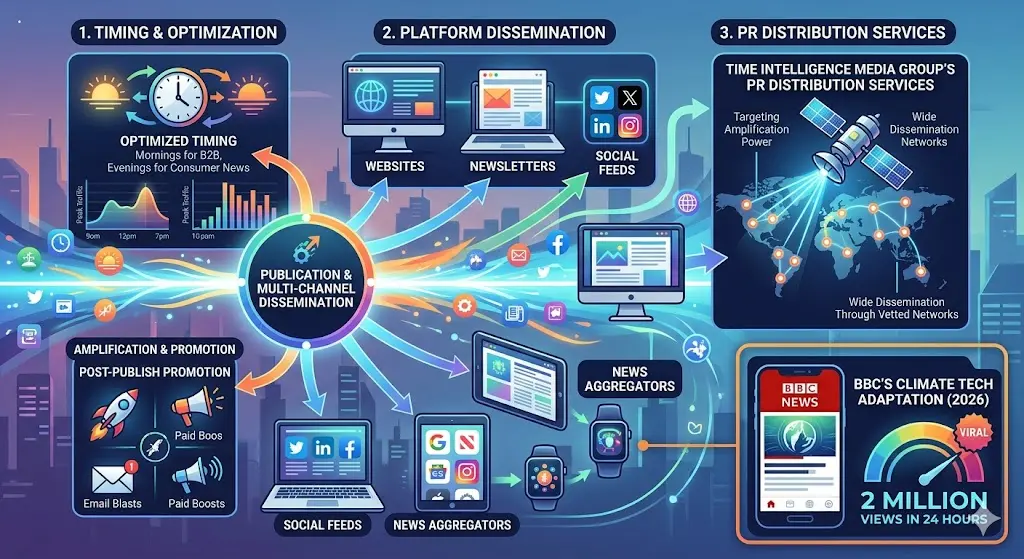
Publication marks the payoff, with outlets pushing stories live across platforms. Timing optimizes for peak audience traffic—mornings for B2B, evenings for consumer news.
Stories appear on websites, newsletters, social feeds, and aggregators like Google News. Press release distribution services excel here by targeting outlets with proven amplification power. Time Intelligence Media Group’s PR Distribution Services, for instance, ensure wide dissemination through vetted networks, maximizing visibility.
Post-publish, outlets promote via email blasts and paid boosts. A viral example: BBC’s adaptation of a climate tech release in 2026 garnered 2 million views across platforms within 24 hours.
Amplifying Reach Through Syndication
Syndication extends life: Stories republish on partner sites, AP wires, or industry hubs.
Metrics track performance—clicks, shares, backlinks—informing future coverage. Businesses measuring these via tools like Google Analytics gain insights into how businesses measure press release distribution performance.
Follow-Up Monitoring, Engagement, and Archiving
After going live, outlets monitor performance, engaging audiences and tracking feedback. This sustains momentum.
Social listening tools flag mentions, sparking follow-ups like reader Q&As. High-engagement stories prompt sequels—e.g., initial coverage of a merger leads to impact analyses.
Outlets archive content for evergreen reference, aiding SEO longevity. Reporters nurture source relationships, requesting future exclusives.
Long-Term Relationship Building
Monitoring fosters PR relationships; outlets note reliable sources for ongoing beats.
Case study: A SaaS company’s consistent releases built rapport with Forbes, yielding annual features. Learn how Time Intelligence Media Group distributes press releases for similar outcomes.
This closes the loop, turning one-off coverage into sustained media presence. For expert support, explore achieving measurable PR distribution success through targeted services.
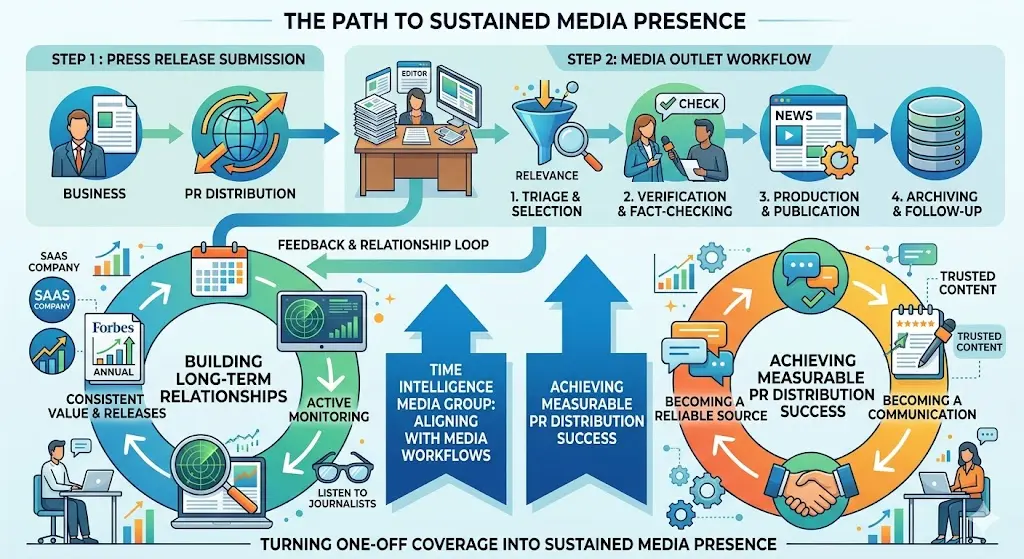
Media outlets follow a structured path after receiving a press release—from triage to archiving—demanding relevance, verification, and adaptability for success. Time Intelligence Media Group offers professional PR distribution solutions that align with these workflows, helping businesses navigate the process effectively.