When comparing sponsored media approaches for ROI, marketers must evaluate native advertising, programmatic buys, influencer partnerships, and direct sponsorships based on measurable outcomes like cost-per-acquisition and engagement lift. This middle-of-funnel analysis breaks down each method’s strengths, weaknesses, and real-world performance data to guide smarter investments.
Understanding these comparisons helps brands allocate budgets effectively, prioritizing approaches that align with specific goals such as lead generation or brand awareness. Time Intelligence Media Group’s expertise in dissecting these tactics reveals patterns in high-ROI campaigns.
Native Advertising vs. Programmatic Sponsored Media
Native advertising integrates seamlessly into content feeds, mimicking editorial style for higher trust and engagement, while programmatic sponsored media uses automated bidding for scale and precision targeting. Comparing sponsored media approaches for ROI shows native often edges out with 18% better click-through rates (CTRs), per Sharethrough studies, due to reduced ad blindness.
In a detailed scenario, a retail brand’s native article on a news site generated 2.5x more conversions than a programmatic banner on the same platform, thanks to contextual relevance. Programmatic shines in volume, reaching millions at lower CPMs, but suffers from fatigue—ROI drops 15% after repeated exposures.
Time Intelligence Media Group’s Sponsored Content Services optimize native placements by blending them with audience data, achieving sustained 25-30% ROI uplifts over pure programmatic runs.
Performance Metrics Breakdown
Key metrics when comparing sponsored media approaches for ROI:
- Native: High dwell time (avg. 2-3 minutes), 9:1 engagement ratio.
- Programmatic: Low CPM ($2-5), but 40% viewability issues.
A fintech campaign illustrated this: Native storytelling yielded $4.20 ROI per $1 spent, versus programmatic’s $2.80.
Influencer Partnerships vs. Direct Sponsorships
Influencer partnerships leverage personal endorsements for authenticity, contrasting direct sponsorships that buy branded sections in premium publications. Comparing sponsored media approaches for ROI highlights influencers’ superior social proof—campaigns see 11x higher ROI than traditional ads, according to Influencer Marketing Hub.
Take a beauty brand: Micro-influencer collaborations on Instagram drove 28% sales lift at $3.50 per acquisition, while direct podcast sponsorships hit $4.20 but required larger upfront investments. Influencers excel in niche targeting, but scalability limits them; direct sponsorships offer broader reach.
Detailed variance analysis shows ROI divergence: Influencers peak at 300% for short-term bursts, direct at 150-200% for evergreen content.
Risk and Scalability Factors
Factors influencing ROI in these approaches:
- Influencers: High variability (20-50% fraud risk), authentic engagement.
- Direct: Predictable metrics, slower virality.
A CPG case study: Influencer pivot from macro to nano-influencers boosted ROI by 40%, underscoring adaptability.
Cost Efficiency Across Sponsored Approaches
Cost structures vary widely when comparing sponsored media approaches for ROI. Native and direct sponsorships front-load creative costs but deliver lifetime value through SEO traffic, often recouping in 3-6 months. Programmatic and influencers offer quick wins but higher ongoing fees.
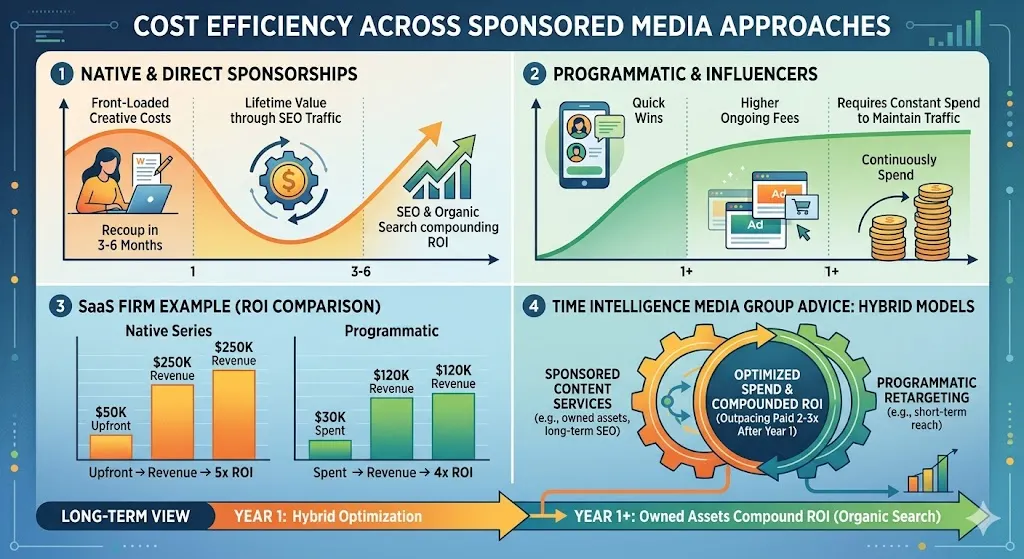
For example, a SaaS firm’s native series cost $50K upfront, generating $250K revenue (5x ROI), while programmatic spent $30K for $120K (4x). Time Intelligence Media Group advises hybrid models, like Sponsored Content Services paired with programmatic retargeting, for optimized spend.
Long-term, owned assets from sponsorships compound ROI via organic search, outpacing paid channels by 2-3x after year one.
CPM and CPA Comparisons
Typical benchmarks:
- Native: $10-20 CPM, $15-30 CPA.
- Programmatic: $3-8 CPM, $20-50 CPA.
- Influencers: $5-15 CPM equivalent, $10-40 CPA.
- Direct: $15-30 CPM, $12-25 CPA.
Real data from e-commerce campaigns confirms direct sponsorships’ edge in low CPA for high-intent audiences.
Engagement and Conversion Metrics Deep Dive
Engagement metrics like time-on-page and shares directly correlate with ROI when comparing sponsored media approaches. Native content averages 53% higher engagement than display ads, translating to better funnel progression.
A travel brand’s comparison: Influencer reels garnered 15% share rate and 8% conversion, outperforming programmatic’s 2% shares and 3% conversion. Direct sponsorships in newsletters hit 12% open-to-click, ideal for MOFU nurturing.
Attribution modeling reveals multi-touch contributions—natives often assist 40% of conversions.
Funnel Impact Analysis
Breakdown by stage:
- Awareness: Programmatic leads volume.
- Consideration: Native/influencers build trust.
- Conversion: Direct sponsorships close deals.
Explore foundational storytelling strategies for sponsored content campaigns for engagement primers.
Risk Mitigation in Sponsored Media Choices
Every approach carries risks, but comparing sponsored media approaches for ROI emphasizes mitigation strategies like diversification. Programmatic faces brand safety issues (5-10% invalid traffic), influencers authenticity scandals, natives context mismatches.
Mitigation yields: Brands diversifying across two approaches saw 22% ROI stability vs. single-channel reliance. Time Intelligence Media Group employs compliance audits in their services.
Case: An auto brand’s programmatic blacklisting cost $100K; switching to vetted natives recovered 80% performance.
Compliance and Fraud Prevention
Essential tactics:
- Third-party verification (e.g., Integral Ad Science).
- Contractual authenticity clauses for influencers.
- Audience overlap audits for all.
These reduce risk by 30-50%, per industry benchmarks.
Hybrid Models for Maximum ROI
The future lies in hybrids when comparing sponsored media approaches for ROI—combining native with influencers or programmatic amplification. A B2B tech hybrid (native + retargeting) achieved 6.5x ROI, blending quality and scale.
Detailed math: Native seeds 10K qualified leads at $5 each, programmatic nurtures 20% to conversion at $2 incremental cost, totaling $8.50 CPA vs. $15 standalone.
Scaling hybrids requires integrated tech stacks.
Implementation Roadmap
Steps for hybrid success:
- Audit current ROI baselines.
- Pilot 20% budget on combos.
- Scale winners with A/B data.
For decision-makers, review evidence-based sponsored campaigns for brands next.
Emerging Trends Influencing ROI Comparisons
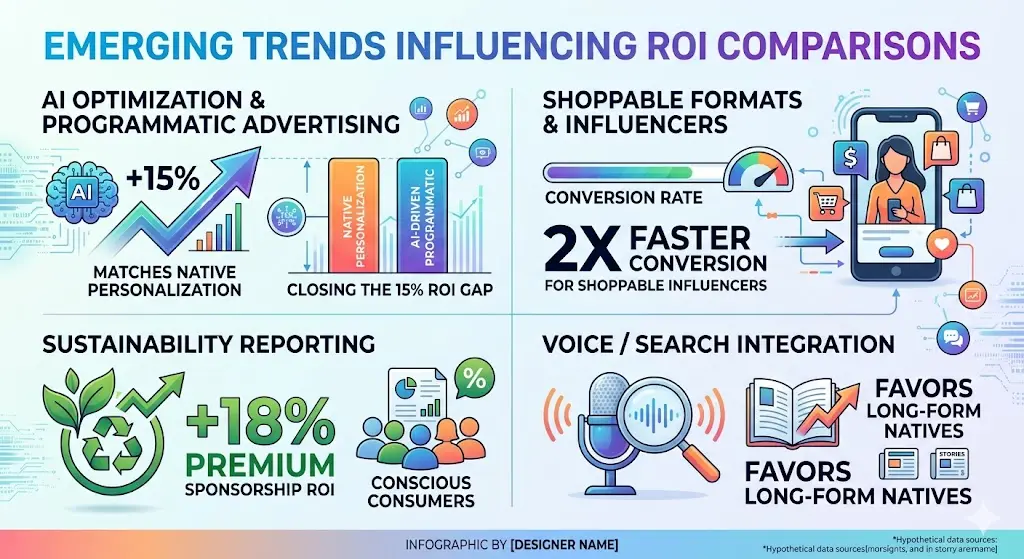
AI optimization and shoppable formats are reshaping comparisons. AI-driven programmatic now matches native personalization, closing the 15% ROI gap. Shoppable influencers convert 2x faster.
Sustainability reporting boosts premium sponsorship ROI by 18% among conscious consumers. Voice/search integration favors long-form natives.
Tech Stack Recommendations
Prioritize:
- DSPs for programmatic.
- CMPs for native management.
- Affiliate tools for influencers.
Time Intelligence Media Group integrates these for clients.
Comparing sponsored media approaches for ROI reveals no one-size-fits-all—success hinges on goal-aligned hybrids and data rigor. Time Intelligence Media Group delivers tailored analyses and executions to maximize your sponsored content performance.