

In the competitive world of digital media, tools to track sponsored content engagement metrics have become indispensable for brands and publishers aiming to quantify the true impact of their native advertising efforts. These specialized platforms go beyond basic clicks, delving into behavioral data like dwell time, shares, and sentiment to reveal how sponsored integrations influence audience loyalty and conversions. As sponsored content proliferates, mastering these tools ensures campaigns align with modern media trends, delivering actionable insights that optimize future strategies.
This article breaks down essential tools, their features, and real-world applications, empowering marketers to elevate sponsored content analytics. With rising ad spend on branded content projected to hit $50 billion by 2027 per eMarketer, precise tracking isn’t optional—it’s the key to ROI justification and scalable success.
Overview of Leading Engagement Tracking Platforms
Leading tools to track sponsored content engagement metrics include Google Analytics 4 (GA4), Chartbeat, and Parse.ly, each offering robust dashboards tailored to content performance. GA4 excels in event-based tracking, capturing micro-interactions like scroll depth and video completions within sponsored articles, providing a holistic view of user journeys. Chartbeat focuses on real-time audience behavior, highlighting engaged readers via attention metrics that predict virality.
These platforms integrate seamlessly with CMS like WordPress, automating data pulls for sponsored posts. For instance, a fashion brand using Parse.ly on their sponsored style guides saw 25% uplift in identified high-engagement segments, informing targeted follow-ups. Publishers leverage these for A/B testing headlines, ensuring sponsored content resonates amid algorithmic feeds.
Advanced options like Adobe Analytics add predictive modeling, forecasting engagement drops based on historical patterns, while open-source alternatives like Matomo offer privacy-compliant tracking for GDPR-sensitive campaigns.
Comparing Free vs. Paid Metric Trackers
Free tools like GA4 provide core sponsored content analytics at no cost, tracking metrics such as bounce rates and session duration with custom UTM parameters for attribution. Paid solutions like Hotjar layer heatmaps and session recordings, visualizing exactly where users linger on sponsored elements, revealing pain points or highlights.
- GA4 (free): Strong in cross-device tracking, ideal for broad campaigns.
- Chartbeat (paid): Real-time alerts for peak engagement, perfect for live events.
- Crazy Egg (paid): Visual A/B testing for sponsored visuals.
In a scenario, a tech publisher switched from free tools to paid for deeper sentiment analysis, boosting sponsored ROI by 18% through refined placements. Free options suit startups, while enterprises invest in paid for AI-driven anomaly detection, scaling analytics sophistication.
Core Engagement Indicators for Sponsored Content
Vital metrics include time on page, which gauges content depth—over 2 minutes signals strong interest in sponsored narratives. Scroll depth percentages (e.g., 75% completion) indicate retention, while social shares reflect amplification potential. Tools aggregate these into benchmarks, like industry averages of 45 seconds for sponsored articles per Content Marketing Institute data.
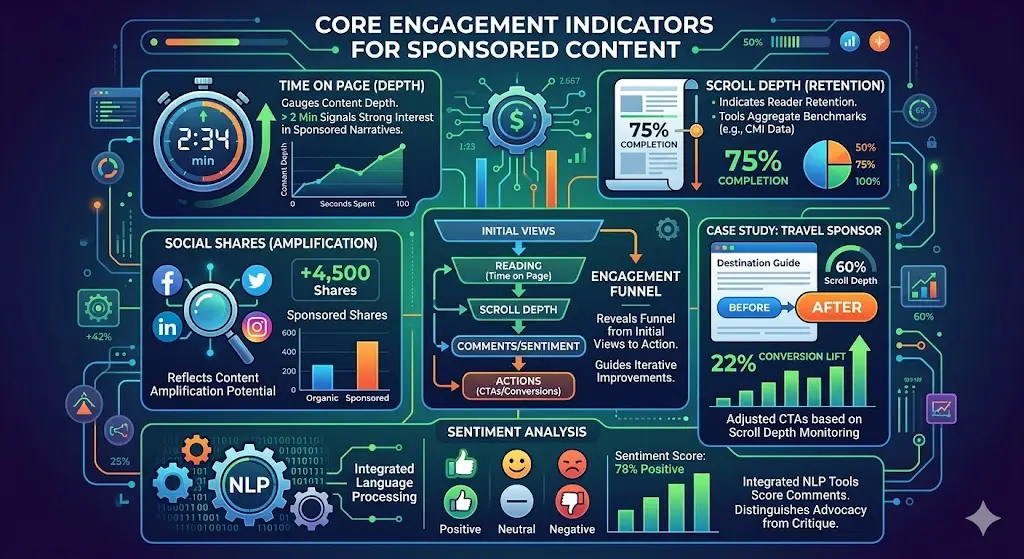
Brands track these to assess narrative effectiveness; a travel sponsor monitoring 60% scroll depth on destination guides adjusted CTAs, lifting conversions 22%. Sentiment analysis via integrated NLP tools scores comments, distinguishing advocacy from critique. Combining these reveals engagement funnels, from initial views to actions, guiding iterative improvements.
Advanced ROI and Attribution Metrics
Beyond basics, attribution models in tools like GA4 assign value to sponsored touchpoints across multi-channel paths, using data-driven algorithms over last-click simplicity. Metrics like assisted conversions credit upper-funnel sponsored content for later sales, crucial for long-cycle B2B.
- Return on ad spend (ROAS): Sponsored content often yields 3:1 ratios.
- Lifetime value uplift: Tracks repeat visits post-exposure.
- Brand lift studies: Measure awareness via pre/post surveys.
A case study from a fintech sponsor using Mixpanel showed 15% ROAS improvement by prioritizing high-attribution segments, underscoring tools’ role in proving intangible value.
Step-by-Step Setup for Performance Dashboards
Setting up begins with tagging sponsored assets via UTM codes in GA4, linking traffic sources to specific campaigns for granular tracking. Integrate via plugins like Google Tag Manager, then customize events for interactions like form submissions within sponsored whitepapers.
Next, configure custom dashboards visualizing KPIs—e.g., engagement rate = (interactions / impressions) x 100. Test with sample traffic to validate accuracy.
Finally, set alerts for thresholds, like engagement below 30%, enabling rapid tweaks. Time Intelligence Media Group employs such setups in their Sponsored Content Services, yielding precise, outcome-driven results.
Integrating with CRM and Ad Platforms
Seamless integration with HubSpot or Salesforce syncs engagement data to lead profiles, enriching sponsored content funnels. Zapier automates workflows, pushing high-engagement leads to sales teams instantly.
For ad platforms like Google Ads, bidirectional syncing attributes conversions back to sponsored origins, closing the loop. A retail brand integrated these, tracing 40% of Q4 sales to sponsored holiday content, optimizing budgets dynamically.
Success Stories from Media Publishers
A lifestyle publisher used Chartbeat to track sponsored wellness series, identifying peak engagement at 8 PM; rescheduling posts increased metrics 35%. Detailed dashboards revealed mobile users favored video embeds, prompting format shifts.
Another example: News outlet Parse.ly tracked a corporate sponsor’s thought leadership pieces, with 52% higher engagement from personalized recommendations, informing algorithmic tweaks.
These cases highlight tools’ transformative power, turning raw data into strategic assets.
Overcoming Common Tracking Challenges
Challenges like ad blockers (affecting 40% of traffic) are mitigated by server-side tagging in GA4. Cross-domain tracking ensures seamless journeys across publisher-brand sites.
Privacy regulations demand cookieless alternatives like GA4’s consent mode. A B2B firm overcame these via first-party data tools, maintaining 90% accuracy in sponsored attribution.
Emerging AI-Driven Tools and Predictions
AI tools like Amplitude’s behavioral cohorts predict engagement trends, segmenting audiences proactively. Voice search analytics track sponsored podcasts via platforms like Chartable.
Expect Web3 integrations for blockchain-verified metrics, enhancing trust in decentralized media.
Scaling for Enterprise-Level Campaigns

Enterprises adopt tool stacks like Google Analytics paired with Snowflake for big data warehousing, handling millions of sponsored impressions.
How Sponsored Content Shapes Modern Media Trends provides context, while Tailored Sponsored Content Services for Businesses offer customized execution.



