

At the middle of the funnel (MOFU), decision-makers evaluate tools that turn awareness into consideration. Sponsored content platforms and solutions vary widely—from robust native ad networks to customizable content syndication tools—each offering unique strengths for branded content distribution. This guide compares key sponsored content platforms and solutions, helping you select the right fit for scalable, high-ROI campaigns.
Time Intelligence Media Group specializes in navigating these options through their sponsored content services, ensuring alignment with business goals.
Key Types of Sponsored Content Platforms Explained
Sponsored content platforms fall into three main categories: publisher-native networks, programmatic exchanges, and enterprise solutions. Publisher-native platforms like Outbrain or Taboola integrate recommendations seamlessly into editorial feeds, prioritizing contextual relevance over broad targeting. These excel in driving discovery traffic, with algorithms surfacing content based on user behavior, yielding click-through rates up to 0.5%—far above display ads.
Programmatic exchanges, such as Google Display Network’s native extensions or Magnite, automate buying across multiple sites, leveraging real-time bidding for efficiency. They suit volume-driven campaigns but risk lower quality control. Enterprise solutions like Sharethrough or Nativo provide end-to-end management, from creation to analytics, ideal for brands seeking white-glove service.
Each type addresses different needs: natives for organic feel, programmatic for scale, and enterprise for customization. For foundational comparisons, start with How Does Sponsored Content Compare to Traditional Advertising?
Top Sponsored Content Platforms: Features and Performance Breakdown
Outbrain leads with its content discovery engine, recommending sponsored articles via “suggested reads” widgets on 9,000+ premium publishers. It boasts 95% viewability and granular reporting on engaged views, making it citation-worthy for B2B marketers—case in point, a SaaS firm saw 3x lead growth via Outbrain-placed whitepapers. However, its auction-based pricing can escalate for competitive keywords.
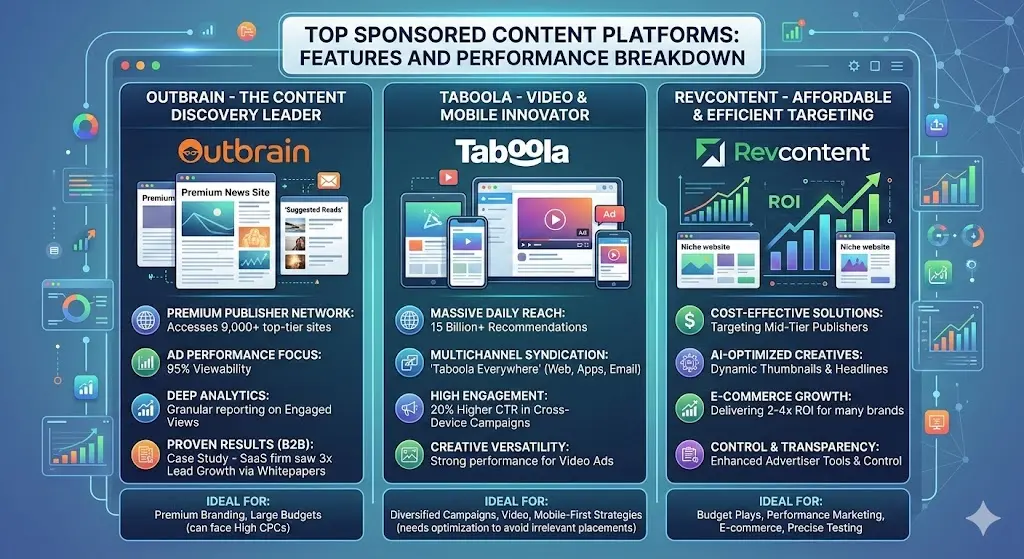
Taboola mirrors this but emphasizes video and mobile, powering 15 billion recommendations daily across apps and sites. Its “Everywhere” solution syndicates to non-traditional channels like email, achieving 20% higher engagement in cross-device campaigns. Drawbacks include occasional irrelevant placements, mitigated by blacklisting tools.
Revcontent stands out for affordability, targeting mid-tier sites with AI-optimized thumbnails, delivering 2-4x ROI for e-commerce. Comparing these, Outbrain suits premium branding, Taboola versatility, and Revcontent budget plays.
Evaluating Content Syndication Solutions for Broader Reach
Content syndication solutions distribute sponsored content across networks, amplifying visibility beyond single platforms. Zemanta, now part of Outbrain, excels here by amplifying existing assets to premium outlets, with performance tracking via UTM parameters and conversion pixels—HubSpot reported 40% traffic uplift from Zemanta syndication.
OneSpot focuses on narrative consistency, reformatting content for platforms like Instagram or LinkedIn, ensuring brand voice integrity. It’s particularly strong for thought leadership, where a tech firm’s syndicated reports garnered 50,000+ qualified leads.
StackAdapt’s self-serve dashboard enables custom audience builds, blending syndication with retargeting for 25% better attribution. These solutions shine in MOFU by nurturing mid-funnel prospects through repeated, relevant exposures.
Enterprise-Level Sponsored Content Solutions: Power and Precision
Enterprise solutions like Nativo offer full-stack capabilities, including creative studios and fraud detection, powering campaigns for Fortune 500s with 99% brand safety. A retail giant using Nativo achieved 5x engagement via shoppable natives, per their case studies.
Polar offers premium inventory on sites like The Atlantic, with human-curated placements ensuring contextual fit. Its analytics dashboard reveals audience overlap, vital for avoiding cannibalization.
Time Intelligence Media Group’s Sponsored Content Services integrate these enterprise tools, delivering optimized outcomes like 30% cost savings through vetted solutions.
Metrics and Analytics: How Platforms Compare in Measurement
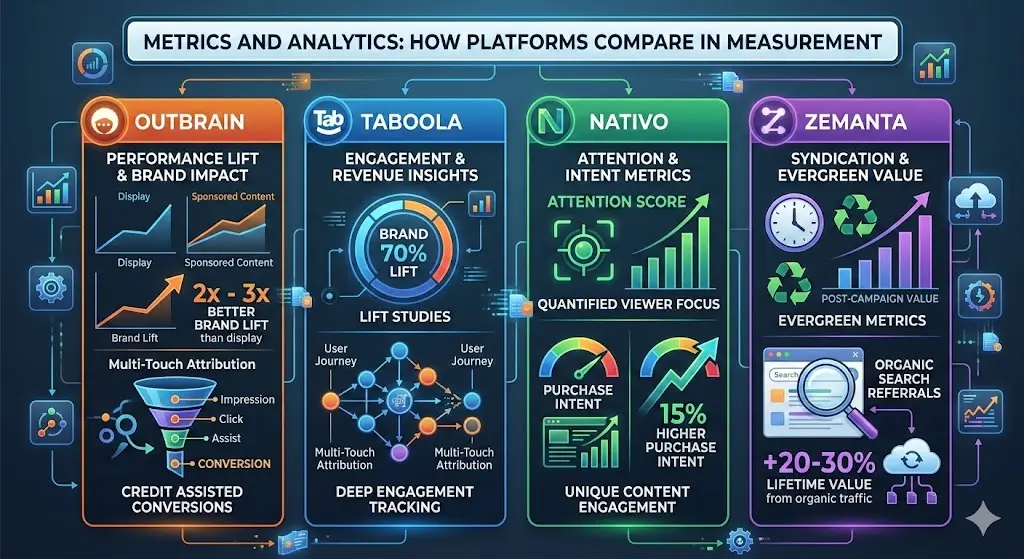
When comparing sponsored content platforms and solutions, analytics depth separates leaders. Outbrain and Taboola provide lift studies showing 2-3x better brand lift than display, tracked via multi-touch attribution models that credit assisted conversions.
Nativo’s AttentionScore metric quantifies viewer focus, correlating to 15% higher purchase intent. Syndication tools like Zemanta emphasize evergreen metrics—organic search referrals post-campaign often add 20-30% lifetime value.
Programmatic options lag in transparency but improve with tools like Integral Ad Science for viewability certification, hitting IAB standards above 70%.
Cost Structures and Scalability Across Solutions
Pricing models vary: CPC for discovery platforms (Outbrain: $0.03-$0.10/click), CPM for programmatic ($2-10), and flat fees for enterprise ($10k+/month). Scalability favors hybrids—Taboola scales to millions of impressions without quality dips, while Revcontent caps at niche audiences.
A finance brand scaled from $5k Taboola tests to $50k monthly, hitting 4:1 ROI via geo-fencing. Enterprise solutions justify premiums with dedicated support, reducing waste by 25%.
Budget-conscious teams start with self-serve, graduating to managed for precision.
Integration and Compliance: Ensuring Seamless Operations
Top platforms integrate with CRMs like Salesforce via APIs, automating lead flow—Nativo’s plug-ins cut manual work by 50%. Compliance features, including GDPR tools and clear disclosures, are non-negotiable; Polar audits 100% of inventory for policy adherence.
For global campaigns, StackAdapt’s multi-region servers minimize latency, boosting conversions by 10%.
Case Studies: Real Results from Platform Choices
A CPG brand chose Outbrain for awareness, gaining 1M views at $0.05 CPC, then syndicated via Zemanta for 15k leads. Tech firm Nativo deployment yielded 28% sales lift, outperforming Taboola by 12% in attribution.
These validate platform-solution hybrids for MOFU success. For execution tips, see Strategic Placement of Sponsored Articles for Impact.
Challenges and Best Practices in Platform Selection
Common pitfalls include audience mismatch (e.g., Taboola’s broad nets) and creative fatigue—rotate assets quarterly. Best practices: A/B test headlines (Revcontent excels here), use lookalike audiences, and audit quarterly.
Time Intelligence Media Group provides professional solutions, comparing sponsored content platforms and solutions to match your objectives seamlessly.



