

What makes an electric vehicle market report authoritative to UK journalists?
An electric vehicle market report becomes authoritative to UK journalists when it provides verifiable data, clear methodology, and direct industry relevance. National media outlets require transparent primary source data from recognised databases to validate published industry facts.
Journalists at UK publications such as Autocar, Fleet News, and The Financial Times receive hundreds of press releases daily. To filter noise from substance, media writers look for verifiable dataset origins, such as official registrations from the Society of Motor Manufacturers and Traders (SMMT) or charging infrastructure tallies from Zapmap. A report must explicitly state its sample size, collection period, and regional boundaries.
To secure coverage, the document must present clear macro-level insights before drilling down into specific market segments. Incorporating primary industry definitions prevents misinterpretation of complex technical subjects. Readers who seek a basic overview of sector analytics can review a foundational guide on research reports, which outlines fundamental data presentation principles for general audiences.
Media credibility depends heavily on context. Reporting a raw number, such as 50,000 new vehicle registrations, carries little weight without historic comparisons. An authoritative report evaluates data against regulatory markers, such as the Zero Emission Vehicle (ZEV) mandate targets, or compares current figures to previous quarters.
          Data Sourcing
  (SMMT, Zapmap, DfT Registrations)
                 │
                 ▼
      Methodology Validation
  (Sample Size, Metrics & Definitions)
                 │
                 ▼
       Analytical Structure
   (Executive Summary -> Specifics)
                 │
                 ▼
        Media Distribution
 (Data Visuals, Press Releases & APIs)
How do you plan the workflow for an electric vehicle market analysis?
Planning an electric vehicle market analysis requires defining research objectives, selecting primary data streams, setting rigorous validation protocols, and organising structural milestones. Executing these steps sequentially ensures the final publication meets strict media standards.
1. Establish research objectives and scope: Define explicit parameters before collecting data.
Identify the specific question your market analysis answers. Determine whether the focus rests on battery electric vehicle (BEV) fleet adoption, public charger distribution, or private consumer purchase intent within the UK.
2. Source primary and secondary datasets: Gather raw information from trusted institutions.
Extract official vehicle registration metrics from SMMT databases, charger deployment numbers from the Department for Transport (DfT), and financial residual values from industry pricing indexes.
3. Validate and clean incoming data: Remove anomalies and normalise variables.
Cross-reference raw registration counts against historical benchmarks. Account for seasonal registration surges, such as the UK plate-change months in March and September, to prevent skewed growth analysis.
4. Synthesise core findings into media assets: Format information for rapid editorial extraction.
Draft concise executive key takeaways, prepare high-resolution data graphics, and extract standalone statistics that journalists can cite directly in national news stories.
What are the essential core components of a media-grade EV report?
The core components of a media-grade EV report include an executive summary, segmented registration figures, charging infrastructure updates, policy impacts, and raw statistical annexes. Standardising these sections allows commercial editors to locate relevant facts instantly.
Executive Summary with Key Findings
The opening section presents the overall narrative of the research document. It isolates three to five critical metrics, such as total battery electric car market share or overall fleet growth rates. National news desks frequently convert well-structured executive summaries directly into brief news stories.
Vehicle Registration and Fleet Segmentation
This section breaks down total adoption numbers into distinct operational categories. Business fleet uptake differs significantly from private consumer purchasing behaviours due to benefit-in-kind (BIK) tax incentives. Presenting these segments separately highlights structural market drivers.
UK EV REPORT CORE SECTIONAL FRAMEWORK
1. EXECUTIVE SUMMARY: Key YoY growth rates, overall BEV share (%)
2. FLEET & PRIVATE SEG: BIK tax impacts, fleet vs retail volumes
3. INFRASTRUCTURE: Rapid/Ultra-rapid deployment vs driver ratios
4. LEGISLATION & MACRO: ZEV mandate compliance, trade tariffs
5. STATISTICAL ANNEX: Raw SMMT data tables, regional heatmaps
Infrastructure Development Tracking
Vehicle deployment data requires parallel context regarding public charging accessibility. Reports must categorise charging hardware by power output, separating standard AC sockets from rapid and ultra-rapid DC chargers. Showing the ratio of registered vehicles to available chargepoints gives journalists a complete operational picture.
Policy, Tariff, and Regulatory Analysis
UK automotive markets operate under distinct regulatory requirements. A robust report analyses how policy levers—such as the ZEV mandate, local low-emission zones, and import tariffs on overseas manufacturers—alter commercial projections.
Statistical Appendix and Data Repository
Media citations increase when reports include access to underlying dataset tables. Providing precise figures in organised annexes enables reporters to verify specific data points without submitting background requests.
Explore More Expert Insights:
How to Turn Energy Market Data Into a Research Report That UK Business and Trade Media Will Cover
How to Analyse the Impact of a New UK Regulation on Your Sector and Publish the Findings as a Research Report
How does structured market research benefit UK automotive brands and publishers?
Structured market research provides UK automotive brands and publishers with earned media coverage, authoritative brand positioning, direct policy influence, and strategic decision-making support. Clear data presentation drives citations across national news platforms.
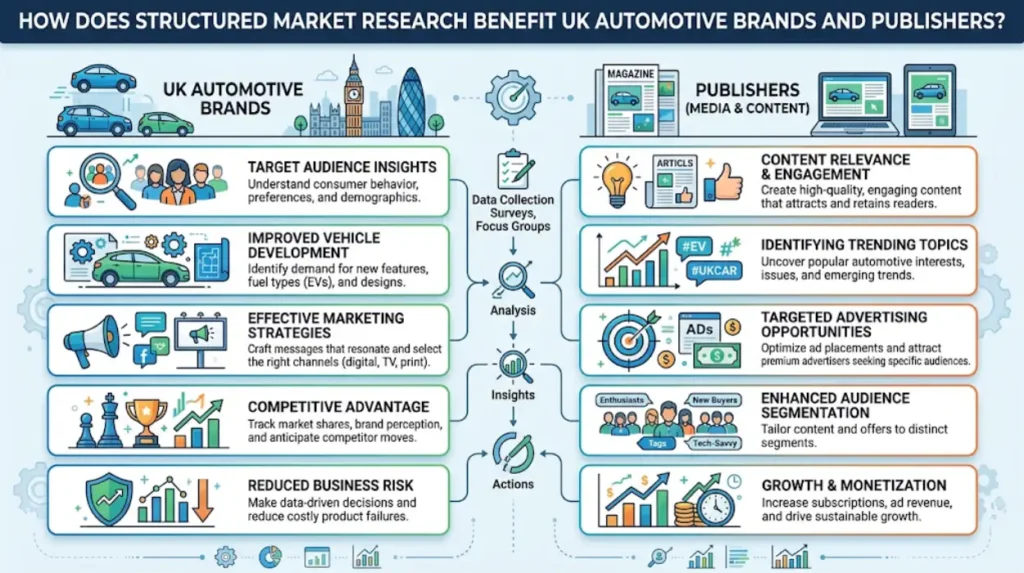
- Earned Media Acquisition: UK publications require original data points to justify headline stories. Highlighting statistical shifts secures natural editorial mentions without paid advertising costs.
- Thought Leadership Validation: Brands that publish reliable monthly or quarterly metrics build trust among industry analysts, trade bodies, and institutional investors.
- Policy and Advocacy Engagement: Government departments and parliamentary committees use structured market evidence when drafting national transport policies and infrastructure grants.
- Commercial Strategy Calibration: Automotive original equipment manufacturers (OEMs), fleet operators, and chargepoint installers rely on granular data reports to allocate capital expenditure effectively.
Commercial teams seeking tailored publication and data structuring services can evaluate dedicated corporate options through report services to build bespoke research programs for UK media outreach.
Which real-world scenarios require a fully structured EV market publication?
A fully structured EV market publication is required during quarterly financial reporting, policy mandate consultations, new brand entry launches, and major infrastructure network expansions. These scenarios demand verified empirical evidence for public distribution.
Quarterly Industry Progress Reviews
Trade bodies like the SMMT publish detailed registration data every quarter. Media teams use these structural releases to report overall market health, highlighting shifts between battery electric vehicles, plug-in hybrids, and internal combustion engine models.
Q1 Registration Analysis
April
Evaluates new registration spikes following the March plate-change, tracking initial year-to-date market share against annual ZEV mandate targets.
Mid-Year Policy Review
July
Assesses commercial fleet procurement patterns and public charging infrastructure growth across England, Scotland, Wales, and Northern Ireland.
Q3 Fleet Market Assessment
October
Measures the volume of business vehicle acquisitions after September registrations, analysing BIK tax efficiency trends.
Full-Year Industry Wrap-Up
January
Consolidates annual registration figures, residual value curves, and regional charger density into a master media reference report.
International OEM Market Entry into the UK
When international electric vehicle brands enter the UK market, media outlets analyse their sales performance against established local incumbents. Structuring market reports around brand-by-brand registration volumes gives journalists clear data regarding market disruption.
Infrastructure Investment and Deployment Announcements
Chargepoint operators raising capital or launching public charging networks publish structured reports to demonstrate utilisation rates. Displaying local council installation speeds alongside regional vehicle density proves the viability of planned infrastructure projects.
Structuring an electric vehicle market report requires strict data sourcing, clear methodological transparency, and logical flow. By isolating key statistics, standardising core analytical sections, and providing direct answers to industry questions, analysts can produce research assets that secure consistent citations across UK motoring, business, and national media channels.
FAQs
Q1: How should an electric vehicle market report be structured for UK media?
Ans: A UK electric vehicle market report should include a clear executive summary, market trends, sales data, consumer behaviour, charging infrastructure, policy developments, and forecasts. Each section should use credible sources and concise evidence that motoring and business journalists can verify and cite.
Q2: What data should an electric vehicle market report include?
Ans: Key data includes EV registrations, market share, sales growth, charging-point availability, consumer demand, vehicle pricing, and government policy changes. UK-specific statistics and clearly dated sources make the report more relevant for media coverage.
Q3: How can EV research reports become more citable for UK journalists?
Ans: EV research reports become more citable when they present original statistics, transparent methodology, authoritative sources, and clearly attributed findings. Tables, charts, concise insights, and quotable conclusions also help journalists identify usable evidence quickly.
Q4: What makes a UK electric vehicle market report credible?
Ans: Credibility depends on reliable datasets, transparent research methods, accurate UK market analysis, and clearly referenced sources. Reports should distinguish verified facts from forecasts and explain how key conclusions were reached.
Q5: How can Times Intelligence Media Group structure EV market research for media use?
Ans: Times Intelligence Media Group can structure EV market research around UK market data, consumer trends, industry developments, regulatory changes, and evidence-based forecasts. A logical report structure with source attribution and concise findings makes the research easier for business and motoring media to reference.



