

Sponsored how-to guides combine useful editorial information with paid brand communication. Their structure determines whether readers receive the answer before encountering promotional messaging. A question-led format places the reader’s problem first, then introduces the sponsoring brand within a relevant solution context.
What is a sponsored how-to guide?
A sponsored how-to guide is paid content that explains how to complete a task, solve a problem or understand a process while integrating a sponsoring brand after the reader receives useful information.
The primary purpose is information delivery. The commercial purpose is contextual brand exposure.
A sponsored how-to guide differs from a conventional advertisement because its structure begins with a reader question. The article identifies a specific information need and provides a practical response.
For example, a technology company can sponsor a guide explaining how UK businesses prepare for a cybersecurity audit. The article first defines the audit process, identifies preparation steps and lists required documentation. The company appears later when its expertise or service becomes relevant.
This structure also connects with the wider role of a sponsored explainer article in explaining complex subjects through accessible editorial content.
What makes the format different from a brand announcement?
A brand announcement communicates an organisational development. A how-to guide addresses a reader task.
A brand announcement focuses on events such as:
- A new product launch
- A company expansion
- A leadership appointment
- A new partnership
- A service announcement
A how-to guide focuses on questions such as:
- How do businesses prepare for an audit?
- How does a company create a media distribution plan?
- How can a retailer improve product information?
- How does an organisation structure a research report?
The reader intent therefore determines the article structure.
How should the reader question shape the article structure?
The reader question should define the article’s primary purpose, section order and evidence requirements, ensuring every section contributes directly to answering the task before introducing information about the sponsoring brand.
Start with one specific question.
Avoid combining unrelated questions into one article. A guide titled How to Prepare a UK Industry Research Report has a defined information need. Its sections can address research scope, source selection, data validation, structure, editing and publication.
The question also determines search intent.
A reader searching how to prepare a research report expects a process. A reader searching what a research report is expects a definition. A reader searching where to commission a research report demonstrates stronger commercial intent.
The sponsored how-to guide belongs between these informational and commercial stages. It provides practical information while creating a natural context for the sponsoring organisation.
How does search intent affect the structure?
Search intent identifies what the user expects from a search result.
For how-to content, the dominant intent is procedural. Readers want steps, requirements, methods or explanations.
A structured guide therefore follows the task:
- Define the problem.
- Establish the required inputs.
- Explain the process.
- Identify important components.
- Address common errors.
- Present relevant solutions.
- Introduce the sponsoring brand where relevant.
This sequence keeps the informational purpose visible throughout the article.
What should the introduction contain before the brand appears?
The introduction should identify the reader’s problem, define the task and establish the practical outcome without leading with company history, product features, promotional claims or service descriptions from the sponsoring organisation.
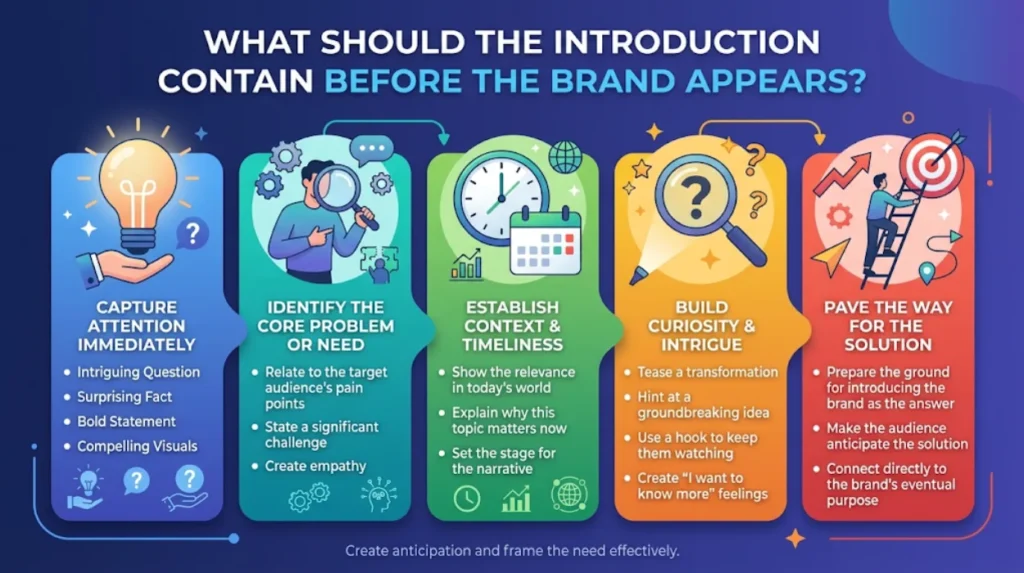
The opening should answer three questions quickly:
- What problem does the reader have?
- What task does the guide explain?
- What will the reader understand after reading it?
For example, a guide about creating a UK media research report can begin by explaining that effective research reports require a defined research question, reliable sources, structured analysis and clear presentation.
The sponsoring company does not need to appear in the first paragraph.
This creates a clear separation between reader need and commercial information.
What information belongs in the opening?
A useful introduction contains:
- The subject definition
- The reader problem
- The process covered
- The intended outcome
- The scope of the guide
Avoid opening with phrases such as our company provides, industry-leading services, or we are pleased to announce.
These phrases shift the article from informational intent to promotional intent before the reader receives value.
What steps should a sponsored how-to guide include?
A sponsored how-to guide needs a sequential process that moves from preparation through execution and review, with each step answering a defined part of the reader’s question before commercial information enters the relevant solution context.
The process depends on the subject, but a clear structure usually contains six stages.
1. Define the objective
Explain what the reader is trying to achieve.
For a media research report, the objective can involve identifying market trends, analysing audience behaviour or producing evidence for editorial decision-making.
2. Identify required information
Specify the sources, data, documents or inputs required to complete the task.
A UK audience research project can require survey data, audience statistics, publication information, search data and relevant industry sources.
3. Explain the core process
Break the task into defined actions.
Each action needs a clear purpose. Each stage needs to connect with the next stage.
4. Explain quality requirements
Identify accuracy, consistency, sourcing, formatting and validation requirements.
This section establishes practical standards without introducing promotional claims.
5. Address common mistakes
Explain where readers lose accuracy or efficiency.
Examples include relying on outdated statistics, using unverified sources, combining incompatible datasets or publishing conclusions without evidence.
6. Connect the process with relevant solutions
Introduce tools, professional support or specialist services only after the reader understands the process.
This is the point where the sponsor becomes contextually relevant.
When should the sponsoring brand be mentioned?
The sponsoring brand should appear after the core reader question has been answered and when its expertise, service or resource directly relates to a defined requirement within the process explained by the guide.
Brand placement depends on relevance rather than a fixed paragraph number.
For example, a sponsored guide explaining how to prepare a rapid-response media report can first cover research requirements, source verification, statistical checking and editorial structure.
The sponsoring media organisation can then be introduced in a section discussing professional research and report production.
The transition remains factual.
Instead of interrupting the process with a product pitch, the article establishes the requirement first. The brand then occupies a clearly defined role within that requirement.
What type of brand information fits naturally?
Relevant information includes:
- The type of service provided
- The research capability involved
- The content format supported
- The audience served
- The publication or distribution function
- The specific stage of the process supported
Unrelated company history has less relevance to a task-focused guide.
The brand section also needs to preserve the original search intent. A reader searching how to structure a sponsored how-to guide expects guidance on structure, not a lengthy company profile.
How should promotional information be separated from instructional content?
Instructional content explains what the reader needs to do, while promotional content explains how the sponsoring organisation supports a defined requirement; keeping these functions separate preserves clarity, relevance and the guide’s original informational purpose.
Use distinct sections when commercial information requires additional detail.
For example:
Instructional section: How to validate research sources
Contextual section: Where professional research support fits
This separation helps readers distinguish between general guidance and information about the sponsor.
It also creates clearer content signals for search engines and AI systems. Definitions, processes, entities and relationships remain explicit.
What promotional elements require careful control?
Control the frequency of:
- Brand mentions
- Product names
- Service descriptions
- Calls to action
- Promotional adjectives
- Repeated company references
A sponsored article does not require repeated brand mentions to establish sponsorship. One clearly relevant introduction can provide the required context.
What components make a sponsored how-to guide useful?
Useful sponsored how-to guides contain a defined question, direct answer, sequential process, supporting evidence, practical examples, quality requirements, relevant solutions and a clearly separated explanation of the sponsoring brand’s role.
The core components include:
Reader question
Defines the information need and controls article relevance.
Direct answer
Provides the central response near the beginning of each major section.
Process
Explains the actions required to complete the task.
Evidence
Supports factual statements with relevant research, statistics or authoritative sources.
Examples
Show how the process applies to real situations.
Common errors
Identify mistakes that reduce quality or effectiveness.
Relevant solution
Connects the reader’s requirement with an appropriate professional resource.
Sponsor context
Explains the sponsoring organisation’s relevant role without replacing the instructional content.
These components create a consistent relationship between search intent, editorial structure and commercial context.
What examples show how the structure works?
A strong sponsored how-to structure places the practical answer before brand information in subjects such as research reports, media distribution, audience analysis, digital communications and industry data interpretation.
Consider a sponsored guide about preparing a UK research report.
The opening defines the purpose of a research report. The next section identifies the research question. Later sections cover source selection, data analysis, evidence checking, report structure and editorial review.
Only after these stages does the article explain how a specialist media organisation supports research and report production.
A second example involves press distribution.
The guide can explain how to identify target publications, prepare a press release, verify media relevance, organise distribution and measure coverage. The sponsor can then be introduced as a provider of distribution or media placement support.
A third example involves audience insights.
The article can explain how to collect reader questions, group recurring themes, identify content gaps and build a topical structure. A relevant audience insights service can then be presented as a solution for organisations requiring professional analysis.
What benefits does this structure provide for readers and brands?
A reader-first structure improves information clarity, while contextual brand placement connects commercial visibility with a demonstrated reader requirement rather than placing promotional information before the article has established its practical value.
For readers, the structure provides:
- Faster access to useful information
- Clearer process explanations
- Defined terminology
- Practical examples
- Better separation between advice and promotion
For sponsoring organisations, the structure creates opportunities to demonstrate relevance through subject expertise.
The commercial connection becomes part of the article’s information architecture. The sponsor appears because the topic creates a logical requirement for its expertise, service or resource.
This approach also supports semantic relevance. Search engines and AI systems can identify the relationship between the reader question, the process, the subject entities and the organisation associated with the solution.
Explore More Expert Insights:
How to Decide the Right Length, Section Count and Depth for a Research Report Aimed at UK Decision-Makers
How to Turn Reader Question Patterns Into a Topical Map That Covers Gaps Your Competitors Have Missed
When is a sponsored how-to guide suitable for a media campaign?
A sponsored how-to guide suits campaigns where the audience has a defined information need, and the sponsoring organisation provides expertise, services or resources directly connected to solving that need.
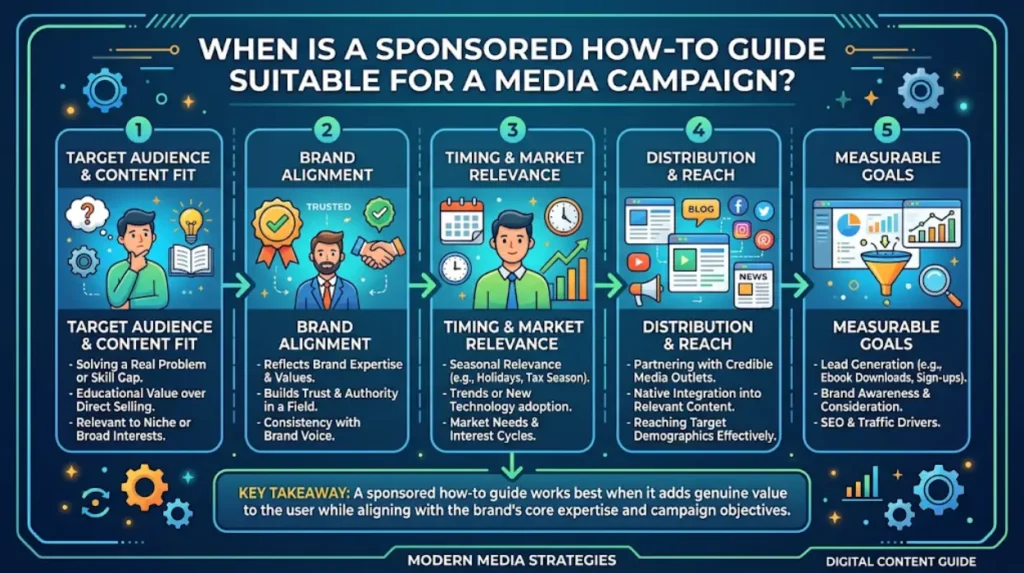
Suitable subjects include professional services, technology, finance, media, research, business operations and specialist industry topics.
The format works particularly well when the audience needs process-based information.
Examples include:
- How to prepare an industry report
- How to plan a UK media campaign
- How to validate research sources
- How to analyse audience questions
- How to structure a corporate communications plan
- How to prepare evidence for a market briefing
The subject needs a clear reader task. The sponsor needs a legitimate relationship with that task.
How can brands develop a sponsored how-to guide without losing reader focus?
Brands can maintain reader focus by defining one question, answering it before promotion, using a sequential process, supporting factual claims with evidence and introducing the sponsor only where its expertise directly addresses an identified requirement.
The production process starts with audience research.
Identify the search question. Define the intended reader. Map the process. Gather evidence. Create the section hierarchy. Write direct answers. Add practical examples. Review the commercial sections separately.
The final review checks whether the article still answers the original question without requiring the reader to consume promotional material first.
For organisations moving from content planning into execution, sponsored content services can provide a route for developing explainer and how-to formats around defined editorial requirements.
A structured sponsored how-to guide therefore connects three elements: reader intent, useful instruction and relevant commercial context. The reader receives the answer first. The sponsoring brand enters when its role becomes relevant to the solution. This structure keeps the content focused while creating a clear relationship between editorial information and sponsored communication.
FAQs
Q1: How should a sponsored how-to guide be structured?
Ans: A sponsored how-to guide should begin with the reader’s question, provide clear steps or practical guidance, and explain the topic before introducing the sponsoring brand. This structure keeps the content useful, informative, and aligned with search intent.
Q2: When should a brand be mentioned in a sponsored how-to guide?
Ans: The brand should be introduced after the guide has answered the reader’s core question and established useful context. A natural brand mention can then connect the solution, service, or expertise to the topic without disrupting the informational flow.
Q3: What makes a sponsored how-to article useful for readers?
Ans: A useful sponsored how-to article provides actionable steps, relevant examples, clear explanations, and answers to the reader’s specific problem. It should prioritise practical information rather than making the article primarily promotional.
Q4: How can sponsored how-to content match search intent?
Ans: Sponsored how-to content should identify the reader’s main question and address it directly through a logical sequence of steps. Using relevant search terms, related questions, and topic-specific explanations helps the article match informational search intent.
Q5: How does Times Intelligence Media Group structure sponsored how-to content?
Ans: Times Intelligence Media Group can structure sponsored how-to content around the reader’s question, followed by practical guidance, supporting details, and a relevant brand connection. The format keeps the main answer clear while allowing the sponsored message to fit naturally within the subject.



