

What is public mobilisation for new foundations?
Public mobilisation is the process of building awareness, participation, support, and action around a foundation’s purpose among people beyond its existing contacts, using multiple communication channels rather than relying on one private audience.
A new foundation needs public visibility to reach people who have no previous relationship with the organisation. Public mobilisation includes awareness, audience discovery, engagement, participation, donations, volunteering, event attendance, advocacy, and community involvement.
Email newsletters provide direct communication with subscribers. They do not automatically create access to people outside the subscriber database.
This distinction matters during the early stages of foundation development. A new foundation often has a small contact list. The organisation therefore communicates repeatedly with the same audience while potential supporters remain outside the communication cycle.
Public mobilisation requires both owned communication and external reach. Owned communication includes email newsletters, websites and subscriber databases. External reach includes journalism, search visibility, social platforms, partnerships, events and other public channels.
For example, a foundation launching a national education campaign can email its existing supporters about the campaign. Public mobilisation begins when the campaign also reaches teachers, parents, journalists, community organisations and potential donors who are not already subscribers.
Why do email newsletters have limited reach for new foundations?
Email newsletters primarily reach people who have already subscribed, provided an email address, or joined an existing database, creating a closed distribution environment that limits discovery among people who have no previous relationship with the foundation.
An email newsletter depends on an established audience. The foundation first needs people to discover its work and then needs those people to subscribe.
This creates a sequential process:
- A person discovers the foundation.
- The person develops sufficient interest.
- The person visits a website or sign-up page.
- The person submits contact information.
- The person receives future newsletters.
- The person decides whether to engage further.
The newsletter therefore performs strongly as a retention and direct communication channel. It performs differently from a discovery channel.
A new foundation faces a structural challenge because its email database starts small. A newsletter sent to 500 subscribers has a defined maximum recipient pool of 500 people for that distribution. Increasing public awareness requires mechanisms that introduce new audiences into the communication system.
Email also competes with other messages inside an individual’s inbox. A subscriber can receive dozens of commercial, professional, organisational and personal emails during the same period.
What is the difference between audience retention and audience discovery?
Audience retention concerns continued communication with people who already know an organisation. Audience discovery concerns reaching people who have not encountered the organisation before.
Newsletters primarily support retention. Public-facing media coverage, search results, social distribution and partnerships support discovery.
Both functions contribute to mobilisation, but they operate at different stages of the audience journey.
How does an email-only communication model restrict audience growth?
An email-only model restricts audience growth because communication remains concentrated within an existing database, while people outside that database receive no direct exposure unless another channel introduces them to the foundation.
The central limitation is audience dependency.
If a foundation has 2,000 subscribers, its newsletter distribution begins with those 2,000 contacts. Subscriber growth depends on attracting additional people through separate discovery mechanisms.
This creates several limitations.
Limited exposure beyond existing contacts
People who have never heard of the foundation do not receive its newsletter. They therefore have no opportunity to evaluate its mission through that channel.
Slow subscriber acquisition
A newsletter does not automatically generate new subscribers. New subscribers require a discovery event, such as a media article, search result, social post, recommendation, event or partnership.
Repeated exposure to the same audience
Regular newsletters repeatedly address an established group. This supports ongoing engagement but does not independently solve the problem of reaching new communities.
Weak public discoverability
Email content generally operates inside private inboxes. Public search engines and journalists do not gain the same discovery opportunity from a private newsletter distribution as they do from publicly accessible content.
For example, a foundation campaigning for improved access to community healthcare can send monthly updates to its 1,500 subscribers. Those emails communicate effectively with the existing audience, but they do not directly introduce the campaign to thousands of people searching for healthcare information or following relevant public-interest reporting.
Explore More Expert Insights:
What Is Audience Overlap Between UK News Titles and Why Does It Matter for Media Planning?
What Is a Rapid-Response Data Report and When Does Reacting to Breaking Industry News Make Sense?
What channels expand the public mobilisation potential of foundations?
Public mobilisation expands when foundations combine direct communication with public discovery channels, including news coverage, search visibility, social media, partnerships, events, community networks and publicly accessible educational content.
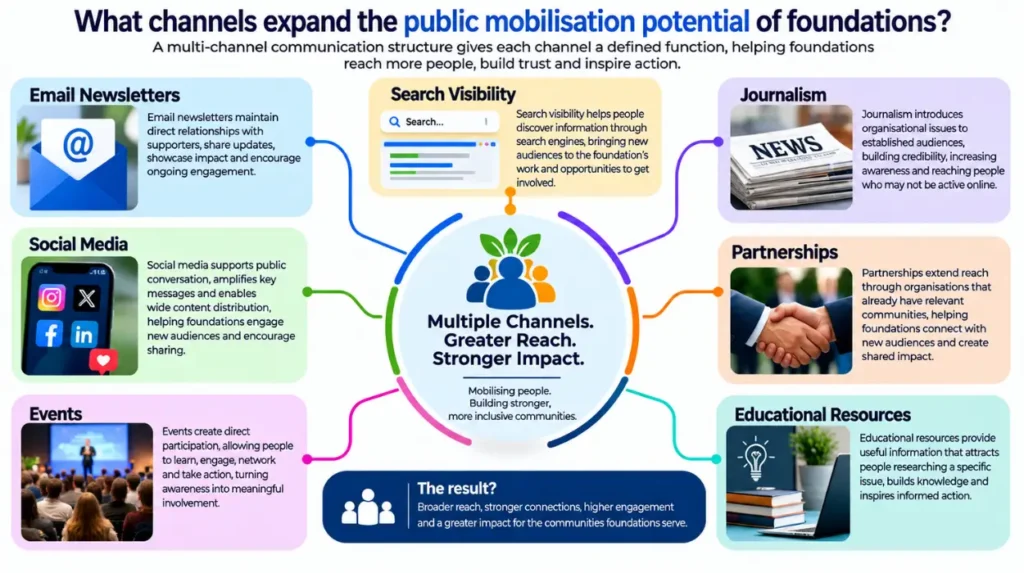
A multi-channel communication structure gives each channel a defined function.
Email newsletters maintain direct relationships. Search visibility helps people discover information through search engines. Journalism introduces organisational issues to established audiences. Social media supports public conversation and content distribution.
Partnerships extend reach through organisations that already have relevant communities. Events create direct participation. Educational resources provide useful information that attracts people researching a specific issue.
Examples include:
- A climate foundation publishing research that receives coverage in environmental media.
- A youth charity partnering with schools and community groups.
- A social-impact organisation publishing a public report that appears in search results.
- A foundation promoting a national campaign through social platforms and local events.
- A health-focused organisation distributing educational resources through professional networks.
The purpose is not to replace email. The purpose is to connect discovery channels with the foundation’s owned audience.
How does press distribution support public awareness?
Press distribution supports public awareness by making verified organisational information available to journalists, publications and wider audiences, creating public discovery opportunities that do not depend on existing newsletter subscribers.
Press distribution refers to the structured dissemination of newsworthy information to media audiences.
For foundations, relevant material includes campaign launches, research findings, funding announcements, community initiatives, policy reports, events and measurable programme outcomes.
A foundation publishing a report on youth employment can distribute information about the findings through appropriate media channels. A journalist covering employment policy can then encounter the organisation through a public information source rather than through its private email list.
Press distribution also creates publicly accessible references to an organisation.
This distinction matters for new foundations because credibility and discoverability develop through repeated exposure across relevant public information environments.
The relationship between audience discovery and direct communication also supports a broader communication sequence. A person can first encounter a foundation through journalism, then visit its website, read its resources, follow its social channels and eventually subscribe to its newsletter.
This makes email one stage within a wider mobilisation system rather than the entire system.
For foundations planning broader national awareness activity, strategic press distribution can form part of the wider communication process alongside owned and community channels.
What role does search visibility play in foundation audience growth?
Search visibility allows people to discover foundation information when they actively search for issues, research, campaigns, organisations or solutions, connecting public-interest content with audiences that have no previous relationship with the foundation.
Search visibility depends on publicly accessible content that search engines can crawl, understand and index.
A foundation can publish research reports, campaign information, educational articles, event information and organisational resources. These assets create opportunities to appear for relevant searches.
For example, a foundation focused on digital inclusion can publish information about internet access, digital skills and technology inequality. People searching for these topics can discover the foundation without receiving an email first.
Search visibility therefore changes the direction of audience acquisition. Instead of requiring an individual to join the database before receiving information, publicly indexed content allows the individual to encounter the organisation first.
This is particularly relevant for new foundations because search demand often exists before organisational awareness.
How can foundations connect newsletters with wider public mobilisation?
Foundations can connect newsletters with wider mobilisation by using public channels to attract new audiences, directing interested people towards useful resources, and then using email to maintain relationships with people who voluntarily subscribe.
The process works as a connected audience journey.
A public article or media report introduces an issue. A reader visits the foundation website. The website provides research, campaign information or educational resources. The visitor then chooses whether to subscribe.
The newsletter becomes a relationship-management channel rather than the primary discovery mechanism.
This structure also creates measurable stages. Foundations can monitor website traffic, newsletter subscriptions, content engagement, event registrations and campaign participation separately.
For example, a foundation can publish a national research report, gain public coverage, attract visitors to a dedicated webpage and invite interested visitors to receive future updates. The newsletter then continues communication with the people who choose to remain connected.
This approach separates reach, engagement and retention into identifiable communication functions.
What should new foundations measure when building public mobilisation?
New foundations should measure audience reach, source of discovery, website engagement, newsletter growth, content interaction, event participation and campaign actions to identify where audiences enter, engage with and continue through the mobilisation process.
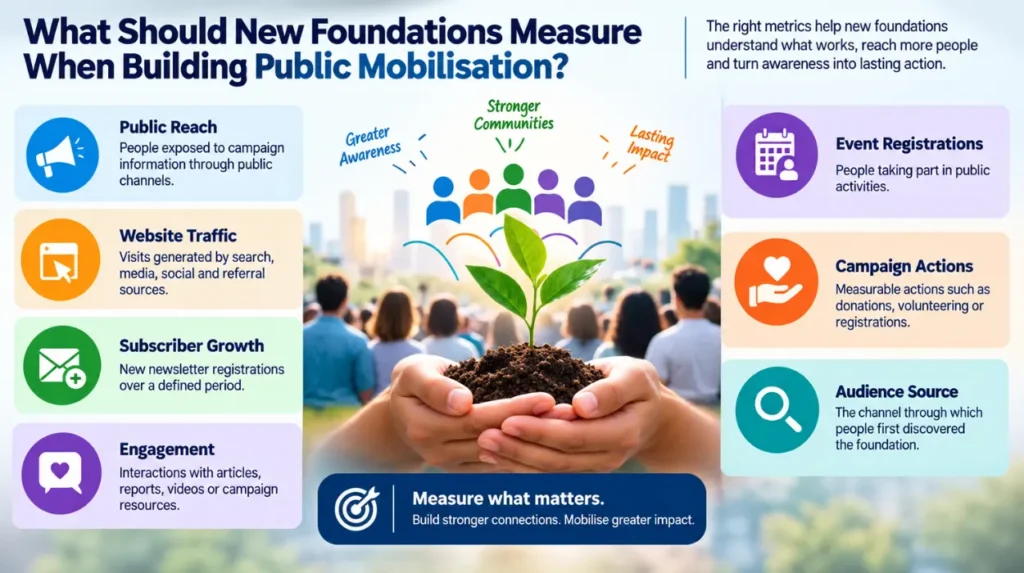
Useful measures include:
- Public reach: people exposed to campaign information through public channels.
- Website traffic: visits generated by search, media, social and referral sources.
- Subscriber growth: new newsletter registrations over a defined period.
- Engagement: interactions with articles, reports, videos or campaign resources.
- Event registrations: people taking part in public activities.
- Campaign actions: measurable actions such as donations, volunteering or registrations.
- Audience source: the channel through which people first discovered the foundation.
Measurement also prevents email performance from becoming the sole indicator of communication effectiveness.
A newsletter open rate describes activity among recipients. It does not measure people who never entered the email database.
A foundation therefore needs channel-level data to understand the complete audience journey.
Why is a multi-channel approach important for new foundations?
A multi-channel approach is important because new foundations need both audience discovery and relationship retention, while email newsletters primarily serve people who already have a connection with the organisation.
Public mobilisation depends on continuous movement between discovery, engagement and retention.
Email newsletters remain useful for direct updates, recurring information and relationship management. They become more effective when new audiences can enter the communication system through public channels.
The central issue is therefore not whether foundations use email newsletters. It is whether newsletters operate as one component within a broader public communication structure.
A new foundation seeking national awareness needs mechanisms that reach people outside its existing database. Public media, search visibility, social distribution, partnerships, events and accessible content provide distinct routes into the organisation.
Once people discover the foundation, email can support continued communication.
This distinction explains why relying purely on email newsletters limits public mobilisation potential. Email starts with an existing audience. Public mobilisation requires continuous audience discovery as well as sustained engagement.
FAQs
Q1: Why is relying only on email newsletters limiting for new foundations?
Ans: Email newsletters mainly reach people who have already subscribed, which limits exposure to new audiences. Public mobilisation usually requires broader channels such as search, social media, journalism, partnerships and events to increase public reach.
Q2: What channels can foundations use beyond email newsletters?
Ans: Foundations can expand public mobilisation through search visibility, social media, media coverage, partnerships, events and accessible online resources. A multi-channel communication strategy helps organisations reach people who are not already on their email lists.
Q3: How can media coverage increase public mobilisation for foundations?
Ans: Media coverage can introduce a foundation’s issues, research or campaigns to established audiences beyond its existing subscribers. News coverage can also generate referral traffic, public awareness and opportunities for further engagement.
Q4: How does search visibility support foundation public mobilisation?
Ans: Search visibility helps people discover a foundation’s campaigns, reports and information when they actively search for related topics. Search traffic can therefore expand public reach beyond audiences already connected through email or social channels.
Q5: How can Times Intelligence Media Group support wider audience reach for foundations?
Ans: Times Intelligence Media Group can be considered as part of a broader media and audience-reach strategy alongside owned channels such as newsletters, websites and social media. The purpose of using additional media channels is to reach relevant audiences beyond an organisation’s existing subscriber base.



