

A rapid-response UK media story converts newly available data into a timely, evidence-based news angle during the active news cycle. It combines verified sources, accurate analysis, clear UK relevance, and fast editorial production without removing essential checks.
A rapid-response media story starts with fresh information. The information can come from a newly published dataset, industry announcement, regulatory update, corporate disclosure, public survey, research release, or official statistic.
The purpose is not simply to publish quickly. The purpose is to connect verified data with an event that journalists and audiences are already following.
For example, a new UK retail dataset showing a measurable change in consumer spending can support a media story when retailers, economists, and business journalists are already reporting on changing household behaviour.
The process requires three conditions:
- The underlying data is recent.
- The data is independently verifiable.
- The resulting story has a clear news connection.
This approach differs from conventional industry reporting because timing becomes part of the editorial value. A report published several weeks after an event serves a different purpose from a data-led story published while the event remains active in the news cycle.
Businesses and research teams that need a broader understanding of this model can first review rapid-response data reports as an educational foundation.
How do you identify fresh data with immediate UK news value?
Fresh data has immediate UK news value when it provides verified evidence about an active issue, changes an established measurement, reveals a new trend, or quantifies an event already receiving attention from UK media and industry audiences.
Data discovery starts with monitoring defined sources. These sources include the Office for National Statistics, government departments, regulators, trade bodies, research organisations, listed companies, universities, and recognised industry datasets.
Freshness alone does not create a media story. A dataset becomes relevant when its findings connect with an identifiable news development.
For example, UK employment data released during an active discussion about recruitment conditions provides a stronger news opportunity than an unrelated historical employment dataset.
Which signals indicate strong news relevance?
Several signals help establish whether fresh data supports a rapid-response story:
- A new official statistic changes a recognised measurement.
- A regulator publishes new enforcement data.
- A company releases material operational figures.
- A research organisation publishes a significant survey.
- A major industry event creates a measurable market response.
- New data confirms or challenges an existing media narrative.
The editorial team then identifies the specific finding that provides the strongest news angle.
A story about consumer confidence, for example, requires a defined measurement, publication date, population, methodology, and comparison period. These details establish whether the finding supports a genuine news claim.
How can you verify fresh data before publication?
Data verification confirms the source, publication date, methodology, sample, measurement definitions, calculations, and supporting evidence before a rapid-response story enters publication. Accuracy depends on checking the dataset rather than relying on secondary reporting.
Verification starts with the primary source. The original dataset, report, filing, research paper, or official release takes priority over summaries published by third parties.
The verification process records the source name, publication date, relevant measurement, geographic scope, population, methodology, and limitations.
A simple verification record can include:
- Source
- Publication date
- Dataset or report title
- Measurement being reported
- Geographic coverage
- Population or sample
- Comparison period
- Calculation method
- Supporting source
- Editorial interpretation
Why does source hierarchy matter?
Primary sources provide the strongest basis for factual claims because they contain the original measurements and methodological information.
Secondary sources remain useful for identifying how a development is being discussed. They do not replace primary evidence.
For example, a news article reporting a 7% increase in a particular UK market does not establish the underlying figure independently. The editorial team needs to locate the dataset or original research that produced the 7% figure.
This distinction becomes critical when publishing during a fast-moving news cycle because early reporting frequently contains incomplete information.
Explore More Expert Insights:
How to Plan Sponsored Content That Consistently Describes Your Brand, Services and Location in Ways Search Engines and Language Models Can Verify
How to Publish Sponsored Content That Follows Google’s Spam Policies on Paid Links, Link Attributes and Scaled Content
What data checks prevent inaccurate rapid-response reporting?
Core data checks include source verification, date validation, geographic scope, sample size, calculation accuracy, comparison periods, unit consistency, statistical definitions, and confirmation that conclusions match the evidence actually provided.
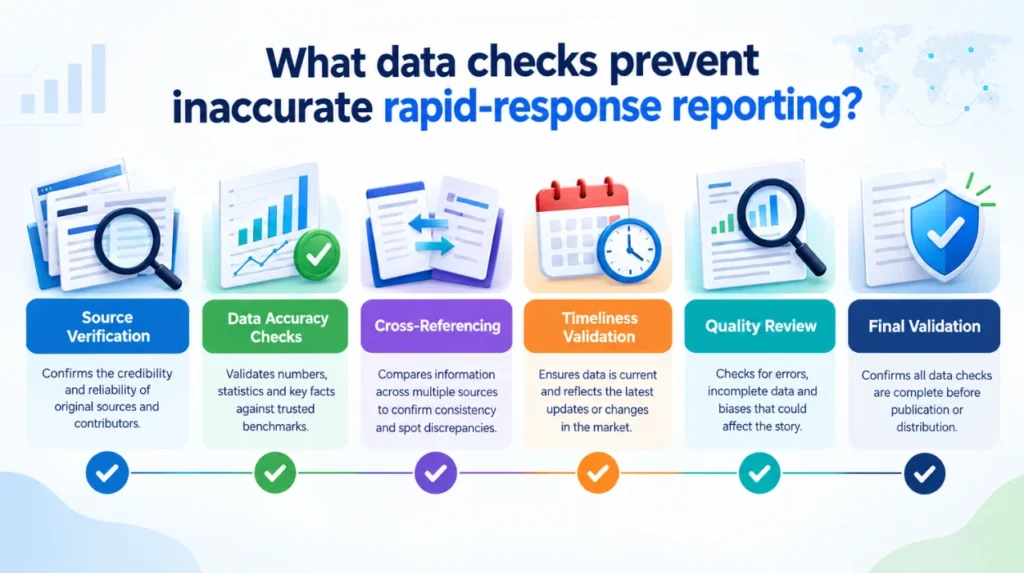
A rapid-response report needs a defined accuracy checklist.
The first check confirms that the data represents the intended UK population or market. The second confirms that the publication date matches the event being covered. The third checks whether the comparison uses the correct period.
Percentage changes require particular attention. A 10% increase can describe different situations depending on whether the comparison is monthly, quarterly, annual, or based on a different baseline.
What should be checked before using a statistic?
A useful editorial check asks:
- What exactly does the number measure?
- Who collected the data?
- When was it collected?
- When was it published?
- Which UK population or market does it cover?
- What is the comparison period?
- Is the figure absolute, percentage-based, indexed, or estimated?
- Does the source explain the methodology?
- Does the headline accurately represent the underlying finding?
These checks reduce errors created by changing definitions or incomplete context.
Accuracy also requires separating the reported measurement from the interpretation. A dataset can demonstrate that sales increased by a defined percentage. It does not automatically establish the single cause of that increase.
How do you turn verified data into a media-ready story?
A media-ready story connects one verified finding with one current news development, explains why the finding matters in the UK, provides supporting evidence, and presents the information in a format journalists can quickly understand and validate.
The editorial process starts by selecting the strongest finding.
A rapid-response story does not need every available statistic. It needs the evidence that directly supports the central news angle.
The opening section establishes the new development. The next section introduces the relevant data. Supporting paragraphs explain the measurement, comparison, source, and UK context.
What structure works for a rapid-response data story?
A clear structure normally contains:
- Current news development
- New data finding
- Source and publication date
- Relevant UK context
- Comparison with previous data
- Supporting evidence
- Practical industry significance
- Methodology or source note
For example, a story about UK housing demand can begin with a new market development, introduce newly released transaction data, identify the change against the previous period, and explain the specific segment affected.
The story remains focused when every section supports the central finding.
How can you preserve accuracy while working inside a short news cycle?
Accuracy remains achievable during a short news cycle when research, verification, calculations, editorial drafting, and source documentation follow a defined sequence instead of occurring simultaneously without controls.
Speed comes from process design rather than removing verification.
A rapid-response workflow can separate research into defined stages. The first stage identifies the event. The second locates fresh data. The third verifies the source. The fourth validates calculations. The fifth develops the news angle. The sixth produces the media-ready article.
This workflow prevents editorial teams from writing conclusions before confirming the evidence.
How should calculations be handled?
Every derived statistic needs a reproducible calculation.
If a dataset reports 55,000 transactions in one period and 50,000 in the previous comparable period, the increase is 5,000 transactions, representing a 10% rise against the previous figure.
The calculation needs to remain consistent throughout the headline, introduction, body copy, and supporting material.
Rounding also requires consistency. If the underlying data supports 10.04%, a headline using 10% needs to maintain that rounding approach throughout the article.
What components should a rapid-response data report contain?
A rapid-response data report contains fresh source material, verified findings, defined methodology, relevant comparisons, UK market context, concise interpretation, supporting evidence, and an editorial structure designed for rapid media consumption and verification.
The most important components work together.
Fresh research
The report uses newly available information connected to an active news development.
Source verification
Every major factual claim links back to an identifiable source.
Data analysis
Raw figures are converted into meaningful measurements such as percentage changes, rankings, totals, averages, or period comparisons.
UK relevance
The report identifies the specific UK market, population, sector, region, or regulatory context affected by the finding.
Editorial framing
The data receives a clear news angle without adding unsupported conclusions.
Supporting evidence
Additional datasets or authoritative sources strengthen the central finding.
Methodology
The report explains where the data came from and how key calculations were produced.
Together, these components create a report that remains useful after the immediate publication window because the evidence and methodology remain identifiable.
What are the benefits of rapid-response data reporting for UK media?
Rapid-response data reporting gives organisations a structured way to respond to active UK news developments with fresh evidence, measurable findings, stronger source transparency, and content prepared for journalists while the topic remains relevant.

The first benefit is timing. Fresh evidence enters the conversation while an issue remains active.
The second benefit is specificity. Data provides measurable information instead of relying entirely on general commentary.
The third benefit is source transparency. Clear documentation allows journalists and other users to verify the underlying evidence.
The fourth benefit is content flexibility. A verified dataset can support a media story, research summary, briefing, chart, press material, or industry analysis.
The fifth benefit is consistency. A defined research process reduces variation between rapid-response reports produced for different events.
When should organisations use rapid-response data reports?
Organisations use rapid-response data reports when a current UK news development creates a clear opportunity for new evidence, measurable analysis, or timely industry context that can be verified and published within the active news cycle.
Common use cases include regulatory announcements, economic releases, consumer behaviour changes, technology developments, corporate announcements, public-sector data releases, and major industry events.
For example, a new UK regulatory measure can create an opportunity to analyse affected business categories using current market data.
A major technology announcement can create a separate opportunity to quantify adoption, investment, employment, or market activity using recent datasets.
Which industries can use this approach?
The model applies across sectors where current data exists.
Examples include:
- Finance and banking
- Retail and consumer markets
- Technology
- Telecommunications
- Healthcare
- Energy
- Professional services
- Manufacturing
- Travel and hospitality
- Human resources
- Real estate
- Media and communications
The data source and verification process differ between sectors, but the core principle remains consistent: identify the current event, locate fresh evidence, verify the evidence, and convert the finding into a clearly sourced UK media story.
How can organisations move from rapid-response reporting to a repeatable media process?
A repeatable rapid-response process combines defined data sources, monitoring rules, verification standards, calculation methods, editorial templates, approval steps, and publication workflows so new UK data can become accurate media content consistently.
The process begins before a breaking news event occurs.
Organisations can define priority sectors, monitored sources, relevant UK datasets, key metrics, editorial thresholds, and verification requirements in advance.
When new information appears, the team already knows which sources to check and which measurements matter.
A structured process also creates a distinction between research and publication. Research establishes what the data demonstrates. Editorial production determines how that evidence is presented to the media.
For organisations evaluating more structured research support, Research and Reports Services can provide a route from fresh information to a documented, media-ready evidence package.
The central requirement remains unchanged throughout the workflow: speed does not replace verification. A rapid-response UK media story becomes useful when fresh data, accurate calculations, transparent sources, and clear news relevance operate within the same editorial process.
FAQs
Q1: How quickly can fresh data be turned into a UK media story?
Ans: Fresh data can be converted into a rapid-response UK media story within the same news cycle when the key findings, sources and editorial angle are identified quickly. A structured data review helps ensure the story remains timely without bypassing essential accuracy checks.
Q2: How do you verify data before publishing a rapid-response media story?
Ans: Data should be checked against the source, methodology, publication date and relevant supporting evidence before publication. Cross-checking calculations, figures and context reduces the risk of inaccurate claims in a fast-moving UK news story.
Q3: What makes a rapid-response UK media story accurate?
Ans: Accuracy depends on verified data, clear attribution, consistent statistics and sufficient context to explain what the findings actually show. Rapid-response media content should distinguish confirmed evidence from interpretation, estimates or emerging information.
Q4: How can businesses respond to breaking news with fresh data?
Ans: Businesses can monitor relevant news developments, identify timely datasets and prepare a concise, evidence-based media angle as events develop. Rapid-response data reporting works best when the information is current, independently verifiable and directly relevant to the news cycle.
Q5: What role does Times Intelligence Media Group play in rapid-response data stories?
Ans: Times Intelligence Media Group can be used as a media-focused resource for developing data-led stories around timely industry developments. A rapid-response approach combines current data analysis, source verification and clear editorial framing to support accurate UK media coverage.



