

Sponsored content becomes more useful for brand entity building when every publication describes the same brand, services, locations, and relationships using consistent factual language. A planned content system creates repeated contextual signals that search systems can interpret and verify.
What is a sponsored content entity strategy?
A sponsored content entity strategy defines how publications repeatedly identify a brand, its services, locations, industry, and relationships using consistent factual descriptions. This structure helps search engines and language models connect related information across multiple independent published sources.
An entity is a clearly identifiable person, organisation, place, product, service, or concept. For businesses, the entity includes attributes such as company name, service category, geographical location, industry, website, leadership, and organisational relationships.
Sponsored content supports this entity structure when articles provide clear information about the same organisation across relevant publications. The objective is not simply to repeat a company name. The objective is to establish consistent relationships between the company and its documented attributes.
For example, a technology consultancy based in Manchester can consistently describe itself as a provider of cloud infrastructure, cybersecurity consulting, and data engineering services. Articles that repeatedly connect the organisation with Manchester, those services, and its technology sector create a clearer contextual pattern.
This approach differs from publishing unrelated promotional articles. Each article has a defined information role and reinforces specific entity relationships.
Provide broader context about sponsored articles and how they contribute to brand attribute association.
How should brands plan consistent descriptions across sponsored articles?
Brands need a controlled description framework covering the official business name, primary category, services, locations, industry, audience, and relevant attributes. Each sponsored article then applies these definitions consistently while addressing a different search or audience context.
Start by creating a factual entity profile. Record the exact business name, primary business category, principal services, operating locations, target markets, and relevant industry terminology.
Next, separate fixed attributes from variable article information.
Fixed attributes remain consistent across publications. These include:
- Official business name
- Primary service category
- Core services
- Main operating location
- Geographic markets
- Industry classification
- Website identity
Variable information changes according to the article. Examples include a specific service application, customer problem, industry development, location-specific topic, or operational use case.
Consider a London-based public relations consultancy. Its fixed description identifies it as a public relations consultancy operating in London and serving organisations with media relations, digital PR, and reputation management services. Individual articles then discuss media outreach, online reputation, journalist engagement, or sector-specific communications.
This creates topical variation without changing the underlying business identity.
Which components need to remain consistent in sponsored content?
The most important components are brand identity, service definitions, location references, industry classification, audience context, and factual relationships. Consistency across these elements reduces ambiguity and creates a structured description of the organisation across external publications.
Brand identity
Use the official business name consistently. Avoid unnecessary variations that create separate-looking references to the same organisation.
For example, a company officially named Northbridge Digital Solutions Limited needs a defined editorial reference such as Northbridge Digital Solutions. Unrelated abbreviations should not alternate between articles without a clear reason.
Service definitions
Define services using stable terminology.
A software company offering artificial intelligence consulting, machine learning development, and data analytics needs these services mapped to clear categories. One article can focus on machine learning development, while another addresses artificial intelligence consulting, but the relationship with the company remains explicit.
Location
Location is an important business attribute. Identify the relevant city, region, country, or operating market according to the actual business structure.
A business operating from Birmingham can use Birmingham as its principal location while separately identifying services delivered across the United Kingdom. These are different attributes and need different wording.
Industry classification
Industry terminology provides additional context. A company can be described through both its primary service and its sector.
For example, a business providing regulatory compliance software can be associated with software development, compliance technology, financial services technology, or enterprise technology when those descriptions accurately reflect its operations.
Audience
Audience context explains who uses the services. Examples include enterprise organisations, financial institutions, retailers, healthcare providers, manufacturers, or professional services firms.
Specific audience references provide additional semantic relationships without changing the core entity description.
How can sponsored content establish consistent brand and location signals?
Location signals become clearer when sponsored articles repeatedly connect the same organisation with verified operating locations, service areas, and geographic contexts. Each location reference needs a factual relationship with the organisation rather than unsupported geographic keyword repetition.
Location information needs structural consistency.
A business with offices in London, Edinburgh, and Manchester can distinguish between office locations and service coverage. An article discussing the London office does not need to imply that every operation occurs there.
Geographic terminology also needs contextual relevance. A London training provider can describe its London operations, United Kingdom delivery, and international training programmes as separate attributes.
Specific examples improve clarity:
- A consultancy headquartered in Leeds and serving clients across the UK
- A training provider operating in London and delivering programmes internationally
- A technology company based in Bristol with software services available across Europe
These descriptions establish relationships between the organisation and geographic entities.
The location does not become meaningful because a city name appears repeatedly. It becomes meaningful because publications explain the relationship between the company and that location.
How should services be connected to the brand entity?
Service relationships become clearer when each sponsored article identifies what the organisation provides, who uses the service, and what business context the service addresses. Repeated service definitions across relevant publications strengthen the connection between services and the organisation.
A service needs more than a keyword mention. It needs a relationship.
For example, an article about cybersecurity consulting can identify the company as the provider, explain the organisations using the service, and describe the relevant cybersecurity functions. Another article can address security assessments while maintaining the same provider relationship.
A structured service framework can include:
- Primary service
- Related service
- Target customer
- Industry application
- Geographic availability
- Business purpose
Suppose a digital marketing agency provides search engine optimisation, content marketing, and paid media management. An article about search engine optimisation can establish the agency as the provider while discussing technical optimisation, content structure, and organic search visibility.
Another article about content marketing can address editorial planning and topical relevance.
The topics differ, but the service-provider relationship remains consistent.
Explore More Expert Insights:
How to Publish Sponsored Content That Follows Google’s Spam Policies on Paid Links, Link Attributes and Scaled Content
How to Refresh a Published Research Report and Preserve the Rankings, Backlinks and Citations It Has Already Earned
How does topical relevance improve sponsored content consistency?
Topical relevance improves consistency when each publication covers a subject directly connected to the brand, its services, industry, customers, or geographic market. Relevant topics create contextual relationships without forcing identical wording into every article.

A planned publication portfolio uses different topics to cover related semantic areas.
For example, a business technology provider can publish content covering cloud migration, infrastructure management, cybersecurity, data governance, and enterprise software. These subjects share an established technology context.
Topic planning also prevents disconnected content. A cybersecurity consultancy publishing articles about unrelated consumer fashion topics creates little useful contextual association with its core business entity.
Each article needs a defined relationship with an existing entity attribute.
A useful content map can connect:
Brand → Industry → Service → Application → Audience → Location
For example:
Technology consultancy → cybersecurity → security assessment → enterprise systems → financial organisations → London
This structure gives each article a specific contextual role.
How can brands maintain factual consistency across multiple publishers?
Brands maintain factual consistency through an approved entity reference sheet containing exact names, service definitions, locations, industry terms, and organisational facts. Editorial teams use this reference before publication to prevent contradictory or fragmented descriptions.
External publications introduce a consistency challenge because different writers can describe the same organisation differently.
A central reference document reduces this problem. It can contain the official business name, approved short name, primary category, service descriptions, office locations, service areas, industry terminology, and factual company information.
For example, the reference sheet can define:
- Business name: Northbridge Digital Solutions
- Category: Digital technology consultancy
- Primary location: Manchester
- Services: Cloud infrastructure, cybersecurity consulting, data engineering
- Market: United Kingdom
- Audience: Medium and large organisations
An article can then discuss cloud infrastructure without incorrectly describing the organisation as a software manufacturer.
The reference document also helps identify outdated information. Business names, office locations, services, and market coverage can change. Content governance needs a defined review process.
What benefits does structured sponsored content provide for search and AI systems?
Structured sponsored content provides repeated factual context that helps systems distinguish an organisation, understand its attributes, connect services with the provider, and interpret geographic relationships across published sources without relying on a single webpage.
Search engines process information from webpages, links, structured data, and other signals to understand entities and relationships.
Language models also process relationships between concepts and textual descriptions. Clear factual language gives these systems explicit information about what an organisation is, what it provides, and where it operates.
The benefit comes from consistency and contextual coverage rather than simple publication volume.
For example, ten articles using inconsistent company descriptions provide less coherent information than ten relevant articles consistently identifying the organisation, its services, industry, and locations.
Structured sponsored content also supports discoverability across different user questions. A person can search for a service, location, industry application, or combination of attributes.
Relevant content then provides contextual evidence connecting those concepts.
When should businesses use a planned sponsored content framework?
A planned sponsored content framework is useful when a business needs consistent external descriptions across multiple publications, services, markets, or locations. It provides editorial control for organisations managing ongoing digital PR, reputation, visibility, and entity-focused content programmes.
The framework is particularly relevant for businesses with several services or locations.
A multinational consultancy, for example, needs to distinguish its global organisation from individual regional offices. A training provider with multiple subject areas needs consistent connections between its organisation, training categories, delivery locations, and professional audiences.
The same principle applies during business expansion.
When a company introduces a new service, the content strategy can establish the service as part of the existing entity rather than treating it as an isolated topic.
When entering a new location, publications can establish the geographic relationship using factual information about operations, delivery, or market coverage.
The process therefore becomes an information-management system as well as an editorial process.
How can businesses evaluate sponsored content consistency?
Businesses can evaluate consistency by auditing brand names, service descriptions, locations, industry terminology, entity relationships, publication relevance, and factual accuracy across published articles. The audit identifies contradictions, missing attributes, outdated information, and inconsistent terminology.
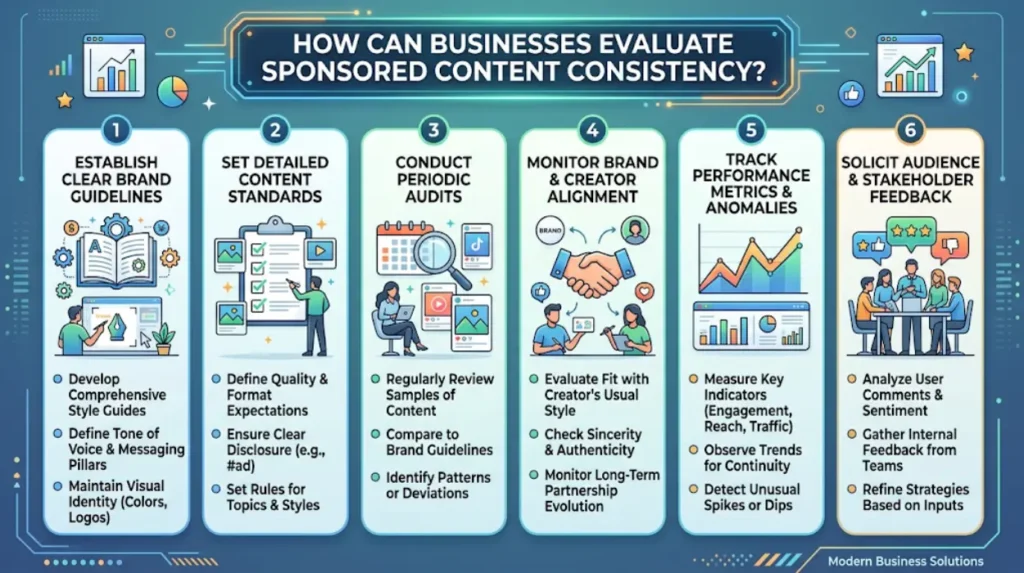
A practical audit can review 20, 50, or 100 published articles depending on publication volume.
Track each article against defined attributes:
| Attribute | Audit question |
|---|---|
| Brand | Is the organisation identified consistently? |
| Service | Is the service relationship accurate? |
| Location | Is the geographic relationship factual? |
| Industry | Is the sector description relevant? |
| Audience | Is the target audience clearly identified? |
| Context | Does the article support an established entity relationship? |
| Accuracy | Does the article contain current information? |
The audit also needs to identify missing relationships.
For example, 30 articles can consistently mention a company’s name but provide little information about its primary services. Another 30 articles can discuss its services but omit the company’s operating location.
The result is incomplete entity coverage.
A structured audit reveals these gaps and provides a basis for future editorial planning.
What is the complete process for planning entity-focused sponsored content?
The process involves defining the entity, mapping its attributes, creating consistent terminology, assigning topics to attributes, selecting relevant publications, reviewing factual accuracy, and auditing published content. Each stage supports a coherent external description of the organisation.
A practical process contains seven stages:
1. Define the business entity
Record the official name, business category, industry, locations, services, and audience.
2. Map entity attributes
Separate fixed business facts from article-specific topics.
3. Create terminology standards
Define approved descriptions for services, locations, industries, and organisational names.
4. Build a topic map
Connect editorial subjects to specific entity attributes and relationships.
5. Plan publication distribution
Select relevant publications based on audience, industry, geography, and subject relevance.
6. Review every article
Check names, services, locations, factual claims, and entity relationships before publication.
7. Audit the published ecosystem
Review content regularly to identify contradictions, missing attributes, outdated facts, and opportunities for stronger contextual coverage.
This process keeps sponsored content focused on information consistency rather than isolated promotional mentions.
For businesses evaluating implementation options, this provides a more specific view of sponsored content services and entity-building programmes.
Why does consistency matter when building a verifiable brand identity?
Consistency matters because search engines and language models need clear relationships between entities and attributes. A stable description across relevant publications provides a stronger information structure for identifying the organisation, its services, locations, industry, and audience.
Sponsored content works as part of a broader digital information environment. A business website, third-party publications, directories, industry sources, social profiles, and other digital references can describe the same organisation.
The strongest content framework keeps core facts aligned across these sources.
The goal is not identical articles. Repetition of identical articles creates limited contextual depth. The goal is consistent entity relationships expressed through different relevant subjects.
A London-based financial technology company can therefore publish articles about payment infrastructure, financial data security, regulatory technology, and digital banking while maintaining the same core business identity.
Each article adds a distinct contextual relationship.
A planned approach gives businesses a method for managing those relationships systematically. It connects brand identity with services, locations, industries, audiences, and topics while maintaining factual consistency across the sponsored content ecosystem.
FAQs
Q1: How does sponsored content help search engines verify a brand’s location?
Ans: Sponsored content can consistently mention a brand’s official location, service area, and relevant geographic terms in clear context. Repeated, accurate location signals can help search engines connect the business with the places it serves.
Q2: What information should sponsored content include to describe a brand accurately?
Ans: Sponsored content should clearly identify the brand, services, industry, location, target audience, and key areas of expertise. Consistent descriptions across published articles can provide clearer entity and topical signals for search engines and language models.
Q3: How can sponsored articles improve brand entity recognition?
Ans: Sponsored articles can strengthen brand entity recognition by using consistent business names, service descriptions, locations, and relevant industry terminology. When these details appear in credible and contextually relevant content, they provide additional information that AI systems and search engines can interpret.
Q4: Why is consistency important when creating sponsored content for SEO?
Ans: Consistent brand descriptions reduce conflicting signals about a company’s services, location, and industry focus. Using the same core facts while adapting each article to its topic can support clearer semantic understanding and search visibility.
Q5: Can language models use sponsored content to understand a brand’s services and location?
Ans: Language models can use publicly available sponsored content as one source of contextual information about a brand, its services, and geographic presence. Clear, factual, and consistently presented information makes those attributes easier for AI systems to interpret and potentially reference.



