
A rapid-response data report is an immediate analytical document published within hours of a major industry event, combining fresh statistical metrics and structured context to explain breaking news developments to media outlets and professional audiences.
What Is a Rapid-Response Data Report?
A rapid-response data report is a structured research document compiled within two to twelve hours of a breaking market event, utilizing freshly aggregated datasets, proprietary survey panels, and immediate econometric analysis to quantify the exact economic and operational impact on specific business sectors.
Defining the Core Components
A rapid-response data report requires specific foundational elements to maintain analytical credibility. These components include raw telemetry feeds, verified transaction records, structured sample frames exceeding 1,000 respondents, and comparative historical baselines. Analysts deploy automated scraping tools and pre-vetted panel networks to ingest metrics instantly. This infrastructure ensures the output meets rigorous academic and journalistic publication standards.
The Evolution of Fast-Turnaround Analytics
Traditional research cycles span three to six months from conception to publication. The digital news ecosystem compresses this timeline into minutes. Modern business intelligence platforms ingest live market signals, consumer sentiment shifts, and supply chain updates continuously. Researchers extract specific slices of this data immediately following major regulatory announcements, macroeconomic data releases, or corporate mergers to satisfy urgent media and stakeholder demands for quantitative clarity.
Why Do Media Outlets Rely on Fast Data During Breaking News?
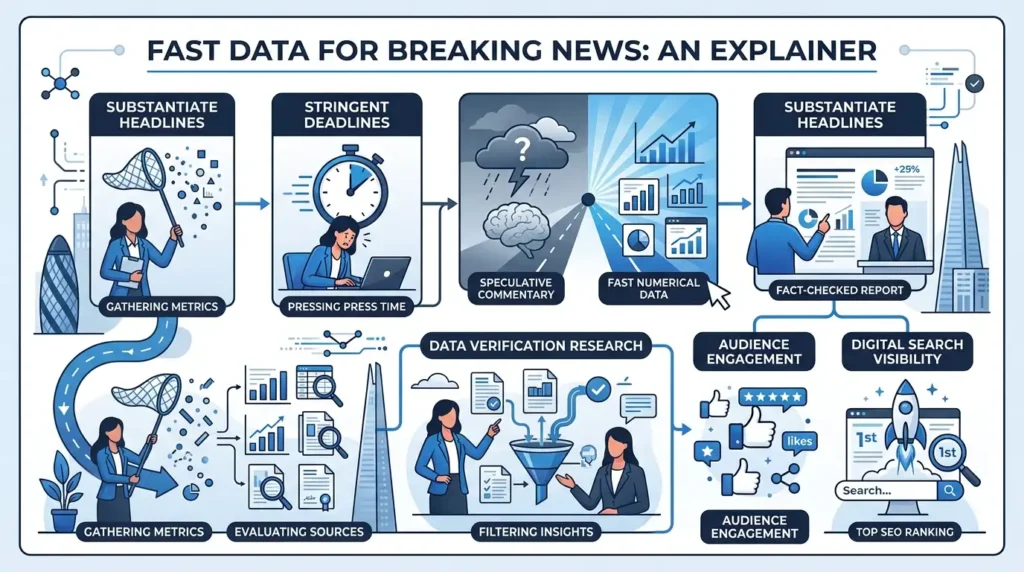
Media outlets rely on fast data during breaking news because journalists face stringent deadlines to substantiate headlines with hard numerical evidence, replacing speculative commentary with verifiable statistical metrics that drive audience engagement and digital search visibility.
Meeting the Twenty-Four-Hour News Cycle
Journalists operate inside compressed twenty-four-hour news cycles across digital and broadcast platforms. When a major policy shift or market crash occurs, newsrooms require immediate verification. Rapid-response data reports provide journalists with precise percentages, financial losses, and affected demographic totals. These concrete data points transform a developing story from an unverified rumor into an evidence-based report that captures search traffic and maintains editorial integrity.
Eliminating Speculation Through Verified Metrics
Unverified commentary introduces factual errors and legal liabilities for publishers. Fast-turnaround datasets mitigate this risk by supplying empirical grounding. When a central bank alters interest rates or a major trade restriction takes effect, quantitative reports deliver instant clarity on historical precedents and projected market contractions. This empirical approach prevents media organizations from publishing speculative claims and anchors their coverage in rigorous statistical reality.
Explore More Expert Insights:
How Online Retailers Recover Abandoned Carts Using Banner Advertising
How E-commerce Stores Boost Sales Using Retargeting Banner Ads
When Does Reacting to Breaking Industry News Make Sense for Organizations?
Reacting to breaking industry news makes strategic sense for an organization only when the breaking event directly impacts its core operational sector, proprietary data assets already exist to quantify the change, and executive leadership can approve publication within a four-hour window.
Assessing Operational Relevancy
Organizations must evaluate whether a breaking news event genuinely alters their operating environment before allocating analytical resources. Minor market fluctuations or irrelevant global events do not warrant a rapid-response report. Reaction makes sense when regulatory bodies enact sudden compliance mandates, major competitors experience catastrophic supply chain failures, or national legislation alters tax structures. If the event alters profit margins, consumer demand, or legal obligations across an entire industry, immediate publication is justified.
Evaluating Data Readiness and Resource Constraints
Executing a rapid-response data initiative requires pre-existing infrastructure. Organizations cannot initiate survey design or database architecture after news breaks. Successful response relies on standing panels, pre-cleaned historical databases, and automated analytical scripts. If an analytics team requires two weeks to clean datasets or secure compliance approvals, the news cycle closes before publication. Organizations must possess immediate data access and pre-authorized sign-off workflows to participate effectively in real-time media cycles.
What Is the Step-by-Step Process for Producing a Rapid-Response Report?
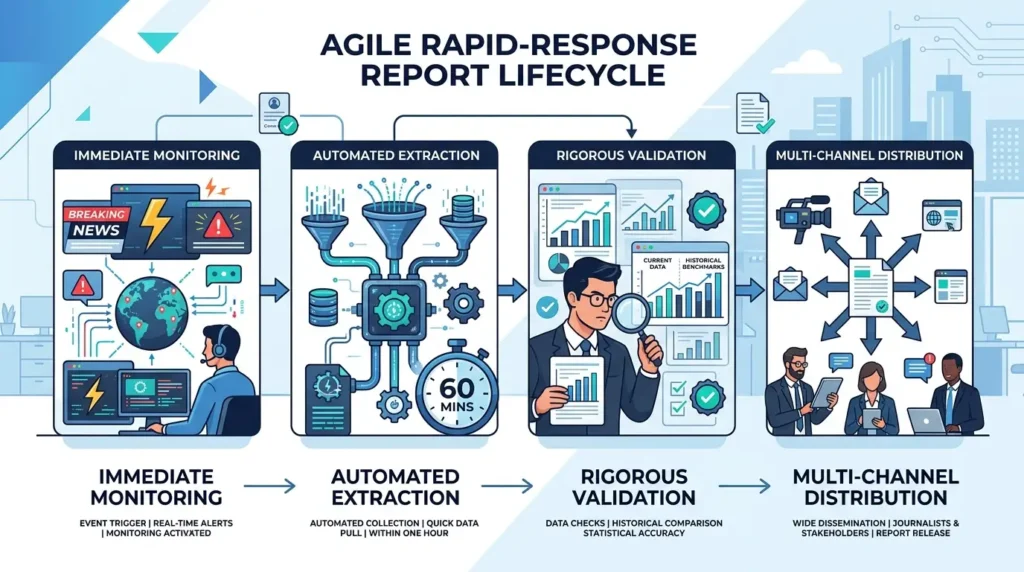
Producing a rapid-response report involves four sequential phases: immediate event monitoring, automated data extraction within sixty minutes, rigorous statistical validation against historical benchmarks, and multi-channel distribution to journalists and industry stakeholders.
Phase One: Ingestion and Filtering
The production pipeline begins with automated monitoring tools tracking regulatory filings, wire services, and social media sentiment spikes. When a threshold-crossing event occurs, research leads convene an immediate briefing. They define the specific research questions that media outlets and industry professionals will ask within the hour. This phase eliminates scope creep and focuses analytical resources exclusively on high-impact variables.
Phase Two: Aggregation and Validation
Data analysts extract relevant subsets from active consumer panels, transaction databases, or regulatory registries. Analysts run automated validation scripts to detect anomalies, missing values, and sample skews. Once the dataset passes basic integrity checks, econometricians apply weighting algorithms to match national census or industry benchmarks. This entire validation process occurs within a strict ninety-minute window to preserve the freshness of the news cycle.
How Does Speed Impact the Trade-Off Between Accuracy and Relevance?
Speed impacts the trade-off between accuracy and relevance by forcing researchers to accept localized sample margins and preliminary trends in exchange for immediate market visibility, requiring explicit methodological disclosures to maintain long-term institutional credibility.
Managing Margin of Error Under Pressure
Rapid-response reporting inherently involves wider confidence intervals than multi-month academic studies. Analysts working under a four-hour deadline must transparently communicate sample limitations, preliminary weighting models, and potential confidence variances. Professional research teams include explicit methodological disclaimers within executive summaries. These disclaimers state sample sizes, data collection timestamps, and margin of error calculations, protecting the publisher from accusations of statistical manipulation or sensationalism.
Preserving Institutional Credibility in Fast-Paced Markets
Publishing incorrect data during a breaking news event inflicts permanent damage on an organization’s reputation. To balance speed with accuracy, top-tier research institutions implement two-tier verification protocols. While a junior analyst cleans the data, a senior statistician reviews the code and methodology simultaneously. This parallel processing cuts production time in half while preserving the mandatory quality control gates required for high-stakes media citations.
Rapid-response data reports bridge the gap between breaking news events and evidence-based journalism by delivering verified statistical metrics within hours of a market shift. Organizations utilize these documents to capture media visibility, educate stakeholders, and replace speculation with empirical reality. Success in rapid-response publishing demands pre-existing data infrastructure, rigorous validation protocols, and strict adherence to editorial timelines without compromising methodological transparency.