
Regional UK newsrooms prefer local angles on national research data because geographical proximity increases audience engagement, drives higher digital subscription conversions, and fulfills local accountability mandates for communities across England, Scotland, Wales, and Northern Ireland.
National datasets often obscure specific regional impacts. Regional publishers such as Reach plc, Newsquest, and National World operate hundreds of distinct titles that serve hyper-local audiences. When a national research report publishes macroeconomic figures, health outcomes, or transport statistics, readers in specific towns demand direct relevance to their municipal boundaries.
Editors evaluate national research datasets through a geographical filter. A dataset reporting nationwide NHS waiting list increases provides broad context, but regional newsrooms require data disaggregated down to local health boards or hospital trusts. This operational priority transforms abstract statistics into immediate community concerns.
The Role of Geographic Proximity in Regional Readership
Geographic proximity dictates news value across local journalism. Readers engage more deeply with content that affects their immediate surroundings, property values, and public services.
Regional publications track metrics showing that stories featuring local postcodes generate higher click-through rates and longer dwell times. Consequently, newsrooms prioritize data that illustrates how national phenomena manifest in specific counties, cities, and parliamentary constituencies.
Regulatory and Audience Expectations for Local Accountability
Local media organisations maintain a public service remit to scrutinize local authorities and regional service providers. National datasets supply the baseline evidence required to hold regional actors accountable.
When national research highlights systemic failures in education or policing, regional journalists extract local figures to question regional police and crime commissioners or local education authorities directly.
How do regional journalists extract local data from national datasets?
Regional journalists extract local data from national datasets by requesting raw comma-separated values files, utilizing freedom of information requests for granular breakdowns, and filtering national spreadsheets by regional identifiers such as local authority codes and postcodes.

The extraction process begins when a national body—such as the Office for National Statistics, NHS England, or a major academic institution—releases a comprehensive research report. National summaries typically highlight headline figures for England or the entire United Kingdom. Regional reporters bypass these national aggregates to locate appendix tables, supplementary data sheets, and regional sub-samples.
Journalists rely on specific software tools to clean, sort, and analyze large volumes of data. They load massive datasets into spreadsheet applications or data analysis programming languages to isolate specific geographic tiers.
National Dataset Release
  -> Access Raw Data Tables
  -> Filter by Regional Codes (ONS/Postcode)
  -> Cross-Reference Local Population Baselines
  -> Calculate Regional Rates and Disparities
Utilizing Standardized Geographic Identifiers
Data analysts and reporters rely on standardized codes to ensure accurate regional extraction. The Office for National Statistics uses Local Authority District codes, standard statistical geography hierarchies, and Parliamentary Constituency codes.
By matching these codes within national datasets, reporters isolate exact figures for specific councils, such as Birmingham City Council or Cornwall Council, avoiding inaccurate generalisations.
Normalising Raw Numbers Against Local Population Baselines
Raw figures alone rarely tell an accurate story because population sizes vary drastically across UK regions. Regional journalists convert raw counts into rates per 100,000 residents or percentage changes over specific time periods.
This mathematical standardisation enables fair comparisons between densely populated urban centers like Greater Manchester and rural counties like Cumbria.
Explore More Expert Insights:
How Online Retailers Recover Abandoned Carts Using Banner Advertising
How E-commerce Stores Boost Sales Using Retargeting Banner Ads
What components define a successful local angle on a national study?
A successful local angle on a national study requires a specific regional data outlier, a direct quote from a local stakeholder, a comparison against national averages, and a clear explanation of municipal impact.
Content structure within regional news articles demands specific narrative elements. Without a clear local hook, national research fails to resonate with regional subscribers. Newsrooms enforce strict editorial criteria before committing resources to investigate a national dataset.
The core components ensure the story serves the specific readership of the regional publication without losing the broader context of the national research methodology.
1. The Regional Outlier
The primary component is an identifiable data point where the local region deviates significantly from the national average. If national research indicates a 5% rise in retail vacancies, but a specific town records a 22% increase, that disparity forms the centerpiece of the local story.
2. Stakeholder Validation
Regional newsrooms require local voices to validate the data findings. Reporters contact local council leaders, regional business directors, NHS trust chief executives, or university researchers to secure local reactions. This contextualizes the numbers through human experiences within the community.
3. Clear Comparative Metrics
Readers must understand how their area performs relative to neighboring regions and the national baseline. Tables and bulleted breakdowns frequently display these comparisons to provide immediate visual clarity.
Why does localizing national research improve audience engagement and trust?
Localising national research improves audience engagement and trust by directly connecting macro-level economic and social trends to the daily lives of regional readers, thereby establishing the news outlet as an indispensable community resource.
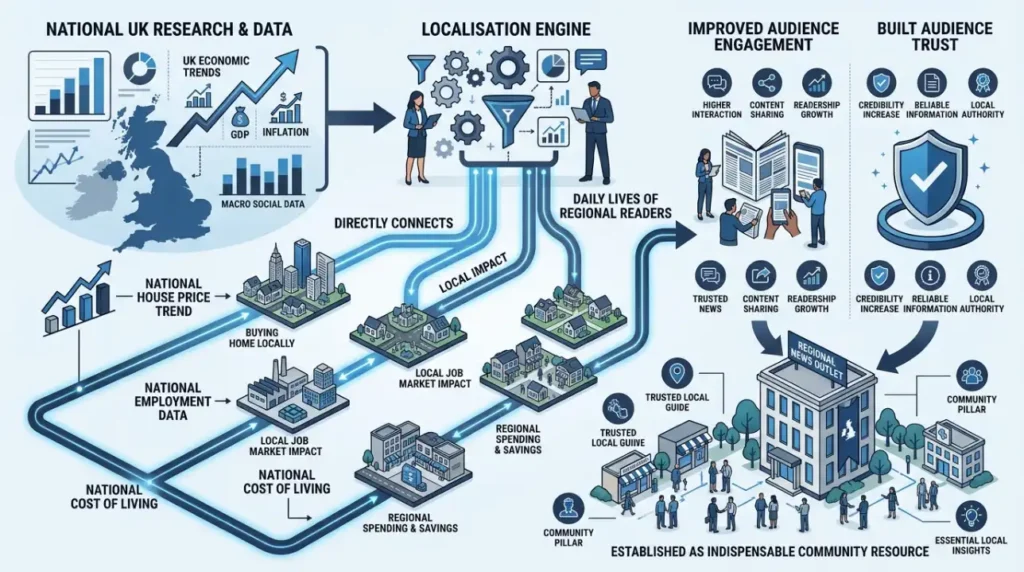
Trust in media correlates directly with perceived relevance and accuracy. When a regional news title translates complex national research into clear, localized insights, readers recognise the tangible value of the publication. This connection drives digital subscriptions, community tips, and sustained readership loyalty.
Furthermore, hyper-local reporting counters the perceived detachment of national broadcasting and London-centric media outlets. Communities frequently express frustration that national media overlooks regional realities. Local newsrooms fill this gap by demonstrating how national policies alter local infrastructure, healthcare access, and job markets.
Combating Information Fatigue Through Hyper-Local Relevance
Audiences experience information fatigue when exposed to continuous streams of broad national statistics. National reports detailing macroeconomic inflation or nationwide NHS backlogs often feel distant to an individual living in a specific Welsh valley or East Anglian town.
Translating those figures into local impacts breaks through the noise by addressing immediate personal concerns.
Strengthening Regional Media Commercial Sustainability
Higher engagement metrics directly support the commercial viability of regional publishing groups. Engaged readers are more likely to convert into paid digital subscribers, register for newsletters, and interact with targeted regional advertising.
Data-driven local journalism provides a clear competitive advantage over generic aggregated news feeds.
What are the primary use cases of regionalised national research in UK media?
The primary use cases of regionalised national research in UK media include housing affordability tracking, public health outcome comparisons, crime rate analysis, and regional economic performance assessments.
UK regional newsrooms apply local data extraction methodologies across multiple distinct journalistic beats. Each sector relies on specific national data providers to generate localized investigations that drive public discourse and policy debates.
Housing and Property Market Analysis
National housing reports from providers like the Land Registry or Halifax supply comprehensive property price data. Regional newsrooms extract these figures to publish hyper-local property market trackers.
These reports detail average house prices, price growth percentages, and affordability ratios down to individual postal districts, assisting local buyers and renters.
Public Health and NHS Performance Tracking
Health journalism relies heavily on data published by NHS England and the Office for National Statistics. Regional titles isolate accident and emergency waiting times, GP-to-patient ratios, and elective surgery backlogs for specific local hospital trusts.
This enables communities to monitor regional health service delivery against national standards.