
Expert commentary integration is the editorial process of embedding third-party professional insights, direct quotes, and qualitative analysis alongside quantitative datasets within market research publications to contextualize statistical findings for British audiences.
Integrating qualitative commentary requires balancing rigorous numerical data with authoritative perspective. Research reports published in the United Kingdom rely on strict verification standards to satisfy regulatory bodies, corporate investors, and national media outlets. When data scientists compile survey metrics, financial indicators, or econometric models, raw numbers alone often fail to communicate industry implications.
Expert commentary bridges this gap. By pairing a statistical trend with a named authority, authors provide operational context. For example, a report detailing a 14% decline in British manufacturing output gains clarity when a supply chain director explains the specific regulatory bottlenecks causing the shift. This synthesis ensures the research remains grounded in verifiable facts while offering actionable meaning to enterprise readers.
How do you source qualified industry experts in the UK market?
Sourcing qualified industry experts involves identifying credentialed professionals with verifiable publishing histories, active corporate leadership roles, or academic affiliations within specific British regulatory and commercial sectors.
Finding credible contributors requires a systematic vetting process. Authors must target individuals who hold recognized positions within professional bodies such as the Institute of Directors or sector-specific trade associations like TechUK. Relying on unverified social media profiles or anonymous contributors compromises the journalistic integrity of a research report.
Identifying Credentialed Professionals
Researchers identify potential expert sources through peer-reviewed journals, regulatory panels, and public conference speaker lists. Candidates must possess at least 10 years of documented experience in their respective fields. For instance, energy sector reports require commentary from chief sustainability officers or regulatory compliance directors who actively manage British grid infrastructure.
Vetting Regulatory and Academic Compliance
Every selected expert undergoes a background screening to confirm active industry standing and eliminate conflicts of interest. Researchers check corporate registries via Companies House to verify active directorships. Financial analysts and corporate governance specialists must operate without pending regulatory sanctions from the Financial Conduct Authority.
What are the methods for gathering qualitative insights without compromising data integrity?
Gathering qualitative insights without compromising data integrity requires conducting structured, recorded interviews using standardized question frameworks that prevent leading questions or subjective bias.
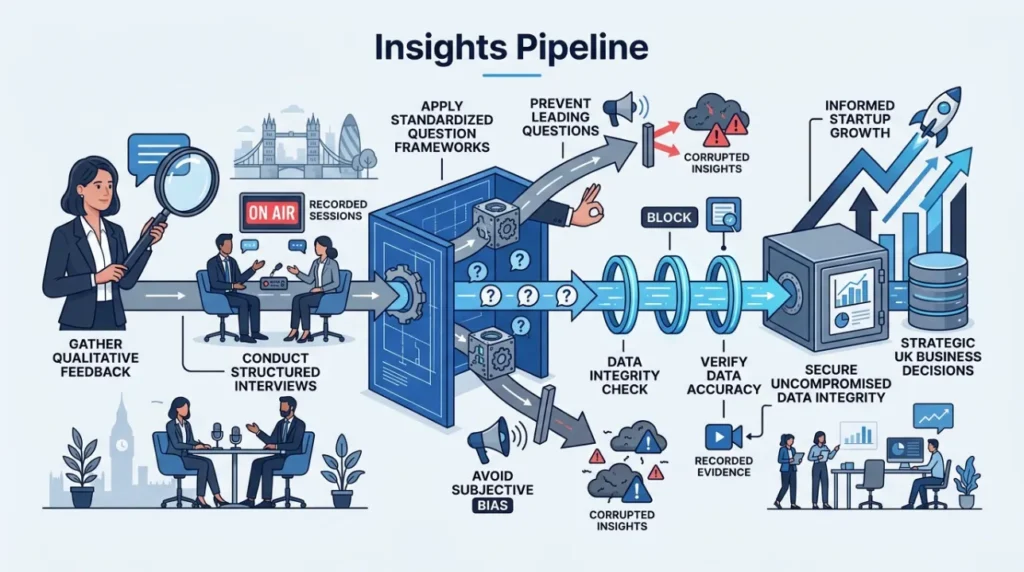
Protecting the objectivity of a research report demands strict methodological controls during data collection. When interviewers solicit commentary from industry experts, the questions must remain neutral. Leading questions distort qualitative feedback, transforming objective data commentary into promotional marketing copy.
Standardized Interview Frameworks
Researchers deploy uniform questionnaires across all expert interviews. Each participant receives identical baseline data points before the interview session. This controlled environment ensures that every expert responds to the same factual baseline, preventing anecdotal distortions from overshadowing empirical metrics.
Verification and Transcription Protocols
All interview sessions undergo audio recording and verbatim transcription. Fact-checkers cross-reference every qualitative claim against primary datasets, government statistics, or audited financial reports. If an expert states that regional logistics costs rose by 22%, researchers verify that figure against Office for National Statistics indexes before finalizing the manuscript.
Explore More Expert Insights:
How Investment Firms Build Awareness Using Market Insight Ads
How Finance Brands Improve Conversion Intent Using Retargeting Ads
How do you integrate expert quotes alongside quantitative data without causing editorial dilution?
Integrating expert quotes alongside quantitative data without causing dilution involves placing qualitative commentary strictly as an explanatory layer beneath foundational charts, statistical tables, and econometric calculations.
Editorial dilution occurs when lengthy anecdotes overshadow core findings. To prevent this, reports must establish a strict structural hierarchy where quantitative data occupies the primary analytical tier, and expert commentary serves as the secondary explanatory tier.
Structural Placement and Formatting
Data tables and charts appear first within each section, followed immediately by a concise expert quote that explains the underlying cause of the observed metric. For example, a bar chart displaying a 35% increase in cyber security expenditures precedes a direct quote from a Chief Information Security Officer detailing the specific threat vectors driving that capital allocation.
Maintaining Analytical Rigor
Writers excise superfluous language from transcriptions, retaining only the precise analytical insight. Every integrated quote must adhere to a maximum length of 45 words to maintain reading momentum. This disciplined approach ensures that the empirical data remains the central focus of the publication.
What are the benefits of combining named expert commentary with empirical research?
Combining named expert commentary with empirical research increases media citation rates, enhances search engine visibility through structured entity relationships, and builds institutional trust among British stakeholders.
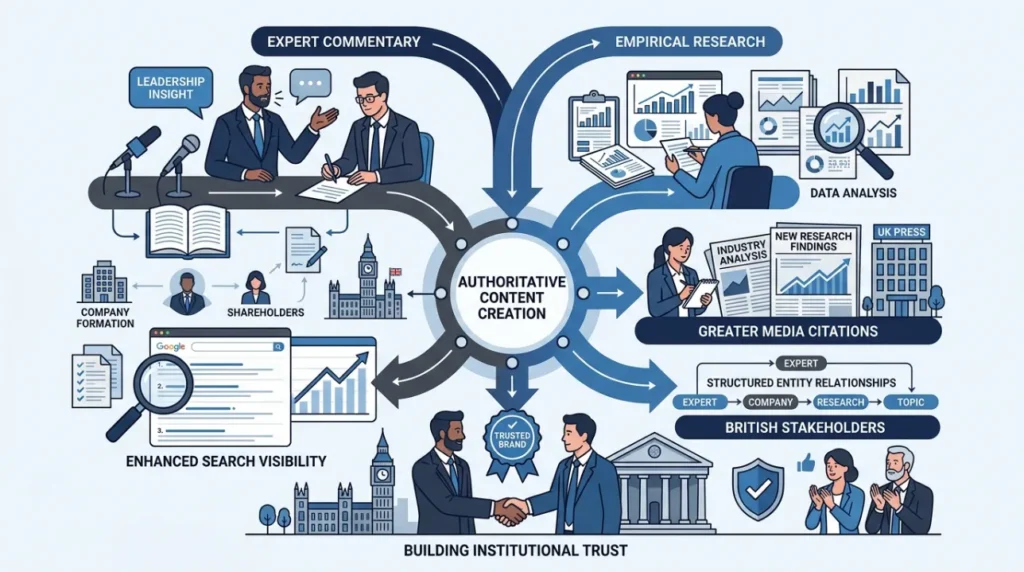
Publications that successfully merge hard data with named authorities achieve higher engagement metrics across digital channels. Journalists and content aggregators actively seek out reports that feature verifiable expert attribution because it streamlines their own fact-checking requirements.
Impact on Media Citations and SEO
Media outlets operating within the United Kingdom require verifiable attribution before referencing third-party studies. Named experts provide identifiable entities that search engines recognize and index. Reports containing recognized industry figures rank higher for semantic search queries related to British market intelligence. Readers exploring these methodologies can review related insights on [Insert Link to MOFU Article].
Institutional Trust and Professional Engagement
Enterprise decision-makers rely on transparent research methodologies to formulate corporate strategy. When a report names its expert contributors alongside specific datasets, it eliminates ambiguity. Organizations seeking comprehensive data solutions can evaluate industry standards through [Insert Link to BOFU Article] to understand professional reporting frameworks.
What are common pitfalls to avoid when sourcing commentary for research reports?
Common pitfalls include utilizing unvetted commentators with commercial conflicts of interest, allowing anecdotal opinions to override statistical outliers, and failing to secure formal copyright permissions for quoted text.
Executing a research report requires vigilance against common editorial errors that invalidate findings. Editorial teams must enforce rigid protocols to protect the publication from legal challenges and credibility deficits.
Managing Commercial Conflicts of Interest
Researchers must reject commentary from individuals whose organizations stand to profit directly from the research findings. For instance, a software vendor cannot provide objective commentary on a market evaluation report that ranks their own proprietary products. All potential conflicts require formal disclosure within the methodology appendix.
Preventing Anecdotal Bias
Experts occasionally rely on generalized assumptions rather than empirical realities. Editors must cross-examine every qualitative statement against the primary data tables. If an expert’s qualitative interpretation contradicts a statistically significant trend within the dataset, the commentary is omitted to preserve report accuracy.