
UK news sites select education research based on national relevance, sample size validity, clear public policy implications, and timeliness. Editors prioritise peer-reviewed findings, government data releases, and independent institutional surveys that offer direct insights into the national curriculum or student outcomes.
Mandatory Criteria for Editorial Selection
UK digital newsrooms operate under strict publication guidelines regarding academic and sector research. To secure coverage on tier-one news sites such as BBC News, The Guardian, or The Telegraph, a research study must meet four quantitative thresholds:
- Sample Size and Methodology: Quantitative surveys must feature a minimum of 1,000 UK-based respondents to demonstrate statistical significance. Qualitative studies must originate from accredited higher education institutions or recognized research bodies such as the Education Endowment Foundation (EEF).
- Timeliness: News outlets require exclusive access or immediate relevance to current legislative debates, such as proposed changes to A-Level grading systems or university tuition fee adjustments.
- Public Relevance: Findings must affect a broad demographic, including parents, teachers, domestic students, or policymakers.
- Data Transparency: Methodologies, data sets, and funding sources must be fully disclosed to pass editorial verification.
Primary News Outlets Covering Sector Findings
Education coverage in the United Kingdom is split between mainstream broadsheets, national broadcasters, and specialized trade publications. Each outlet processes research data through distinct editorial angles:
- National Broadcasters: Outlets like BBC News and Sky News focus on systemic issues, such as national literacy rates and regional school funding disparities.
- National Broadsheets: The Guardian, The Times, and The Telegraph examine policy impacts, higher education economics, and social mobility metrics.
- Sector Trade Outlets: Publications such as Schools Week, Times Higher Education (THE), and TES (formerly Times Educational Supplement) analyze granular pedagogical data, institutional compliance, and administrative strategy.
What Is the Process of Pitching Education Findings to UK Journalists?
Pitching education research to UK journalists involves preparing embargoed press materials, identifying specialized education correspondents, verifying statistical claims, and distributing data ahead of major news cycles. Successful pitches align study metrics directly with ongoing national socio-economic discussions.
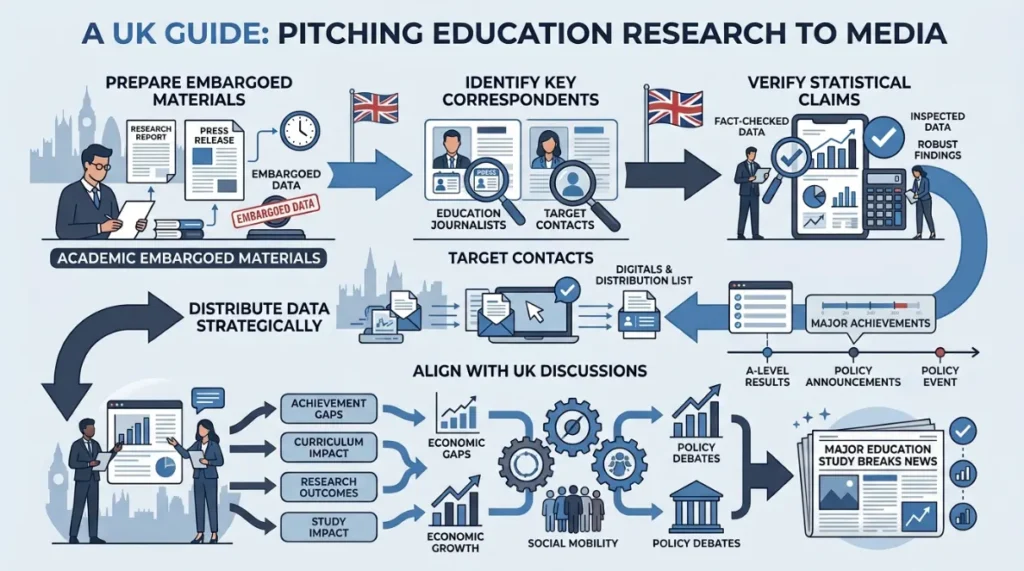
Preparation of Editorial Materials
Journalists review hundreds of press pitches daily. Research organizations must translate complex academic papers into accessible, news-ready assets. The core document required is a structured press release containing:
- A direct summary of the key findings in the first paragraph.
- Verified data points displayed in clear bulleted formats.
- Attributable quotes from lead researchers or institutional directors.
- Methodological notes detailing sample sizes, survey dates, and demographics.
Organizations seeking to understand the foundational reasons why institutions release these findings in the first place can review [Insert Link to TOFU Article].
Timing and Embargo Strategies
Timing dictates coverage success in the UK media ecosystem. Research teams distribute materials under an embargo—an agreement where journalists receive data early but cannot publish until a specified date and time.
National education reporters require access to full research papers 3 to 5 business days prior to the public launch. This window allows journalists to cross-reference data, conduct interviews with independent experts, and write comprehensive analysis pieces. Pitching aligns with the UK academic calendar, focusing on strategic moments such as term starts, exam result days in August, or autumn budget announcements.
Explore More Expert Insights:
How Investment Firms Build Awareness Using Market Insight Ads
How Finance Brands Improve Conversion Intent Using Retargeting Ads
What Are the Essential Components of a Newsworthy Education Report?
A newsworthy education report contains verifiable methodology, clear regional data breakdowns, actionable policy solutions, direct quotes from credible experts, and accessible data visualizations. Reports must present objective facts without overt commercial promotional language to pass journalistic review.
Core Structural Elements
UK news sites reject research reports that read like promotional marketing materials. Editors evaluate incoming studies using a structured checklist of objective criteria.
| Component | Standard Requirement | Purpose in News Coverage |
| Executive Summary | Under 300 words, data-led | Provides journalists with instant context |
| Geographic Disaggregation | Data split by UK regions (e.g., North East vs. London) | Allows local and regional press customization |
| Demographic Metrics | Breakdowns by age, socio-economic status, or school type | Validates equity and social mobility angles |
| Independent Peer Review | Endorsement by third-party academic bodies | Guarantees scientific integrity |
Avoiding Commercial Bias
News editors immediately discard reports designed primarily as lead-generation assets for commercial entities. To maintain newsroom trust, education research must maintain strict neutrality.
Funding disclosures must appear prominently within the report notes. If a commercial company sponsors the research, the study design and data collection must remain independently managed by a qualified research agency, such as YouGov, Savanta, or an accredited university department.
How Does Coverage on UK News Sites Benefit Education Organizations?
UK news coverage builds institutional authority, drives high-intent organic search traffic, establishes thought leadership among sector decision-makers, and informs government policy debates. Editorial mentions provide third-party validation that traditional advertising channels cannot replicate.

Authority and Search Visibility
Securing coverage on established UK news sites delivers substantial digital authority. Tier-one digital newspapers possess high domain authority metrics. When these platforms reference a research report, they frequently include attribution that reinforces the originating institution’s digital footprint.
Search engines evaluate these citations when assessing the Expertise, Authoritativeness, and Trustworthiness (E-E-A-T) of an organization. Consistent editorial coverage positions an entity as an authoritative source of primary data within the education domain.
Policy Influence and Sector Awareness
Media coverage acts as a catalyst for institutional impact across the UK public sector:
- Government Department Visibility: Officials at the Department for Education (DfE) closely monitor national media coverage to gauge emerging sector trends and public sentiment.
- B2B Sector Influence: Headteachers, university vice-chancellors, and corporate learning directors rely on broadsheet and trade coverage to identify strategic operational challenges.
- Stakeholder Trust: Parents, prospective students, and international partners view independent media coverage as proof of institutional capability and reliability.
For organizations seeking structured assistance with research creation and multi-channel media placement, exploring specialized [Insert Link to BOFU Article] provides a path toward sustained industry visibility.
How Do UK News Sites Handle Different Types of Education Research?
UK news sites handle higher education, primary education, and corporate training research differently. Higher education research focuses on economic outcomes and global rankings, primary education targets curriculum and welfare, while vocational research highlights skills gaps and employment metrics.
Higher Education vs. K-12 (Primary/Secondary) Coverage
Editorial desks segregate education coverage based on target audiences and systemic impacts:
- Higher Education (HE): Journalists focus on quantitative outcomes, such as graduate employment rates, research excellence framework (REF) scores, tuition fee value, and international student enrolment trends. Studies involving institutions like the University of Oxford, Imperial College London, or the Russell Group receive dedicated higher education correspondent review.
- Primary and Secondary Education (K-12): Outlets prioritize stories affecting daily family life and public spending. Key metrics include Key Stage 2 SATs results, GCSE and A-Level grade distributions, teacher retention rates, and school infrastructure conditions.
Vocational and Lifelong Learning Research
Research covering further education (FE), apprenticeships, and adult upskilling appeals strongly to business and economics editors alongside standard education correspondents.
Coverage in this category focuses on national productivity, the UK skills gap, industrial strategy integration, and regional economic development. Reports that combine regional employment figures with specific training deficits consistently secure features in both national media and regional outlets like the Manchester Evening News or Yorkshire Post.
What Metrics Track the Success of Education Research Media Coverage?
Education research media coverage success is measured using referral traffic metrics, total audience reach, domain authority growth, policy citations, and branded search volume increases. Tracking these data points evaluates media effectiveness and editorial ROI.
Key Performance Indicators for Media Evaluation
To assess the impact of a media campaign, research teams monitor specific quantitative metrics:
- Editorial Quality Index: Evaluating whether coverage appeared in target outlets (e.g., national daily vs. local blog).
- Message Alignment: Measuring the percentage of articles that included the report’s core data points and primary quotes correctly.
- Organic Search Impact: Tracking lift in non-branded search engine rankings for keywords associated with the research topic.
- Referral Web Traffic: Analyzing Google Analytics data to measure direct visitor sessions originating from news site links or coverage mentions.
- Secondary Sector Citations: Counting subsequent references to the research in parliamentary briefings, academic papers, or industry whitepapers.
By systematically evaluating these metrics, educational institutions, non-profits, and sector service providers refine their future research topics to match the evolving information needs of UK newsrooms and the broader public.