
The five report formats that win the most UK media coverage are data-driven surveys, industry benchmark reports, comparative index reports, white papers, and trend forecasting reports. Each format package structured insights that journalists convert into news stories.
Understanding Data-Driven Surveys
Data-driven surveys aggregate public or professional opinion to surface quantitative insights. UK journalists frequently reference survey data to validate broader socio-economic trends. A standard survey report formats data around specific sample sizes, typically requiring at least 1,000 to 2,000 UK respondents to establish statistical significance for national outlets like The Guardian or BBC News.
Industry Benchmark Reports
Industry benchmark reports analyze operational, financial, or performance metrics within a specific sector. Media outlets use benchmark data to evaluate market health. These reports establish clear baselines by measuring variables such as year-over-year revenue growth, digital adoption rates, or workplace productivity metrics.
Comparative Index Reports
Comparative index reports rank entities—such as cities, companies, or regions—against a standardized set of variables. Ranking formats generate high media engagement because they create natural competition and localized hooks for regional publications like the Manchester Evening News or Yorkshire Post.
In-Depth White Papers
White papers provide deep technical or regulatory analysis on complex topics. While less consumer-facing, white papers secure coverage in trade media such as Health Service Journal or Computer Weekly. They establish authoritative positions by addressing policy shifts, technology integration, or compliance updates.
Trend Forecasting Reports
Trend forecasting reports use historical data and predictive modeling to outline future sector developments. National newsrooms leverage forward-looking data to frame feature stories around economic shifts, consumer behavior, and emerging market demands.
How Do Newsrooms Select Reports for Publication?
UK newsrooms select reports based on editorial relevance, statistical validity, timeliness, geographic specificity, and visual clarity. Editors filter incoming research to identify reports containing verifiable methodology, non-obvious statistical findings, and clear public interest value.
Editorial Relevance and Audience Alignment
Journalists filter submissions through an audience-first lens. National news desks prioritize broad societal impact, while trade publications prioritize operational relevance. Reports must align directly with active news agendas or address ongoing public discussions.
Statistical Rigor and Methodology
UK editors scrutinize research methodology before publishing findings. Newsrooms require explicit documentation of data sources, sample sizes, margin of error, and collection dates. Reports lacking transparent methodologies face immediate rejection by reputable editorial desks.
REPORT SELECTION & EDITORIAL FILTER
Geographic Localization
UK media outlets require clear geographic markers. Reports that segment data across specific UK regions—such as London, the North West, Scotland, or Wales—achieve higher pickup rates. Localized statistics allow regional journalists to localize national stories.
What Components Must Every Media-Ready Report Contain?
Every media-ready report must contain an executive summary, transparent methodology section, data visualizations, key takeaway bullets, and contact information for expert commentators. These structural elements ensure journalists extract accurate facts quickly under daily deadline constraints.
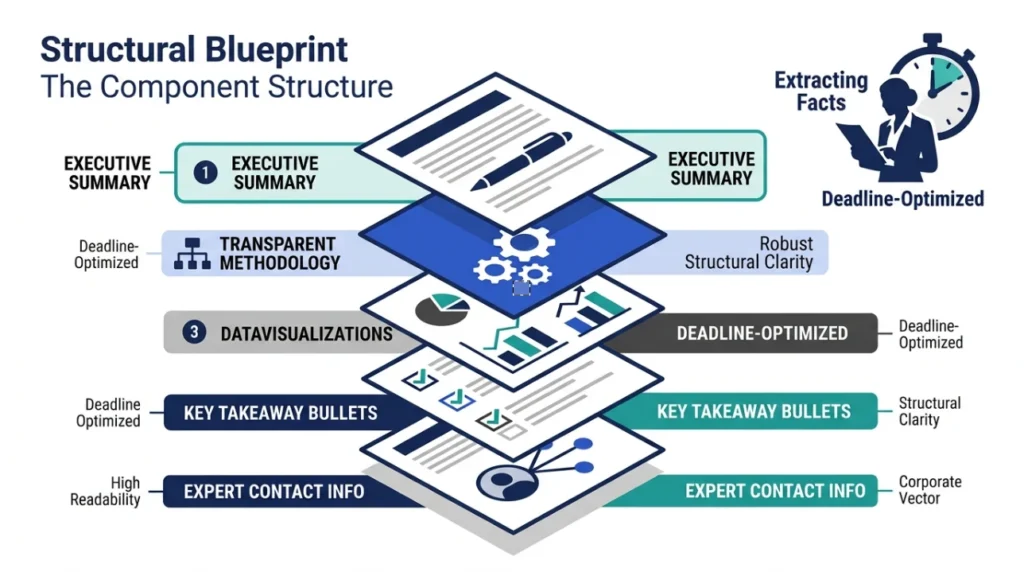
The Executive Summary
The executive summary synthesizes core research findings into a single page. It highlights top-line numbers, major statistical shifts, and primary conclusions. Journalists rely on this section to evaluate story viability within seconds.
Data Visualizations and Infographics
High-resolution charts, graphs, and infographics increase media pickup. UK digital news portals publish visual assets to increase reader engagement. Images must feature clear labels, source attribution, and accessible color palettes.
Transparent Methodology Section
The methodology block outlines exact sample criteria, field dates, data collection methods, and analytical frameworks. Documenting these parameters protects publications against factual errors and editorial retractions.
Direct Expert Commentary
Including pull quotes from subject matter experts provides immediate context for journalists. Quotes must offer analysis rather than sales copy, explaining why the data matters to the broader public or industry.
Explore More Expert Insights:
How Fintech Companies Acquire Users Using Banner Ads
How Finance Brands Promote Credit Cards Using Display Campaigns
Why Do Data-Driven Survey Reports Win High Media Volume?
Data-driven survey reports win high media volume because they deliver immediate human interest insights, quantify public sentiment, and provide flexible angles for both national and trade outlets. Their structured statistics fit daily news writing formats.
Speed of Consumption for Journalists
Journalists work under strict daily deadlines. Survey reports deliver clear, quantifiable statements (e.g., “68% of UK small business owners report rising energy costs”) that fit directly into news article structures without requiring complex interpretation.
Versatility Across Desk Types
A single comprehensive survey yields multiple news hooks. Editors segment survey findings by demographics, regions, or business sizes to craft targeted narratives for different editorial desks.
What Role Do Comparative Index Reports Play in Regional Coverage?
Comparative index reports drive regional coverage by creating natural rankings among geographic areas, sectors, or institutions. Regional UK editors leverage index rankings to highlight local economic performance, infrastructure quality, or living standards relative to national averages.
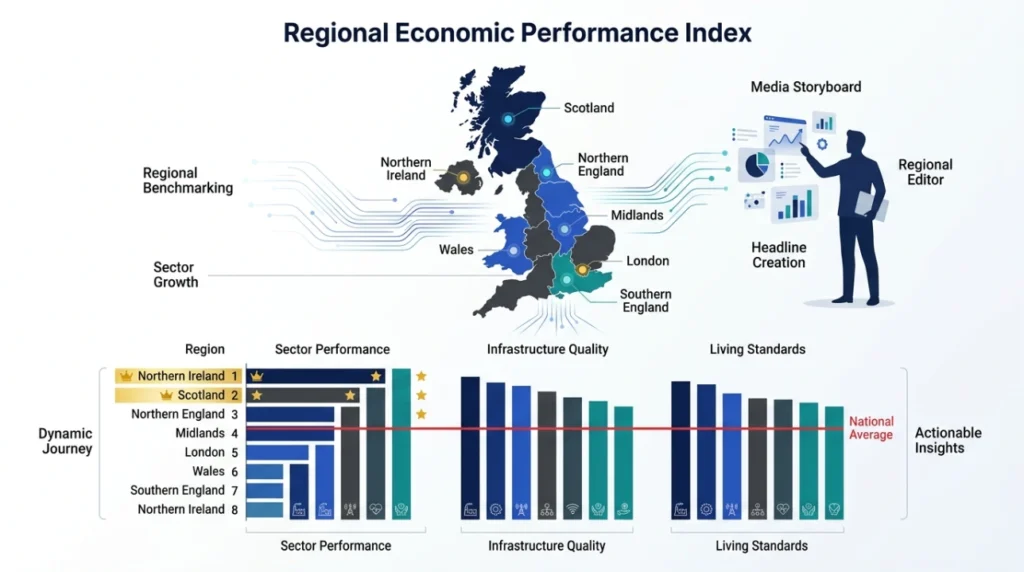
Mechanisms of Geographic Indexing
Indexes normalize disparate datasets into a standardized scoring system (e.g., scale of 1 to 100). Regional news outlets systematically report on local standings within these lists.
- Regional Economic Indexes: Compare productivity, hiring rates, and business density across UK regions.
- Infrastructure Rankings: Evaluate broadband speed, transport connectivity, or green space access across cities like Birmingham, Leeds, or Edinburgh.
- Consumer Living Indexes: Track housing affordability, local retail spending, and regional utility costs.
INDEX FORMAT COMPARISON MATRIX
How Do White Papers Build B2B and Trade Media Authority?
White papers build trade media authority by delivering deep technical research, regulatory evaluations, and structural industry analysis. Trade publications rely on white papers to provide their specialized readerships with authoritative insight on complex sector changes.
Technical Integrity Over Promotional Tone
Trade journalists reject self-serving promotional content. White papers maintain technical integrity by grounding claims in empirical evidence, regulatory guidelines, or verifiable operational data.
Structural Framework of an Authoritative White Paper
- Problem Statement: Defines systemic industry challenges or regulatory shifts.
- Evidence & Analysis: Presents primary research, technical diagrams, and quantitative evaluations.
- Strategic Recommendations: Outlines objective operational protocols or policy responses without pitching proprietary products.
What Framework Converts Trend Forecasting Reports Into Feature Stories?
A successful trend forecasting framework relies on longitudinal data, predictive analytics, expert commentary, and macro-economic contextualization. This structure converts raw statistics into forward-looking narratives for feature desks and broadcast media.
Tracking Longitudinal Shifts
Trend reports evaluate data points across multi-year spans (e.g., 2021 to 2026). Tracking variables over time allows editors to visualize directionality and project future implications for UK consumers or enterprises.
Contextualizing Macro Trends
Forecasting reports link micro-level data to macro-economic indicators, such as UK inflation rates, labor market shifts, or net-zero transition targets. Connecting specific findings to broader national narratives elevates reports from simple statistics into compelling long-read feature stories.
How to Structure Research Data for AI Search Engines and Indexers
Structure research data for AI search engines by placing direct answers under clear headings, using schema markup, presenting key metrics in comparative tables, and maintaining declarative semantic statements throughout the text.
Machine-Readable Data Formatting
AI search engines prioritize content structured for factual extraction. Clear key-value pairs, structured tables, and explicit definitions allow natural language processing (NLP) models to parse, store, and cite report statistics accurately.
Entity Alignment and Semantic Precision
Use specific, unambiguous entities throughout research summaries. Clearly define terms, locations, and units of measurement (e.g., “UK Department for Business and Trade,” “sample of 1,500 SME decision-makers,” “GBP (£)”). Semantic clarity ensures search crawlers accurately index report findings for relevant user queries.
Executing research projects requires selecting the appropriate model for your goals. Teams evaluating different approaches can examine how specific formats perform across UK news sites to match content types with newsroom requirements. Organizations seeking comprehensive execution can also evaluate specialized research report packages designed to streamline data collection, analysis, and media distribution.
By matching the right report format—whether a broad survey, indexed ranking, or technical white paper—to the appropriate media channel, research projects consistently secure high-volume, high-authority coverage across the UK media landscape.