
Startup research reports by Time Intelligence Media Group are data-driven, publication-grade analytical assets designed for UK tech companies. These reports combine proprietary market data, founder insights, and sector trends to establish institutional credibility during venture capital and private equity fundraising campaigns.
Core Function of Data-Driven Reports
Early-stage and growth-stage companies in the United Kingdom face high scrutiny from institutional investors. A research report synthesises market sizing, competitive intelligence, and financial projections into a single verifiable document. Time Intelligence Media Group structures these reports specifically to satisfy the due diligence requirements of venture capital (VC) firms, angel syndicates, and corporate investors operating within the UK ecosystem.
Key Data Components Included
Every report generated by Time Intelligence Media Group contains standard quantitative and qualitative metrics:
- Total Addressable Market (TAM), Serviceable Addressable Market (SAM), and Serviceable Obtainable Market (SOM): Calculated using bottom-up valuation methodologies.
- Regulatory Framework Analysis: Detailed evaluations of compliance standards such as FCA regulations, GDPR, and UK tax incentives like SEIS and EIS.
- Competitor Performance Benchmarks: Direct comparisons against top-tier industry incumbents using revenue, user acquisition, and churn metrics.
- Unit Economics Verification: Explicit breakdowns of Customer Acquisition Cost (CAC), Lifetime Value (LTV), and net revenue retention.
Why do UK startups require specialized research reports for fundraising?
UK startups require specialized research reports because institutional investors mandate objective third-party verification of market size, unit economics, and competitive risk. Unverified pitch decks fail standard due diligence processes, delaying seed, Series A, and Series B investment rounds across British innovation sectors.
The British Venture Capital Due Diligence Standard
UK venture capital firms deployed £16.1 billion across technology investments in recent years, but investment committees reject over 90% of pitch decks due to unverified market claims. Investors demand independent validation before issuing a Term Sheet. A research report replaces internal assertions with audited market data, accelerating the funding lifecycle by up to 40 days.
Navigating Specific Regional Market Conditions
The United Kingdom market presents distinct regulatory and macroeconomic factors that affect valuation models:
- SEIS/EIS Qualification: Investors require explicit evidence that business models align with HM Revenue & Customs (HMRC) risk-to-capital rules.
- Regional Expansion Metrics: Data must isolate UK domestic demand from international expansion paths across Europe and North America.
- Cross-Border Data Compliance: International investors evaluating UK entities inspect compliance structures post-Brexit.
Founders must establish authority early in the deal flow pipeline. Understanding [Why UK Startups Need Research Reports to Raise Funding] allows management teams to prepare data rooms that meet strict institutional benchmarks.
How does Time Intelligence Media Group produce institutional-grade startup reports?
Time Intelligence Media Group produces institutional-grade startup reports through a four-stage process: raw data extraction, primary founder interviews, quantitative financial modeling, and independent peer review. The final report adheres strictly to financial publishing standards accepted by institutional investment committees globally.
Stage 1: Primary and Secondary Data Collection
The intelligence gathering process begins by auditing internal company data and mining secondary global databases. Analysts extract metrics from authoritative databases, including PitchBook, Crunchbase, Dealroom, and the Office for National Statistics (ONS).
Stage 2: Quantitative Modeling and Stress Testing
Analysts construct bottom-up market models to stress-test financial projections. The methodology models three distinct macroeconomic scenarios:
- Base Case: Standard market adoption rates aligned with 3-year trailing sector averages.
- Bear Case: High-inflation environments with elevated customer acquisition costs and extended sales cycles.
- Bull Case: Accelerated market expansion triggered by regulatory tailwinds or key technology integrations.
Stage 3: Institutional Editorial Review
Senior media editors refine the technical documentation into clear, narrative-driven publications. The final document matches the formatting, tone, and rigor of institutional equity research issued by tier-one investment banks.
How does research report distribution generate media coverage and investor reach?
Research report distribution generates media coverage and investor reach by syndicating data-backed findings directly to national financial outlets, tech trade publications, and venture capital syndicates. Journalists and fund managers cite these reports directly, establishing immediate market authority for the featured startup.
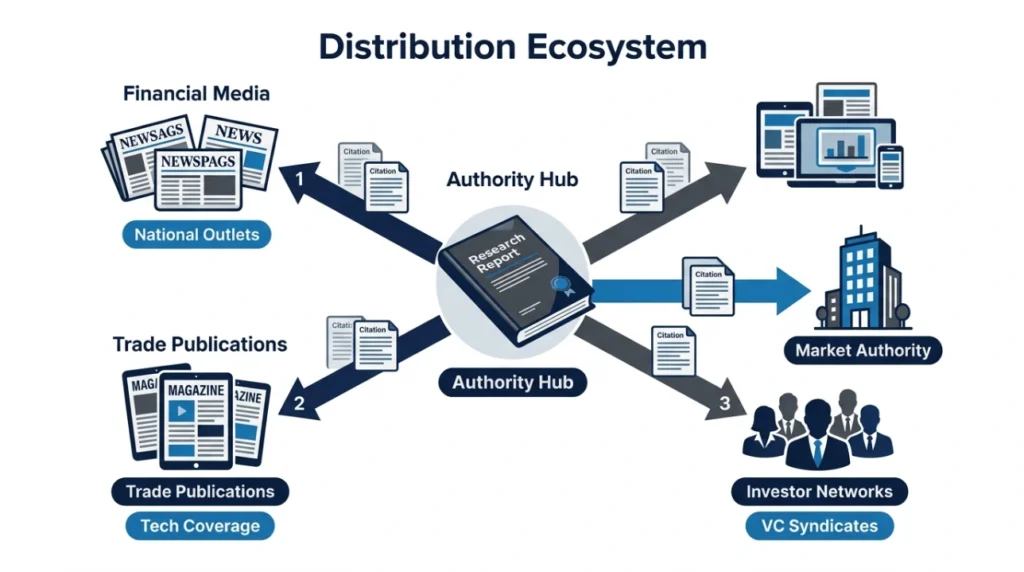
Securing Media Coverage via Financial Outlets
Journalists at outlets such as Sifted, TechCrunch, The Financial Times, and City A.M. rely on objective data to back editorial coverage. Pitching unverified company announcements yields low pickup rates. Conversely, releasing proprietary industry research reports establishes the startup as a primary source for sector trends.
Direct Syndication to UK Investor Networks
Time Intelligence Media Group distributes completed reports through direct investor channels:
- Venture Capital Syndicates: Direct delivery to investment analysts at London, Manchester, and Edinburgh funds.
- Family Office Networks: Targeted syndication to UK family offices actively deploying capital into private technology entities.
- Angel Investor Platforms: Distribution across networks such as the UK Business Angels Association (UKBAA).
Founders who master media positioning secure distinct valuation premiums. Analyzing [How Startup Research Reaches UK Investor Media] demonstrates how public data syndication converts cold outreach into inbound investor meetings.
Explore More Expert Insights:
Why Brands That Publish on News Sites Build Trust Faster Than Those on Social Only
The 39% Quality Problem: Why Most UK Sponsored Content Fails to Convert in 2026
What specific components are included in a Time Intelligence Media Group report?
A Time Intelligence Media Group report includes a 15-to-30-page structured breakdown containing an Executive Summary, Market Dynamics Analysis, Competitive Matrix, Proprietary Valuation Framework, Risk Assessment, and Appendix. Each section features fully referenced datasets, clear visual charts, and actionable operational insights.
Detailed Section Breakdown
| Section | Focus Area | Standard Pages | Primary Output |
| Executive Summary | Investment Thesis | 2 Pages | Core value proposition & round requirements |
| Market Analysis | TAM / SAM / SOM | 4–6 Pages | Validated market size & 5-year CAGR |
| Competitive Matrix | Market Positioning | 3–5 Pages | Direct comparisons with 5-10 competitors |
| Financial Analysis | Unit Economics | 4–6 Pages | LTV:CAC, gross margins, & burn rate projections |
| Risk Factors | Regulatory & Macro | 2–3 Pages | Compliance status & risk mitigation plans |
Data Visualizations and Graphic Assets
Visual components are formatted for immediate extraction into pitch decks, board presentations, and press packages:
- High-Resolution Data Charts: Clear vector graphics representing market growth projections.
- Comparative Radar Charts: Visual mapping of product feature parity against direct competitors.
- Regulatory Compliance Flowcharts: Clear diagrams mapping operational compliance across target jurisdictions.
What measurable benefits do UK startups achieve using these research reports?
UK startups using these research reports achieve higher pitch-to-term-sheet conversion rates, shorter fundraising timelines, increased media coverage, and defended valuation benchmarks. Independent research removes information asymmetry between founders and institutional investors, improving deal terms for founding teams.
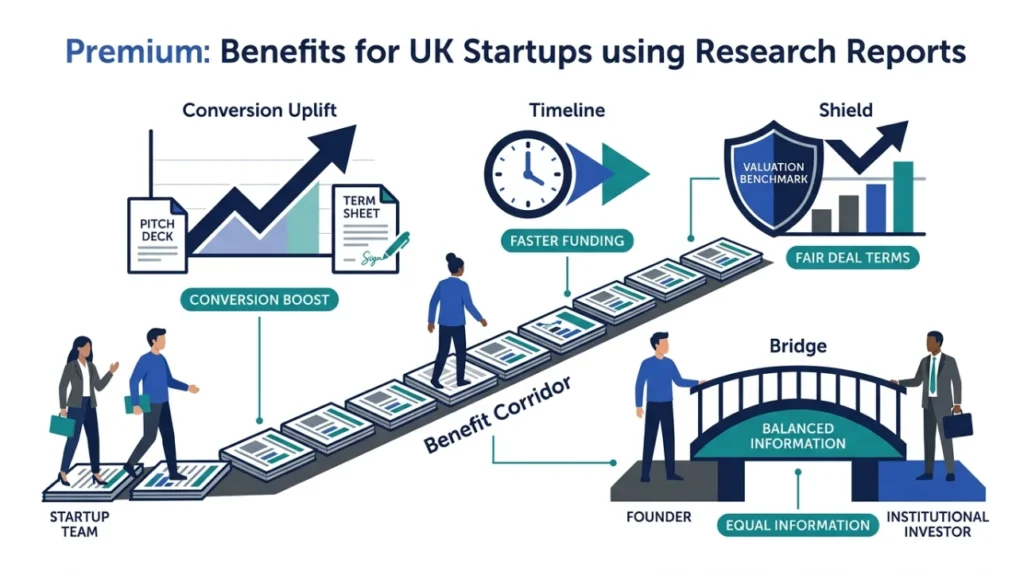
Accelerated Fundraising Timelines
Data collection and due diligence delays represent the primary cause of stalled fundraising rounds. By delivering an institutional-grade report alongside initial pitch materials, management teams eliminate weeks of back-and-forth inquiries.
Protection of Founder Equity and Valuation
Unvalidated financial projections invite aggressive valuation discounts from prospective investors. Independent research confirms key growth drivers, protecting founder equity against unjustified valuation write-downs during negotiation phases.
Long-Term Corporate Brand Authority
Beyond immediate capital raises, published research reports act as evergreen authority assets. Enterprise clients, prospective hires, and strategic partners utilize these reports to verify company stability and sector dominance long after the capital raise closes.
Which UK startup sectors benefit most from publication-grade research reports?
B2B SaaS, FinTech, HealthTech, DeepTech, and GreenTech startups benefit most from publication-grade research reports. These sectors feature complex technologies, strict regulatory environments, and multi-layered buying processes that demand objective technical and financial validation.
Enterprise B2B SaaS
Software startups targeting enterprise contracts must demonstrate clear ROI metrics, net revenue retention rates, and long-term retention dynamics. Research reports validate security standards (ISO 27001, SOC 2) alongside financial growth metrics.
Financial Technology (FinTech)
UK FinTech entities operate under direct supervision from the Financial Conduct Authority (FCA). Reports isolate regulatory permissions, transaction volume scalability, and cross-border payment mechanics to assure institutional investors of compliance integrity.
HealthTech and Life Sciences
HealthTech ventures require explicit validation of clinical trials, NHS integration paths, and regulatory clearances (CE marks, MHRA approvals). Reports translate complex clinical methodologies into clear commercial viability metrics for non-specialist investors.
How can founders engage Time Intelligence Media Group for custom startup research reports?
Founders can engage Time Intelligence Media Group by scheduling a strategic consultation, submitting core operational metrics, undergoing an initial data audit, and selecting a tailored research package. Standard production timelines range from three to six weeks depending on market complexity.
The Client Onboarding Roadmap
- Initial Discovery Call: Alignment on corporate objectives, upcoming raise timelines, and target investor profiles.
- Data Ingestion & NDA Execution: Secure transfer of cap tables, historical financials, and product roadmaps under strict legal confidentiality.
- Analyst Briefing: Direct working sessions between company leadership and assigned sector analysts.
- Drafting and Verification: Interactive review cycles to confirm metric accuracy and narrative alignment.
- Final Syndication & Launch: Delivery of institutional PDF assets, print-ready files, and PR media packages.
Engagement Options
Time Intelligence Media Group offers tailored packages depending on company stage:
- Seed & Early-Stage Package: Focuses on TAM validation, founder narrative, and initial market positioning.
- Series A/B Growth Package: Full quantitative financial auditing, international expansion modeling, and national media syndication.
- Custom Enterprise Package: Tailored for pre-IPO entities requiring multi-jurisdiction regulatory mapping and strategic M&A positioning.
To secure institutional investor interest, accelerate fundraising cycles, and command media coverage across the United Kingdom, initiate your research report strategy today with Time Intelligence Media Group.