
Data journalism reports by Time Intelligence Media Group are commercial research deliverables that combine primary data collection, statistical analysis, and journalistic storytelling. These reports provide UK brands with media-ready campaigns that secure top-tier national news coverage and authoritative backlinks.
Data journalism reports bridge the gap between complex research and digital PR execution. Modern search engine algorithms and media outlets prioritize verifiable facts over subjective marketing copy. Time Intelligence Media Group structures raw datasets into structured, news-focused narratives that editorial teams publish.
Core Components of a Commercial Data Journalism Report
A commercial data report comprises four distinct elements:
- Primary and Secondary Datasets: Information gathered through consumer surveys, Freedom of Information (FOI) requests, public APIs, or proprietary database extraction.
- Methodology Documentation: Explicit research frameworks that outline sample sizes, demographics, margins of error, and analytical models to pass newsroom verification.
- Editorial Narrative Formulation: News-first copy structured using the inverted pyramid model, placing key findings in the headline and primary paragraphs.
- Data Visualization Assets: Publication-ready charts, infographics, and interactive embeds optimized for digital news outlets.
Understanding how data journalism turns reports into UK news stories relies on transforming complex data points into actionable insights that editors can publish immediately. Time Intelligence Media Group executes this transformation by pairing statistical accuracy with digital PR distribution strategies across the United Kingdom market.
How does Time Intelligence Media Group produce data journalism reports?
Time Intelligence Media Group produces data journalism reports through a six-stage workflow: research design, data extraction, statistical validation, news angle extraction, content production, and media outreach. This structured process guarantees that every campaign meets UK editorial standards and search engine guidelines.
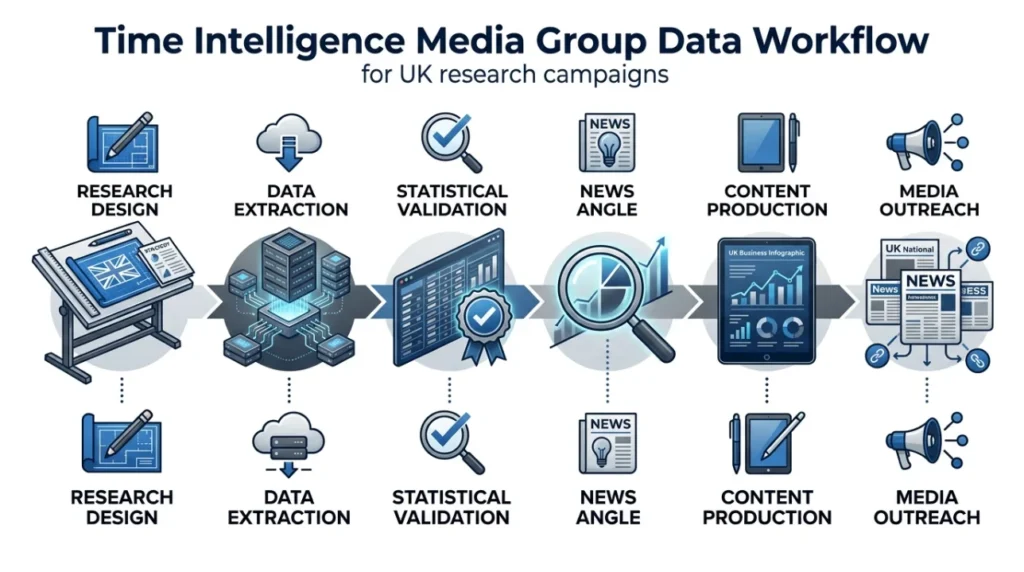
Stage 1: Research Strategy and Angle Discovery
The production process begins by identifying search demand, media trends, and brand positioning opportunities. Time Intelligence Media Group analyzes target UK publications—including The Guardian, The Telegraph, BBC News, and regional titles—to map current news agendas.
Research questions are engineered to yield definitive, headline-worthy conclusions. Rather than asking generic questions, surveys and data requests test precise hypotheses that reveal consumer behavior shifts, economic disparities, or regional trends.
Stage 2: Data Acquisition and Extraction
Data acquisition relies on verifiable sourcing methods:
- Consumer Polling: Nationally representative sampling across the UK, stratified by age, gender, region, and socioeconomic status.
- Freedom of Information (FOI) Requests: Statutory requests submitted to UK government bodies, NHS trusts, local councils, and regulatory authorities.
- Open Data Scraping: Automated extraction from public databases including the Office for National Statistics (ONS), Land Registry, and Gov.uk repositories.
Stage 3: Statistical Cleaning and Validation
Raw datasets undergo rigorous auditing to eliminate duplicate records, correct sampling bias, and verify statistical significance. Quantitative analysts calculate margins of error, confidence intervals, and percentage variations. Clean datasets ensure immunity against editorial retractions or public challenges.
Stage 4: Journalistic Synthesis and Design
Data journalists translate statistical outputs into written assets. The content structure uses plain UK English, active voice, and declarative statements. Graphic designers simultaneously convert raw numbers into visual graphics, static charts, and interactive maps tailored to publisher specifications.
Stage 5: Syndication and Media Pitching
The final deliverable is packaged into a digital press center containing the core report, executive summary, high-resolution imagery, and raw data files. Media specialists distribute tailored pitches to news editors, desk journalists, and niche industry commentators.
What metrics make data journalism reports effective for UK digital PR?
Data journalism reports achieve digital PR effectiveness by measuring high-tier news coverage, authoritative follow links, referral traffic, organic keyword rankings, and brand citations. These specific quantitative metrics validate the return on investment for enterprise marketing teams across the United Kingdom.
High-Authority Backlink Acquisition
Search engines rank websites based on the quantity and quality of external references. Data journalism reports incentivize high-authority domains to link back to the target website as the primary source of a statistic. A single report frequently secures links from sites with a Domain Rating (DR) above 80, including national news portals and academic institutions.
Co-Occurrence and Semantic Entity Building
Beyond direct hyperlinking, data reports establish brand names alongside core industry entities in search engine knowledge graphs. When national publications cite a brand as the source of market research, search algorithms index that brand as a topical authority within its specific sector.
Direct Referral Traffic and Brand Equity
Tier-one news placements place brand attributes directly in front of targeted UK audiences. Readers who click on embedded source links represent high-intent referral traffic. Furthermore, persistent media mentions build long-term brand equity, reducing customer acquisition costs across paid channels.
Explore More Expert Insights:
Why Brands That Publish on News Sites Build Trust Faster Than Those on Social Only
The 39% Quality Problem: Why Most UK Sponsored Content Fails to Convert in 2026
Why choose Time Intelligence Media Group for commercial data reports?
Choosing Time Intelligence Media Group provides direct access to veteran journalists, dedicated data analysts, and established UK media distribution networks. The agency delivers turnkey, newsroom-ready research campaigns that consistently secure top-tier press coverage and high-authority search engine placements.
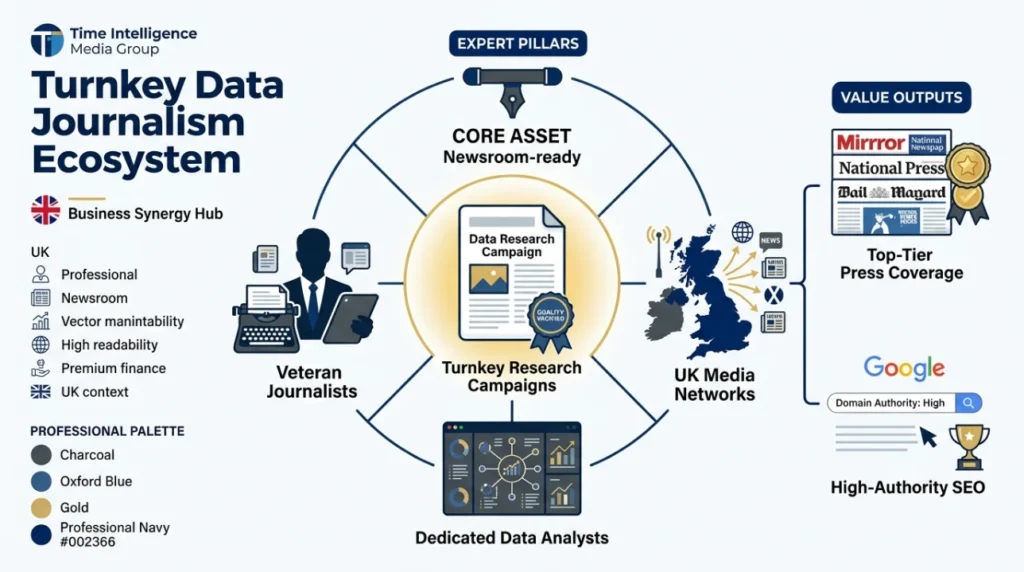
Dedicated Technical and Editorial Expertise
Time Intelligence Media Group employs specialist teams that operate at the intersection of data science and journalism. Unlike traditional digital PR agencies that rely on basic internal surveys, the agency deploys quantitative analysts who work alongside former national news reporters. This dual structure prevents factual errors while maximizing news value.
Proven Methodology Compliance
UK newsrooms maintain strict guidelines regarding commercial content submission. Surveys must adhere to Market Research Society (MRS) standards, featuring minimum sample sizes of 2,000 UK adults for national representation. Time Intelligence Media Group builds full compliance into every project, eliminating editorial resistance during the outreach phase.
Measurable ROI and Transparent Reporting
Campaign tracking focuses on business outcomes rather than vanity metrics. Client dashboards detail every placement, including domain authority, link attributes (follow/nofollow), referral visits, and keyword movement.
What industries benefit most from data journalism research?
Fintech, real estate, healthcare, e-commerce, and professional services benefit most from data journalism research. These sectors rely on trust, consumer authority, and high topical authority to rank for competitive search terms and convert high-value customers within the UK.
Real Estate and Property
Property markets depend entirely on transactional and demographic data. Reports analyzing regional price disparities, rental yield shifts, and local council planning applications regularly secure lead coverage in publications like The Times and Daily Mail.
Finance and Consumer Credit
Financial services companies use data journalism to simplify complex economic shifts. Studies examining household savings patterns, inflation impacts, and debt accumulation establish brands as authoritative market commentators while earning links on high-tier financial outlets.
Healthcare and Wellness
Health research demands absolute accuracy. Analyzing public health records or conducting large-scale demographic health surveys yields authoritative campaigns. Understanding why data journalism powers credible UK research reports helps health organizations present clinical findings in clear, media-ready formats that educate the public and build brand credibility.
How do data journalism reports enhance search engine optimization?
Data journalism reports enhance search engine optimization by earning organic backlink profiles, driving topical authority signals, increasing brand search volume, and fulfilling Google E-E-A-T requirements. These structural enhancements directly raise organic search engine rankings for core target keywords.
Building E-E-A-T (Experience, Expertise, Authoritativeness, Trustworthiness)
Google evaluates content credibility through E-E-A-T guidelines. Publishing original research establishes first-hand experience and expertise. When tier-one media outlets cite the campaign, search engines receive strong trust signals that elevate the parent domain’s overall search visibility.
Organic Backlink Velocity
Standard marketing content rarely attracts unprompted links. Data reports act as persistent link assets. Once published, third-party writers, bloggers, and academics discover the research via search engines and continuously link to the data source, generating natural backlink velocity over months and years.
Contextual Relevance and Internal Linking Networks
Data reports create opportunities to optimize site architecture through targeted internal links. By linking research assets directly to commercial landing pages, marketers pass acquired PageRank across their site structure while maintaining contextually relevant anchor text.
How can brands commission a data report with Time Intelligence Media Group?
Brands commission a data report with Time Intelligence Media Group by scheduling an initial strategy consultation, defining primary campaign goals, approving the research methodology, and launching the outreach campaign. The process takes six to eight weeks from kickoff to initial media publication.
Step 1: Initial Discovery and Scope Alignment
The commissioning process begins with a formal briefing session. Marketing leads meet with strategy directors to establish key performance indicators, target publication lists, target keywords, and underlying product positioning goals.
Step 2: Pitch Concept Approval
Time Intelligence Media Group presents three to five distinct, data-backed campaign hooks. Each concept includes proposed data sources, estimated sample costs, target media outlets, and projected link volumes. The brand selects the optimal campaign angle.
Step 3: Execution and Asset Sign-Off
The agency manages data collection, statistical auditing, report writing, and graphic production. The commissioning brand reviews and signs off on the final assets, ensuring brand guidelines and factual parameters align with corporate standards.
Step 4: Outreach and Coverage Reporting
Media specialists execute syndication strategies across target UK news desks. The agency provides live coverage dashboards tracking media hits, direct links, social shares, and domain metrics throughout the four-week outreach window.
Data journalism reports provide a repeatable, data-driven framework for winning top-tier media coverage and search engine market share in the United Kingdom. By pairing rigorous statistical gathering with journalistic publishing techniques, Time Intelligence Media Group delivers measurable PR and SEO outcomes for growth-focused brands. Commissioning a bespoke research campaign transforms complex corporate data into authoritative digital assets that drive organic performance over the long term.