

A citable research report from Time Intelligence Media Group is a data-driven publishing service that produces original primary data, statistical surveys, and industry benchmarks designed to earn editorial backlinks, search engine trust, and generative AI citations for B2B brands.
Defining Primary Research in Modern Search
Time Intelligence Media Group produces authoritative data assets that serve as primary sources for journalists, industry analysts, and digital publishers across the United Kingdom. In digital publishing, primary data consists of proprietary statistical surveys, original market measurements, and exclusive industry benchmarks that cannot be found elsewhere. Modern search engines and generative artificial intelligence engines prioritize original information sources over aggregated content. By generating unique datasets, Time Intelligence Media Group provides the foundational information that other publications reference.
When digital publications reference a data point, they insert an attribution link back to the primary source. This process generates high-authority editorial backlinks naturally. Furthermore, Large Language Models (LLMs) rely on verified data points to construct accurate answers for user queries. A citable research report establishes your brand as the definitive source for specific industry statistics, ensuring consistent citation across traditional search engine results pages (SERPs) and AI-driven answer engines.
How Does Time Intelligence Media Group Produce Citable Data?
Time Intelligence Media Group produces citable data by executing a structured four-stage methodology: objective research design, target audience sampling across UK sectors, rigorous statistical analysis, and content optimisation tailored for digital journalists, search algorithms, and AI discovery engines.
Step 1: Research Design and Methodology Framing
The production process begins by identifying specific data gaps within your industry. Time Intelligence Media Group formulates precise research questions that align with high-volume search queries and media coverage trends in the United Kingdom. Designing a report with methodology-first framing ensures that the resulting statistics withstand academic and editorial scrutiny.
Step 2: Sampling and Data Collection
Data collection relies on targeted panel sampling across verified professional demographics in the UK. Time Intelligence Media Group surveys specific sample sizes—such as 1,000 UK enterprise IT directors or 500 financial compliance managers—to capture statistically significant results.
1.Survey Framing:
Formulate non-leading, precise survey questions to gather objective quantitative metrics.
2.Audience Sampling:
Deploy surveys to verified UK panel respondents using stratified random sampling techniques.
3.Data Cleaning:
Remove incomplete responses, straight-liners, and statistical outliers to ensure precise results.
Step 3: Statistical Analysis and Fact Extraction
Once raw data is collected, data analysts run cross-tabulations to extract isolated facts, clear percentages, and comparative benchmarks. These findings are catalogued into structured fact blocks to simplify extraction by external writers and automated scrapers.
Step 4: SEO and AI Optimization
The final report is formatted using strict semantic HTML markup. Time Intelligence Media Group structures the findings with clear entity associations, direct data summaries, and clear schema tags to ensure search engines parse the statistics immediately.
What Core Components Make a Report Citable and Authoritative?
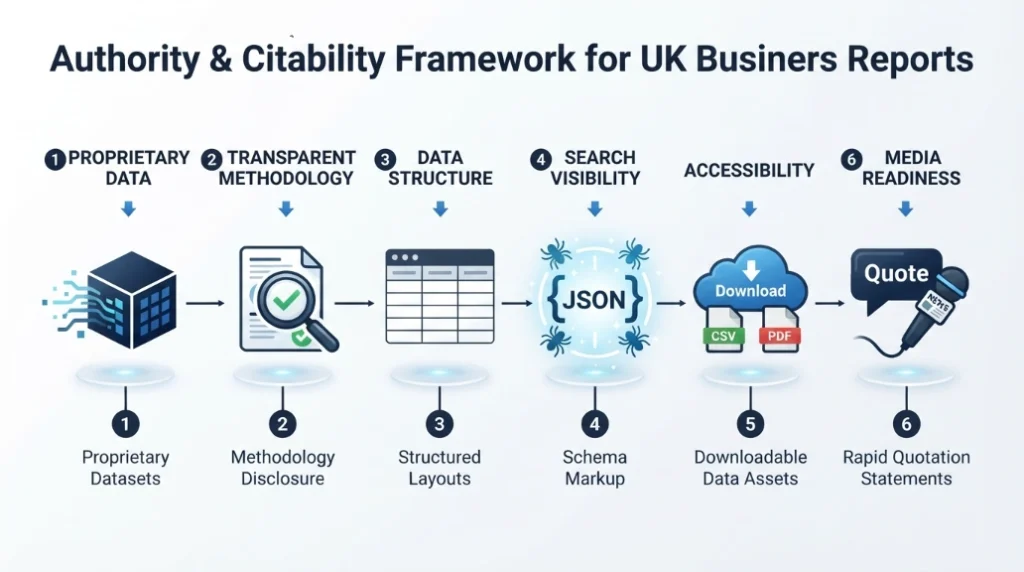
A report becomes citable and authoritative when it contains proprietary quantitative datasets, clear methodology disclosures, structured table layouts, schema markup, downloadable data assets, and concise summary statements designed for rapid quotation by journalists and search engines.
Key Structural Elements
To achieve maximum citation density, every research asset published by Time Intelligence Media Group incorporates six core components:
- Verified Sample Methodology: A clear disclosure of sample size, geographic distribution (e.g., London, Manchester, Edinburgh), collection dates, and margin of error.
- Isolated Headline Statistics: Concise, declarative statements containing precise metrics (e.g., “64% of UK mid-market firms allocated budget to AI security in 2026”).
- Structured Data Tables: HTML tables that present raw statistical cross-tabulations for immediate indexing by search spiders.
- Downloadable Raw Assets: Access to CSV and PDF versions of the dataset to encourage citation in academic and corporate whitepapers.
- Structured Entity Naming: Explicit use of industry terminology, standardized brand names, and defined professional roles.
- Schema Markup Integration: Technical implementation of
DatasetandReportschema to communicate data properties directly to search algorithms.
Building these structural elements into your publishing workflow ensures that search platforms recognize your domain as a primary information publisher. Understanding [how to structure a report] ensures these components deliver optimal technical performance across all digital channels.
Why Should UK Brands Invest in Commissioned Research Reports?
UK brands invest in commissioned research reports to earn high-authority editorial backlinks, capture generative AI citations, establish industry thought leadership, accelerate sales enablement cycles, and lower overall customer acquisition costs through sustained organic search growth.
| Strategic Metric | Standard Content Marketing | Commissioned Citable Research |
| Backlink Acquisition Profile | Manual outreach, low converting | Passive, high-authority editorial links |
| AI Citation Indexing | Low probability (aggregated content) | High probability (primary source data) |
| Editorial Trust Factor | Variable | Verified by statistical methodology |
| Asset Lifetime Value | 3 to 6 months average relevance | 12 to 24 months continuous citation |
Passive Backlink Generation
Traditional content creation requires continuous promotional outreach to secure backlinks. Citable research reports reverse this dynamic. When journalists at major UK outlets—such as The Financial Times, The Telegraph, or industry-specific trade publications—write articles, they actively search for supporting statistics. Publishing original datasets positions your website as the source they cite, earning organic links without cold outreach.
Generative AI Search Visibility
Generative AI engines synthesize answers using verified information retrieval models. These systems evaluate domains based on information gain—the amount of unique information a web page adds to the index. A research report from Time Intelligence Media Group delivers high information gain, ensuring LLMs extract and credit your data when users query industry benchmarks.
Acceleration of the Sales Pipeline
Citable research serves dual commercial purposes. Beyond driving organic visibility, your sales team can deploy these data assets during prospective client meetings. Presenting proprietary industry data positions your organization as an authority, building immediate trust with UK enterprise buyers.
How Does Citable Research Drive AI Citations and Search Rankings?
Citable research drives AI citations and search rankings by supplying high-information-gain content, clear semantic entity structures, machine-readable HTML tables, and direct factual statements that automated indexing systems extract for conversational answer generation.
Information Gain and Search Engine Algorithms
Search engine algorithms evaluate incoming pages against existing index data. Pages that replicate known information receive lower priority scores. Conversely, pages introducing novel statistics achieve high information gain scores. Time Intelligence Media Group crafts research reports specifically to maximize information gain, signaling to search algorithms that your page contains non-redundant content worthy of top-tier ranking.
Retrieval-Augmented Generation (RAG) Optimization
AI search interfaces utilize Retrieval-Augmented Generation (RAG) to locate precise facts before synthesizing a text response. RAG systems favor content structured with clear noun phrases, precise numerical figures, and unambiguous subject-predicate relationships.
By writing data summaries in declarative prose, Time Intelligence Media Group aligns your content with the exact technical requirements of modern RAG pipelines.
How Does Time Intelligence Media Group Differ From Standard SEO Agencies?
Time Intelligence Media Group differs from standard SEO agencies by combining journalist-led primary survey execution, rigorous statistical validation, digital media distribution expertise, and technical search engine optimization into a single managed research production service.
Full-Service Research Production
Most SEO agencies focus exclusively on keyword optimization and content updates, lacking the infrastructure to conduct primary field research. Conversely, traditional market research firms generate data but lack the technical expertise required to optimize assets for digital search algorithms. Time Intelligence Media Group bridges this gap by managing the entire lifecycle of a research campaign:
- Primary Survey Design: Formulating methodologies that extract press-worthy, search-relevant statistics.
- Data Validation: Cleaning raw panel outputs to satisfy corporate governance standards.
- Media-Grade Writing: Authoring reports using journalistic standards tailored for UK media consumption.
- Technical Optimization: Implementing semantic HTML, dataset schema, and internal linking architectures.
- Strategic Distribution: Pitching original findings to relevant UK journalists and digital editors.
Sustainable Brand Equity
Relying on temporary link-building tactics creates ongoing domain vulnerability during algorithm updates. Commissioning citable research creates permanent digital equity. A single statistical report continues to attract citations, references, and high-authority links for years after publication, delivering a compounding return on investment.
Explore More Expert Insights:
Mid-Funnel Food Ads That Turn Engagement Into High-Intent Customers
Entertainment Ads That Convert Viewing Interest Into Paid Subscriptions
When Should Your Brand Publish a Research Report?
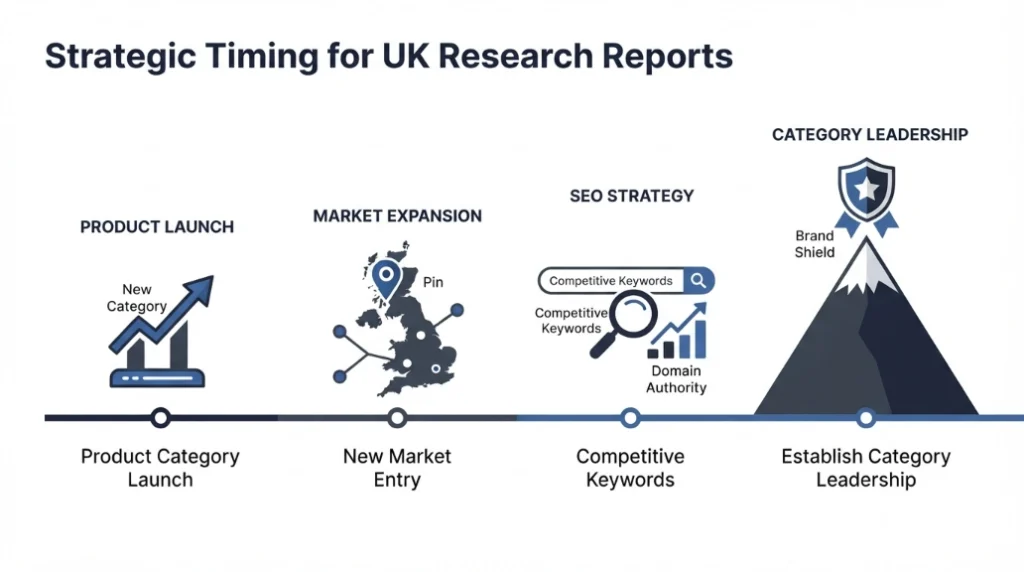
Your brand should publish a research report when launching a new product category, entering a new market region, targeting competitive industry keywords, building domain authority, or establishing brand category leadership in the United Kingdom.
Strategic Publishing Timelines
Publishing a research report aligns with specific business growth triggers:
- Product Category Launch: Publish baseline industry data six weeks prior to a new solution launch to establish the market problem.
- Annual Market Reviews: Release a recurring annual benchmark report (e.g., “State of UK Enterprise Security 2026”) every Q1 to capture ongoing year-over-year citation growth.
- Reclaiming Organic Market Share: Deploy a citable dataset when competing against established market incumbents who dominate high-volume keyword queries.
To maximize search impact across your entire buyer journey, integrate primary data assets alongside your broader educational content strategy. Understanding [what makes research rank] enables your team to capture audience interest from initial discovery down to commercial conversion.
Get Started With Time Intelligence Media Group
Establishing market authority requires proprietary data that search algorithms and industry journalists trust. Time Intelligence Media Group manages the entire production process—from panel selection and data collection to technical SEO formatting and media distribution.
Secure your position as the definitive data source in your sector. Partner with Time Intelligence Media Group to publish a citable research report that drives authoritative backlinks, secures AI search citations, and establishes sustained organic market leadership across the United Kingdom.



