

How to structure a report that ranks and gets cited requires a logical hierarchy, precise data presentation, schema markup, and clear entity definitions. This framework ensures search engine crawlers and artificial intelligence models index, trust, and quote the published content.
What Is a Search-Optimised and Citable Report Structure?
A search-optimised and citable report structure is a technical layout that organises analytical data into machine-readable headers, structured tables, and explicit definitions. It enables search engines to rank content while helping artificial intelligence models extract verifiable facts accurately.
Information retrieval systems prioritise clarity over decorative prose. When search engine bots crawl a page, they scan HTML elements to establish the context of the material. A structured report uses semantic markup to signal the primary topic, supporting findings, and foundational methodology.
A report must separate its narrative into primary and secondary logical levels using standard header tags. This hierarchical arrangement creates a distinct information architecture:
Header Hierarchy and Semantic Markup
The document structure must move strictly from $H1$ to $H2$ to $H3$ without skipping levels. The $H1$ tag contains the main topic. Each $H2$ tag addresses a specific sub-topic or research question. $H3$ tags break down specific data sets or methodology details under the main questions.
Machine Readability and Large Language Models
Large language models and search engines parse information through entity extraction. Entities are distinct, well-defined concepts, places, organisations, or metrics. Explicitly defining these entities inside your document structure ensures that natural language processing tools attribute facts directly to your published domain.
What Is the Process for Structuring a High-Ranking Report?
The process for structuring a high-ranking report involves establishing target user intent, designing an explicit heading taxonomy, converting research data into structured tables, adding structured JSON-LD schema markup, and validating technical crawlability before publishing the final document online.
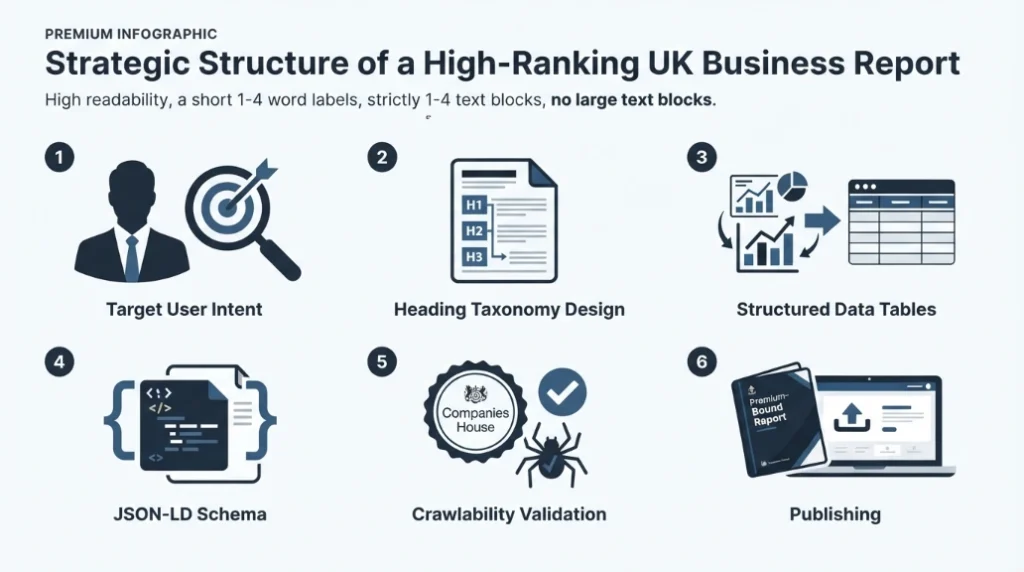
Creating a citable document follows a repeatable technical process. Each step ensures that search engine algorithms understand the context of the data while external writers find specific data points to cite.
Intent Mapping and Heading Design
Every section must address specific queries searched by readers and journalists. Map secondary target terms directly into $H2$ headers as clear questions. This structure directly satisfies user intent and optimizes the content for featured snippets.
Data Structuring and Table Conversion
Raw numbers presented within narrative prose hinder automated indexing. Convert complex quantitative findings into HTML tables. Tables allow search engine crawlers to extract raw numerical data directly into search summaries and answer boxes.
Schema Implementation and Technical Validation
Before publication, apply explicit Schema.org markup to the HTML body. Use schemas such as TechArticle, Report, or Dataset. Test the markup using code validation tools to confirm zero structural errors exist within the code.
What Are the Core Components of a Citable Report Structure?
The core components of a citable report structure include a bold executive summary, descriptive headers, structured data tables, clear methodology statements, explicit entity definitions, schema markup, and an optimized, machine-readable reference list for third-party attribution.
To earn citations from academic institutions, journalists, and search algorithms, a report must include specific structural elements that validate its authoritative status.
| Structural Component | Primary Function | SEO & AI Impact |
| Executive Summary | Summarises key data points immediately. | Earns featured snippets and direct AI quotes. |
| Data Tables | Formats numerical results cleanly. | Enables direct table parsing by search engines. |
| Methodology Section | Explains research scope and sample sizes. | Establishes domain authority and trust metrics. |
| Reference List | Cites primary sources and foundational data. | Connects page content to known web entities. |
Executive Summaries for Direct Citation
Place a short, fact-dense summary at the top of every major section. Present the primary discovery in 40 words or fewer using bold text. This visual and structural signal helps automated scrapers identify the core factual claim of the page.
Analytical Data Tables
Present raw variables, percentages, and sample sizes within clean tabular HTML markup. Avoid using images or visual graphics to display numerical values, as search engine web crawlers cannot read rasterised image text accurately.
Explicit Methodology Frameworks
Detail the exact research methods, sample sizes, and collection dates. For example, specify a survey sample of 1,500 UK marketing executives conducted between January 2026 and March 2026. Explicit details confirm the original nature of the data.
What Are the Search Engine and Citation Benefits of a Structured Report?
The benefits of a structured report include higher search engine ranking position, increased zero-click snippet capture, improved artificial intelligence source attribution, higher domain authority through earned backlinks, and longer user engagement metrics from target industry audiences.
Organising a report through logical structural frameworks yields measurable technical advantages across multiple digital discovery channels.
Search Engine Crawl Efficiency
Structured documents reduce rendering overhead for search engine crawlers. Clear semantic HTML allows search bots to parse, categorize, and index the full context of a 5,000-word document without hitting crawl budget limitations.
Automated Citation by AI Engines
Large language models select sources that present unambiguous facts. When an AI engine generates a response regarding market statistics, it selects content bounded by clear entity definitions and structured data formats.
High-Value Backlink Acquisition
Content creators and journalists reference data sources that are easy to read and verify. Reports with clean headers, standalone statistical tables, and explicit summaries receive higher organic backlink volume from authoritative news publications.
What Are the Primary Use Cases for Structured Reports?
The primary use cases for structured reports include industry benchmarking studies, proprietary data disclosures, consumer trend analyses, technical white papers, and corporate research publications designed to establish authority across business-to-business sectors in the United Kingdom.
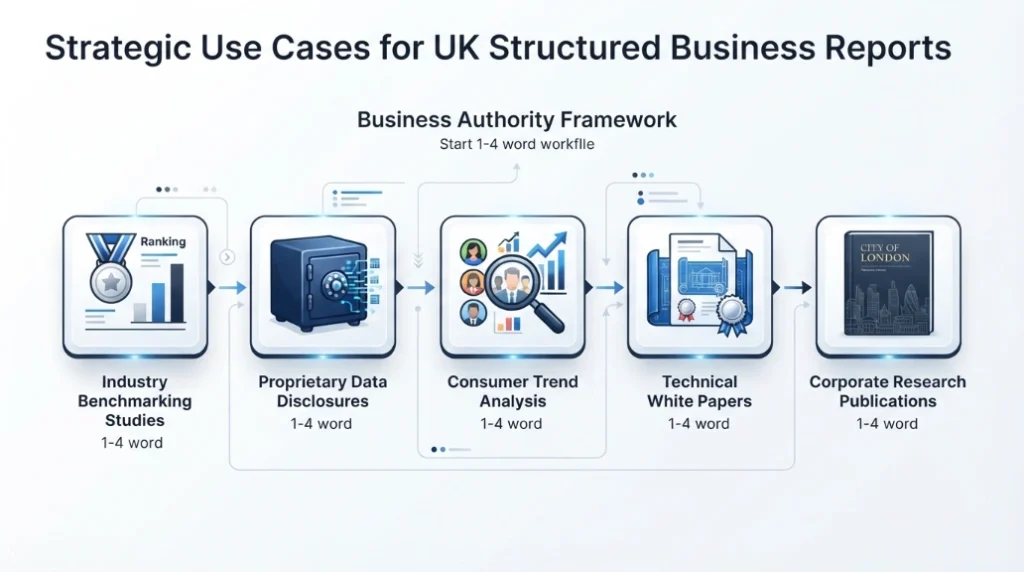
Different report types require slight structural adaptations while maintaining core technical standards.
Industry Benchmarking Studies
Benchmarking reports evaluate performance metrics across a specific sector. Present metrics using clear comparative tables. Break sections down by specific operational categories, such as annual revenue growth or digital marketing spend.
Proprietary Research and Consumer Surveys
Surveys publish original quantitative data gathered from targeted populations. Structure these reports by placing the primary survey findings directly under user-focused $H2$ questions. Detail the margin of error and geographic constraints explicitly within the methodology section.
Options for Professional Media Execution
Organizations seeking to produce high-impact, citable publications often consider specialized external support. Media agencies and research production firms offer structured workflows to generate authoritative content.
Organizations can evaluate various market solutions to execute their research strategies effectively. For foundational knowledge on digital publishing strategies, review our guide on what makes a research report rank. To accelerate production with dedicated media expertise, businesses can explore how to get a citable research report built to exact industry specifications.
How to Maintain Citation Quality and Ranking Performance Over Time?
Maintaining citation quality and ranking performance requires updating obsolete statistics annually, fixing broken outbound links, monitoring structured schema accuracy, re-evaluating target user queries, and refreshing published data sets to retain domain authority over extended periods.
Search engines prioritize fresh, accurate information. A report structured correctly at launch requires ongoing technical maintenance to sustain its organic positions and citation volume.
Annual Data Refresh Protocols
Update statistical data points every 12 months. Replace outdated historical metrics with current figures while maintaining the established URL structure. Mark updated sections with explicit date metadata using standard HTML time tags.
Schema and Entity Auditing
Audit structured data regularly using validation tools. Ensure that referenced external entities, organization names, and author profiles remain active, correct, and linked to authoritative knowledge bases across the web.



