

Fintech research reports by Time Intelligence Media Group turn structured financial technology data into evidence-led reports designed for publication, media use, search visibility, and commercial communication across the United Kingdom’s fintech market.
A fintech research report presents original findings about financial technology markets, consumer behaviour, business performance, technology adoption, investment trends, or regulatory developments. It converts data into a structured publication with methodology, findings, analysis, statistics, and supporting evidence.
Time Intelligence Media Group develops research-led content for organisations that need a credible asset for media communication and digital visibility. The report format supports fintech companies seeking a documented source that journalists, analysts, publishers, business websites, and search systems can reference.
A strong report does not simply present statistics. It establishes the research question, explains the data source, identifies measurable findings, and connects those findings to a defined UK fintech context.
This distinction matters in a market where financial technology businesses compete for media attention, search visibility, investor awareness, and authority.
Why do UK fintech brands invest in original research reports?
UK fintech brands invest in original research reports because proprietary findings create evidence that supports media stories, executive commentary, thought leadership, digital content, customer communications, and search visibility while differentiating a company from competitors.
Original research gives a fintech brand data that is directly associated with its research project. Examples include a survey of UK consumers about digital banking, an analysis of payment adoption among SMEs, or research into business attitudes towards open banking.
Research also creates multiple content assets from one evidence base. A single finding can support a report section, press release, media pitch, executive article, social post, infographic, or sales presentation.
The commercial value depends on the quality of the research and its presentation. Clear methodology, transparent sourcing, precise statistics, and relevant UK context strengthen the report.
Brands can also use:
Fintech research reports as durable content assets. The report remains available after the initial media campaign and provides a reference point for future communications.
For organisations evaluating the production process, understanding:
Fintech data helps establish the connection between raw evidence and a citable publication.
How does Time Intelligence Media Group develop a fintech research report?
Time Intelligence Media Group develops a fintech research report by defining the research subject, establishing measurable questions, structuring the evidence, analysing findings, producing the report, and preparing the final asset for professional publication and media communication.
The process begins with research definition. The subject needs a clear relationship with fintech, the target audience, and the intended communication objective.
1. Define the research question
The research question establishes what the report measures. A question such as “How are UK SMEs adopting embedded finance?” creates a specific research direction.
A broad subject such as “The future of fintech” does not provide the same measurement structure.
2. Establish the evidence base
The evidence base identifies the information used to support findings. This includes original survey data, company data, market data, public datasets, regulatory information, or other documented sources.
3. Analyse the findings
Analysis identifies measurable patterns within the dataset. Percentages, year-on-year changes, demographic differences, adoption rates, and market segments provide specific evidence.
4. Structure the report
The findings are organised into sections that allow readers to understand the research question, methodology, results, implications, and supporting evidence.
5. Prepare the publication
The final report is formatted as a professional research asset. Tables, charts, statistics, methodology notes, references, and explanatory sections support readability and citation.
What components make a fintech research report credible?
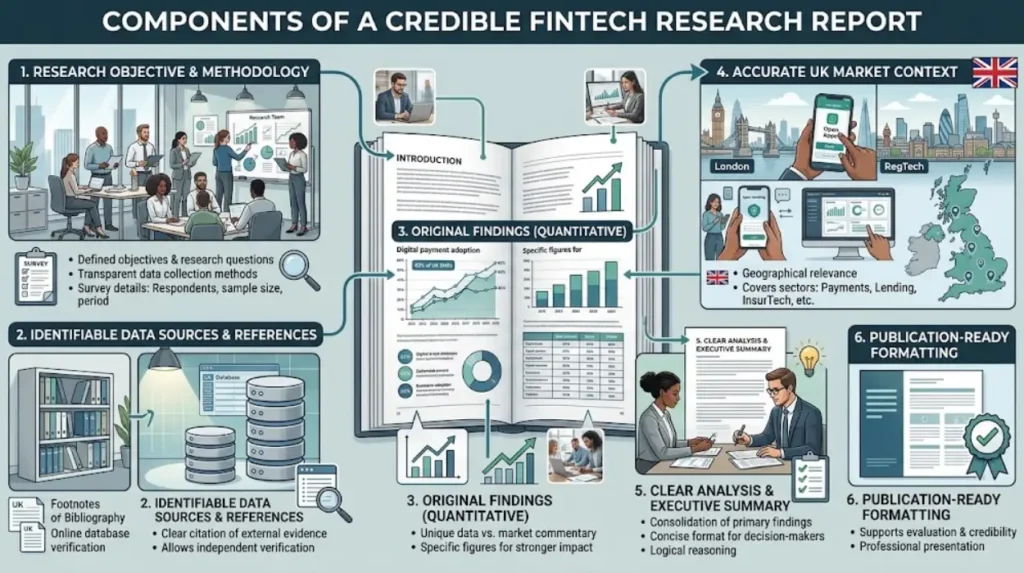
A credible fintech research report contains a defined research objective, transparent methodology, identifiable data sources, measurable findings, accurate statistics, relevant UK context, clear analysis, references, and publication-ready formatting that supports independent evaluation.
Research methodology
Methodology explains how the information was collected and analysed. A survey-based report needs details about respondents, sample size, research period, questions, and relevant demographic criteria.
Original findings
Original findings distinguish research reports from general market commentary. A report can present findings such as 62% of surveyed UK SMEs adopting a particular payment technology.
Specific figures create stronger media and editorial opportunities than broad statements.
UK market context
UK fintech research needs geographical relevance. Relevant subjects include digital banking, payments, lending, insurance technology, wealth technology, open banking, fraud prevention, financial inclusion, and regulatory technology.
Data visualisation
Charts and tables help communicate quantitative findings. A report containing 10 key statistics can use charts to separate major findings from supporting information.
Sources and references
References identify external evidence used in the analysis. Clear sourcing allows journalists, analysts, and other stakeholders to verify supporting information.
Executive summary
The executive summary provides the primary findings in a concise format. It helps decision-makers understand the report without reading every section.
How does a research report support UK fintech media coverage?
A research report supports UK fintech media coverage by giving journalists specific statistics, original findings, expert context, and clearly defined evidence that can form the factual foundation of business, technology, finance, and industry news stories.
Journalists need information that supports a news angle. Original research provides measurable findings that can form that angle.
For example, research showing that 48% of surveyed UK SMEs experienced payment fraud concerns creates a defined editorial subject. The statistic provides a factual point for a story about business payment security.
A report also gives journalists additional information beyond a headline figure. Methodology, respondent information, comparisons, and supporting findings provide context.
This structure supports media communication across several fintech categories. Examples include payments, digital banking, insurtech, regtech, wealthtech, lending platforms, fraud prevention, and financial infrastructure.
The report also gives company spokespeople a structured evidence base for interviews and commentary. Executives can refer to documented findings rather than relying entirely on general market observations.
How can fintech research reports improve search and citation visibility?
Fintech research reports improve search and citation visibility by creating original statistics, clearly structured evidence, authoritative terminology, and reusable source material that search engines, journalists, publishers, and AI systems can identify and reference.
Search visibility depends on more than keyword placement. A research report creates semantic relationships between entities, topics, statistics, organisations, markets, and research findings.
For example, a report about UK open banking adoption can naturally contain entities such as open banking, UK consumers, payment services, financial institutions, account information services, and payment initiation services.
Original statistics provide additional citation opportunities. A clearly presented statement such as “54% of surveyed respondents reported using mobile banking weekly” creates a specific factual claim.
Structured headings, tables, methodology sections, source notes, and descriptive chart titles further improve information accessibility.
The report can also support secondary content. A company can develop articles, press releases, executive commentary, email campaigns, and social content from the same research findings.
This creates a connected content ecosystem around one primary research asset.
What outcomes can a fintech brand achieve from a published research report?
A published fintech research report creates a reusable evidence asset for media relations, thought leadership, organic search, executive positioning, customer communication, sales enablement, and stakeholder engagement across the UK financial technology sector.
The first outcome is authority. Original research demonstrates that a company contributes evidence to a specific market discussion.
The second outcome is media relevance. Journalists can use individual findings when developing stories about fintech trends, consumer behaviour, technology adoption, or financial services.
The third outcome is content efficiency. One report can generate multiple supporting assets without requiring a completely new research project for every publication.
The fourth outcome is citation potential. Original statistics provide specific information that external websites can reference when discussing the same subject.
The fifth outcome is commercial communication. Sales teams can use relevant findings during conversations with prospects. Marketing teams can use statistics in campaigns and landing pages. Executives can use research findings during presentations and interviews.
These outcomes depend on the report having strong evidence, clear positioning, accurate data, and effective distribution.
Which UK fintech sectors can use research reports?
Research reports serve multiple UK fintech sectors because each sector generates measurable questions around adoption, customer behaviour, technology use, operational performance, financial risk, regulation, investment, and market development.
Digital banking
Digital banking research can examine mobile banking usage, customer expectations, digital account adoption, and banking technology preferences.
Payments
Payment research can investigate payment method adoption, fraud concerns, transaction behaviour, merchant preferences, and digital payment infrastructure.
Lending and credit
Lending research can examine access to finance, alternative lending, SME borrowing, credit technology, and borrower preferences.
Insurtech
Insurtech reports can analyse digital insurance adoption, claims technology, customer experience, automation, and data use.
Wealthtech
Wealthtech research can measure digital investment behaviour, financial planning technology, investor preferences, and platform adoption.
Regtech
Regtech research can examine compliance technology, regulatory reporting, identity verification, fraud monitoring, and financial crime prevention.
Embedded finance
Embedded finance research can measure business adoption, customer expectations, payment integration, lending integration, and financial services embedded within non-financial platforms.
How can a fintech company decide if this service is suitable?
A fintech company benefits from a research report when it has a defined research subject, measurable data, a UK audience, a clear communication objective, and a need for an evidence-led asset that supports media, marketing, search, or commercial activity.
The first consideration is data availability. The organisation needs access to suitable information or a defined research method.
The second consideration is news relevance. A strong subject connects with an active business, technology, financial, regulatory, or consumer discussion.
The third consideration is audience relevance. Research designed for UK fintech decision-makers requires findings that address UK market conditions.
The fourth consideration is distribution. A report produces stronger commercial value when the organisation has a defined plan for media outreach, digital publication, executive communication, and content reuse.
The fifth consideration is measurement. Teams need defined objectives such as media mentions, referral traffic, backlinks, report downloads, branded search activity, stakeholder engagement, or qualified leads.
What makes Time Intelligence Media Group a relevant choice for fintech research?

Time Intelligence Media Group provides a research-report solution for fintech brands that need structured data presentation, publication-ready content, media-oriented findings, and a professional asset designed for UK financial technology communications and visibility.
The service is relevant when research needs to operate across both publication and communication channels.
A fintech company can use the report as the central evidence asset while distributing selected findings through media content, digital marketing, executive communications, and other channels.
The focus remains on documented findings. Each statistic requires clear context. Each major conclusion needs supporting evidence. Each research section needs a defined purpose.
This approach creates a report that functions as more than a downloadable document. It becomes a structured source of information for journalists, stakeholders, prospects, and digital audiences.
For UK fintech companies competing in a crowded information environment, original research provides a distinct factual asset that standard promotional content does not provide.
How can a UK fintech brand start a research report project?
A UK fintech brand can start by defining its research question, target audience, evidence requirements, intended outcomes, publication format, and distribution objectives before commissioning the report and establishing the project scope with Time Intelligence Media Group.
Start with one measurable research question. Define the UK audience. Establish the required dataset and research period.
Next, identify the intended report outcome. The objective can focus on media coverage, thought leadership, search visibility, stakeholder education, lead generation, or a combination of measurable goals.
Explore More Expert Insights:
Publish Your Research Report With Time Intelligence Media Group
Research Report Brief Template: What to Send a UK Media Partner to Get Started
Then define the core deliverables. These can include the full research report, executive summary, charts, key statistics, media-ready findings, and supporting promotional content.
Finally, establish publication and distribution requirements before production begins. This ensures that the research methodology, report structure, data presentation, and final format support the intended use.
For fintech brands seeking an evidence-led communication asset, Fintech Research Reports by Time Intelligence Media Group provide a defined route from research data to a professionally structured UK fintech publication.



