

Publishing your research report with Time Intelligence Media Group provides a structured route from completed research to UK media exposure, using report publication, news distribution, targeted media outreach, and measurable coverage across relevant news platforms.
A research report contains original findings, data, analysis, or evidence that addresses a defined topic. Publishing the report through a media-focused distribution service turns that research into a news asset designed for journalists, business audiences, search engines, and digital publications.
For UK organisations, publication requires more than placing a PDF on a website. The report needs a clear news angle, strong supporting data, an accurate headline, concise findings, and media-ready content.
Time Intelligence Media Group provides a publication route focused on converting research findings into a media story. The process connects research production with distribution, coverage, and digital visibility.
Organisations can also review how a media-published report reaches multiple UK news sites before selecting a publication strategy.
How does Time Intelligence Media Group publish a research report?
Time Intelligence Media Group publishes a research report by transforming key findings into media-ready content, preparing the report for distribution, identifying relevant UK media opportunities, distributing the story, and tracking resulting publication and coverage.
1. Research report assessment
The process starts with the completed research report. Key information includes the research subject, sample size, methodology, principal findings, publication date, organisation, and intended audience.
The report needs a defined news value. A statistic such as “42% of UK SMEs increased technology spending in 2026” creates a clearer media angle than a general statement about technology adoption.
2. News angle development
The strongest finding becomes the central news angle. Supporting findings provide additional context.
For example, a report examining UK fintech investment can focus on investment growth, changes in funding preferences, regional differences, or adoption rates. Each angle creates a different media narrative.
3. Media-ready content creation
Research findings are converted into concise publication material. This includes the headline, introduction, key statistics, supporting information, organisation description, and relevant report details.
The content remains fact-based. Claims connect directly to the underlying research.
4. Distribution and publication
The completed media content enters the distribution process. Relevant UK news websites and media channels receive the publication.
The objective is to place the research where its subject has editorial relevance. A property report requires different media targeting from a healthcare, fintech, technology, or professional-services report.
5. Coverage monitoring
Published coverage is monitored after distribution. This creates a record of where the report appears and how the research travels across digital media.
The resulting coverage provides measurable evidence of media distribution rather than relying solely on website traffic or social engagement.
What does a media-published research report include?
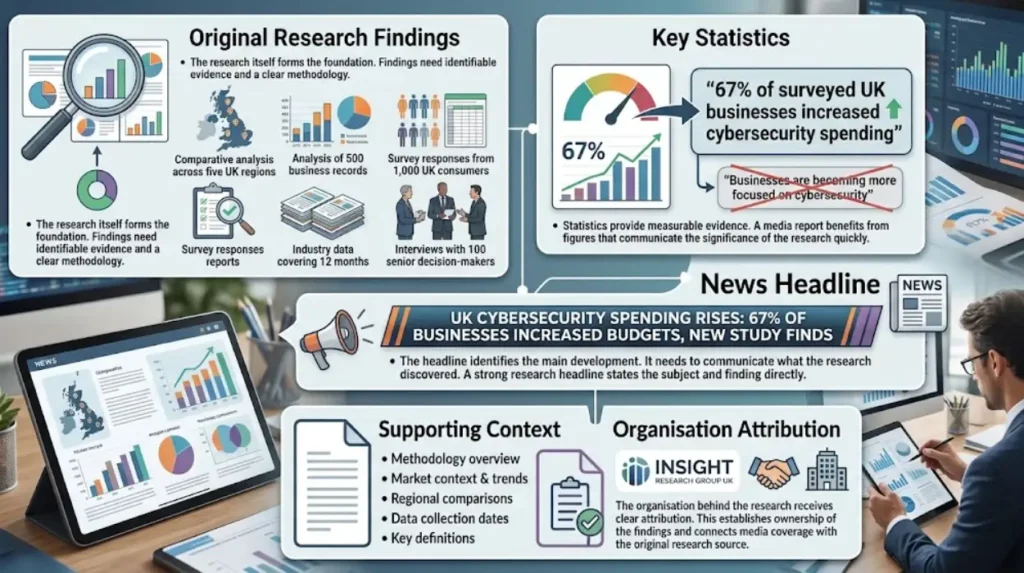
A media-published research report includes original findings, a defined news angle, evidence-based statistics, supporting context, an organisation profile, publication information, and media-ready content that communicates the research clearly to UK audiences.
Original research findings
The research itself forms the foundation. Findings need identifiable evidence and a clear methodology.
Examples include:
- Survey responses from 1,000 UK consumers
- Analysis of 500 business records
- Industry data covering 12 months
- Interviews with 100 senior decision-makers
- Comparative analysis across five UK regions
Specific research details increase clarity for journalists and professional audiences.
Key statistics
Statistics provide measurable evidence. A media report benefits from figures that communicate the significance of the research quickly.
For example, “67% of surveyed UK businesses increased cybersecurity spending” communicates a specific finding. “Businesses are becoming more focused on cybersecurity” provides less measurable information.
News headline
The headline identifies the main development. It needs to communicate what the research discovered.
A strong research headline states the subject and finding directly.
Supporting context
Supporting information explains why the finding matters within its sector. This section can include methodology, market context, comparisons, dates, and definitions.
Organisation attribution
The organisation behind the research receives clear attribution. This establishes ownership of the findings and connects media coverage with the original research source.
How does the publication process support UK media coverage?
The publication process supports UK media coverage by presenting research as a structured news story, connecting findings with relevant media interests, distributing content across appropriate channels, and creating publication opportunities that extend beyond an organisation’s owned website.
UK media coverage depends on relevance, timing, evidence, and presentation. Research reports provide strong source material because they contain original information.
A report on UK consumer spending provides a different editorial proposition from a report on commercial property vacancies. Media targeting needs to reflect that distinction.
Time Intelligence Media Group positions the report around its strongest newsworthy findings. This creates a clearer connection between the research and the media audience.
Distribution also extends the report beyond an organisation’s existing audience. A company website primarily reaches existing visitors, customers, prospects, and search users. Media publication introduces the research to external audiences through news platforms.
This creates multiple discovery points for the same research asset.
What benefits does publishing a research report provide?
Publishing a research report provides measurable media exposure, stronger research visibility, third-party publication opportunities, brand attribution, potential referral traffic, reusable content assets, and a wider distribution footprint across relevant UK digital media channels.
Increased research visibility
Research requires an audience to create commercial and informational value. Media publication places findings in front of audiences beyond the original report landing page.
A 2026 UK employment report, for example, gains additional visibility when its findings appear in business and employment-focused publications.
Third-party validation
Publication on external media websites creates third-party references to the research. The organisation is no longer the only source discussing its findings.
This distinction matters when prospects, journalists, analysts, and search systems assess the visibility of a research topic.
Brand attribution
Media coverage connects research findings with the organisation that produced them. This creates an association between the organisation and the subject covered by the research.
A cybersecurity consultancy publishing original research on UK ransomware trends can build stronger subject relevance when its findings appear alongside its company attribution.
Search visibility
Published coverage creates additional indexed pages containing references to the organisation, research topic, and findings.
Where publishers provide appropriate links, coverage can also generate referral pathways to the original report or relevant website pages.
Content reuse
One research report can generate several communication assets. These include media coverage, social posts, website content, sales material, executive commentary, presentations, and follow-up research.
This increases the practical value of the original research investment.
Which organisations can use research report publication?
Research report publication suits organisations that produce original data and need external visibility, including consultancies, fintech companies, technology firms, universities, professional-services businesses, charities, property companies, and research-led organisations.
Fintech companies
A fintech company can publish research covering payments, financial behaviour, digital banking, fraud, investment, or financial technology adoption.
For example, a report showing changes in UK digital payment preferences provides a specific media story.
Professional-services firms
Consultancies, legal firms, accountants, and advisory businesses can use research to demonstrate sector knowledge.
A 2026 report analysing SME business confidence gives a professional-services firm an evidence-based media asset.
Property and construction firms
Property organisations can publish research covering house prices, commercial property, construction activity, development trends, or regional investment.
Regional findings create additional editorial angles when the research compares London, Manchester, Birmingham, Leeds, and other UK markets.
Technology companies
Technology companies can publish research covering artificial intelligence, cybersecurity, cloud adoption, software use, digital transformation, and technology spending.
Original statistics provide a stronger media proposition than general product messaging.
Charities and research organisations
Charities can publish evidence covering social issues, public attitudes, community needs, fundraising, employment, education, or access to services.
Research-led publication gives these findings a route into wider public and professional discussion.
What should you prepare before publishing your research report?
Before publication, prepare the final research report, methodology, key statistics, supporting evidence, preferred headline, organisation information, publication objectives, target audience, and destination URL to create an accurate and efficient media distribution process.
A publication-ready checklist includes:
- Final research report
- Research methodology
- Sample size or dataset description
- Three to five principal findings
- Supporting statistics
- Publication date
- Organisation description
- Research contact information
- Preferred media angle
- Destination URL
- Target UK audience
- Relevant industry categories
Accuracy is essential. Every statistic in the media content needs to match the underlying research.
The destination URL also needs to point to the relevant report or landing page. Sending media traffic to an unrelated homepage reduces the connection between coverage and research.
How can you measure the results of research report publication?
Research report publication can be measured through the number of media placements, publishing domains, coverage quality, referral traffic, backlinks, branded searches, engagement, and conversions associated with the published research and resulting media exposure.
Media placements
Count the number of confirmed publications carrying the research story.
Publishing domains
Measure the number of distinct websites that publish the report or its findings. Domain count provides a clearer distribution measurement than page-view totals alone.
Referral traffic
Track visits arriving from published media coverage using analytics and campaign tracking.
Backlinks
Record links pointing from external publications to the original report or relevant company page. Link quality depends on the publishing domain, relevance, placement, and destination.
Lead generation
For commercially focused reports, track enquiries, downloads, consultation requests, registrations, or other defined conversion events.
A report about UK procurement technology, for example, can direct interested readers towards a relevant research landing page and measure subsequent enquiries.
Why choose Time Intelligence Media Group for research report publication?
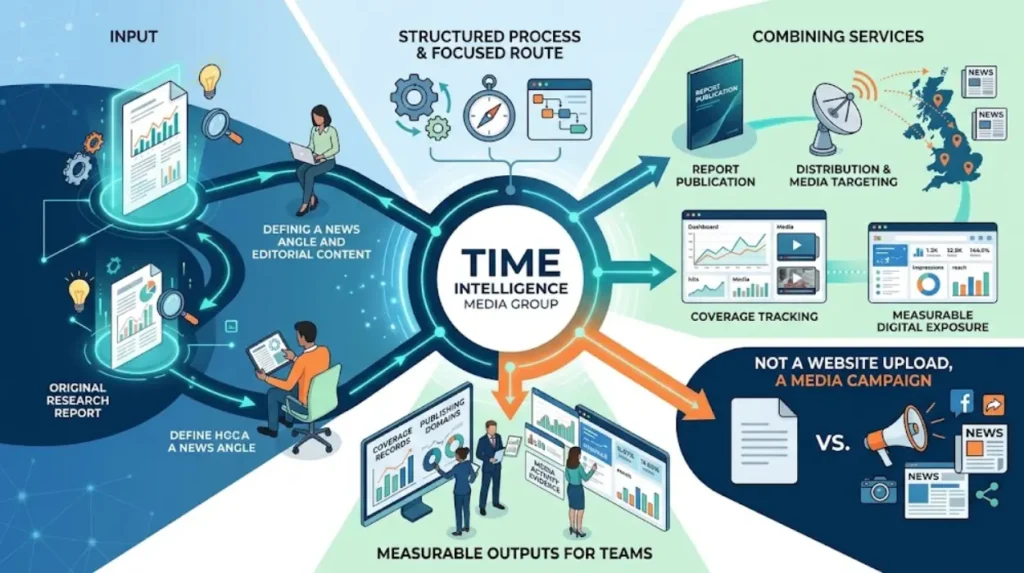
Time Intelligence Media Group provides a focused route for organisations that want to turn original research into UK media content, combining report publication, distribution, media targeting, coverage tracking, and measurable digital exposure within one structured process.
The decision depends on the organisation’s publication objectives.
A business seeking UK media visibility needs more than a report upload. It needs a defined news angle, accurate editorial content, appropriate distribution, and measurable results.
Time Intelligence Media Group focuses on this publication workflow. The service connects the research asset with media distribution rather than treating the report as an isolated website document.
Explore More Expert Insights:
Research Report Brief Template: What to Send a UK Media Partner to Get Started
Research as a Lead Generation Engine: A 6-Month UK Attribution Case Study
The approach also supports organisations that need evidence of media activity. Coverage records, publishing domains, and resulting digital activity provide measurable outputs for internal marketing and communications teams.
For organisations comparing publication approaches, the next step is to define the research topic, target UK audience, principal findings, desired publication timing, and measurement criteria.
How do you publish your research report with Time Intelligence Media Group?
To publish your research report with Time Intelligence Media Group, prepare the completed research, identify its strongest news finding, define your UK audience, provide the required publication information, and request a distribution plan based on your objectives.
Start with the report itself. Identify the three most important findings and the statistic that best communicates the central development.
Then define the intended audience. A report targeting UK fintech decision-makers requires different media relevance from a report targeting consumers, property professionals, healthcare organisations, or technology buyers.
Next, establish the desired outcome. Common objectives include media coverage, research visibility, referral traffic, backlinks, brand attribution, lead generation, or a combination of these outcomes.
Finally, provide the publication materials and request the appropriate distribution process from Time Intelligence Media Group.
The result is a structured route from original research → media-ready content → UK distribution → published coverage → measurable digital exposure.
For organisations ready to move from research production to media publication, this process provides a practical decision framework for turning a completed report into a wider UK media asset.



