

Sponsored content is paid media that publishes a brand’s message within a trusted editorial environment. Unlike traditional advertising, it uses educational, informative, or commercially relevant content to attract readers who already show interest in a specific topic, industry, product, or business problem.
For UK businesses, sponsored content creates a structured path from audience attention to lead generation. A reader discovers an article, evaluates its relevance, engages with the information, and takes a measurable action. This process turns content visibility into identifiable prospects.
Businesses using sponsored content need more than publication reach. They need relevant audiences, clear messaging, useful information, credible publishers, conversion-focused calls to action, and measurable lead attribution. Each component affects the quality of leads generated from the campaign.
What makes sponsored content different from ordinary advertising?
Sponsored content combines paid distribution with useful editorial-style information, allowing brands to reach relevant readers through articles, guides, interviews, or educational features that encourage engagement before a commercial conversion.
Traditional display advertising places a promotional message directly in front of an audience. Sponsored content uses a longer information format. The reader interacts with the subject before encountering the commercial proposition.
Common sponsored content formats include:
- Educational industry articles
- Expert interviews
- Research-led features
- Product explainers
- Business trend reports
- Customer-focused case studies
- Practical guides
For example, a UK cybersecurity company can publish an article explaining ransomware risks for small businesses. The content attracts readers researching cybersecurity problems. A relevant call to action can then direct interested readers towards a security assessment or consultation.
This creates a connection between content relevance and commercial intent.
Businesses at the consideration stage often use sponsored content because the audience already has an identifiable interest. The content answers questions while positioning the business as a relevant solution provider.
Readers interested in understanding the broader role of sponsored content can explore:
Sponsored content for additional educational context.
How does sponsored content move readers through the lead-generation funnel?
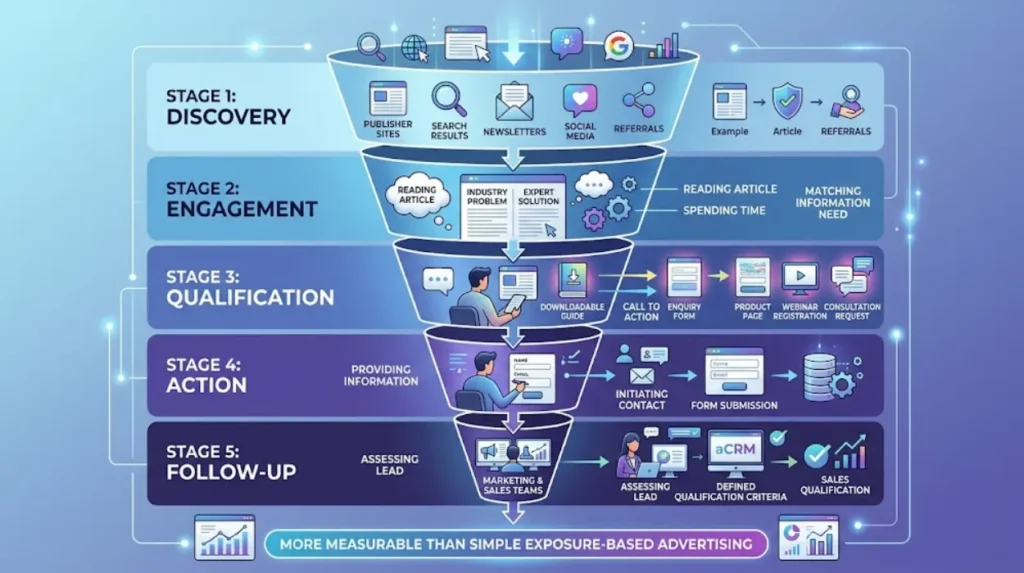
Sponsored content converts readers through sequential stages: discovery, engagement, qualification, action, and follow-up. Each stage removes low-intent audiences and identifies readers who demonstrate stronger interest in a business solution.
The first stage is discovery. A reader finds sponsored content through a publisher, search result, newsletter, social channel, or referral.
The second stage is engagement. The reader spends time consuming the article because the subject matches an existing information need.
The third stage is qualification. The reader interacts with a relevant commercial element, such as a downloadable guide, enquiry form, product page, webinar registration, or consultation request.
The fourth stage is action. The reader provides information or initiates contact.
The fifth stage is follow-up. Marketing and sales teams assess the lead against defined qualification criteria.
For example:
Article → Industry problem → Expert solution → Call to action → Landing page → Form submission → Sales qualification
This structure makes sponsored content more measurable than simple exposure-based advertising.
Which components make sponsored content effective for qualified lead generation?
Effective sponsored content combines audience relevance, useful information, credible publication, commercial alignment, conversion pathways, measurable calls to action, and lead qualification criteria that connect reader behaviour with business objectives.
Audience relevance
Audience relevance determines whether readers have a genuine connection to the subject.
A fintech article targeting UK financial professionals attracts a different audience from a general business article. The campaign therefore needs publication environments that match the intended customer profile.
Content relevance
Content relevance connects the reader’s information need with the business solution.
For example, a commercial property company can publish content about UK property investment risks. The topic attracts readers already researching the relevant market.
Editorial credibility
Publisher credibility affects how readers interpret the information. Established business, technology, finance, property, healthcare, and trade publications provide defined audience environments.
Conversion pathway
Every sponsored article needs a logical next action. Examples include downloading a report, requesting information, registering for an event, visiting a product page, or submitting an enquiry.
Lead qualification
Lead qualification separates general engagement from commercial interest.
A form submission from a reader seeking pricing information demonstrates stronger intent than a page view. A consultation request demonstrates stronger intent than a content download.
How does content quality affect lead quality?
Content quality affects lead quality because relevant, specific, and useful information attracts readers with stronger topic alignment. Clear explanations also create better conditions for readers to evaluate a business before submitting contact information.
Low-quality content attracts attention without establishing relevance. High-quality content addresses a defined problem and provides useful information connected to a specific industry or business need.
A strong sponsored article normally includes:
- A clearly defined subject
- A specific audience
- Evidence or factual information
- Practical explanations
- Relevant business context
- A logical next step
For example, a UK HR technology provider can publish an article explaining how organisations manage employee onboarding at scale. Readers researching onboarding systems have stronger topical relevance than a general audience reading an unrelated corporate announcement.
This distinction matters because lead volume and lead quality are separate metrics.
A campaign generating 500 low-intent visits does not automatically outperform a campaign generating 100 visits with 20 relevant enquiries.
How do calls to action turn readers into leads?
Calls to action convert reader interest into measurable behaviour by directing engaged audiences towards a specific next step. Effective calls to action match the article topic, reader intent, and stage of the buying process.
The call to action needs to continue the reader journey rather than interrupt it.
Suitable actions include:
- Download a detailed report
- Request a product guide
- Register for a webinar
- Book a consultation
- Explore a relevant service
- Request pricing information
- Contact a specialist
The appropriate action depends on the reader’s intent.
An educational article about financial compliance can direct readers towards a regulatory checklist. A product-focused article can direct readers towards product information. A comparison article can direct readers towards a consultation or pricing request.
The wording also needs to communicate the action clearly.
“Download the UK Compliance Checklist” provides a specific outcome. “Click Here” provides no information about the next step.
How can businesses qualify leads generated from sponsored content?
Businesses qualify sponsored-content leads by evaluating reader information, engagement behaviour, business relevance, purchase intent, and fit with predefined customer criteria rather than treating every conversion as an equally valuable sales opportunity.
Lead qualification starts with defined criteria.
For B2B businesses, these criteria can include:
- Company type
- Industry
- Employee count
- Geographic market
- Job role
- Business requirement
- Purchase timeframe
- Budget authority
- Requested solution
For example, a UK enterprise software provider targeting organisations with more than 250 employees can classify a matching decision-maker as a higher-priority lead than an individual outside its target market.
Content engagement provides another qualification signal.
A reader who views an article and leaves immediately demonstrates limited measurable intent. A reader who reads the article, visits a service page, downloads a technical guide, and submits an enquiry demonstrates stronger intent.
How does sponsored content support the UK B2B buying journey?
Sponsored content supports UK B2B buying journeys by providing information at multiple consideration points, helping prospects understand business problems, evaluate solutions, compare providers, and identify appropriate next actions before direct sales engagement.
B2B purchasing involves multiple information requirements. Decision-makers often research suppliers before contacting them.
Sponsored content supports this process by addressing questions such as:
- What problem requires attention?
- What solutions exist?
- What factors affect supplier selection?
- What risks require consideration?
- What implementation requirements apply?
- What results can businesses measure?
For example, a UK construction technology company can publish content explaining digital project management challenges. A procurement manager researching project management systems can use that information to assess the problem before evaluating vendors.
This positions sponsored content within the consideration stage, where readers already recognise a subject as commercially relevant.
The content also creates an opportunity to connect informational demand with a measurable business action.
How can businesses measure sponsored content lead-generation performance?
Businesses measure sponsored content performance through reach, engagement, traffic, conversion rate, lead volume, qualified leads, cost per lead, and revenue attribution, creating a measurable connection between publication activity and commercial outcomes.
Key metrics include:
| Metric | What it measures |
|---|---|
| Impressions | Content visibility |
| Clicks | Audience response |
| Engagement | Reader interaction |
| Referral traffic | Visitors generated |
| Conversion rate | Percentage completing an action |
| Leads | Identifiable prospects |
| Qualified leads | Prospects meeting defined criteria |
| Cost per lead | Acquisition efficiency |
| Sales opportunities | Leads entering the sales pipeline |
| Revenue | Commercial outcome |
Businesses need to measure these metrics across the same campaign.
For example, a campaign generating 2,000 visits and 40 leads produces a 2% visitor-to-lead conversion rate. If 12 of those leads meet the company’s qualification criteria, the campaign generates 12 qualified leads rather than simply 40 contacts.
This distinction gives marketing teams a clearer view of campaign performance.
When is sponsored content suitable for lead generation?
Sponsored content is suitable when a business needs targeted visibility, educational engagement, qualified website traffic, measurable conversions, or stronger consideration-stage communication within a defined industry or audience market.
Sponsored content works across multiple B2B use cases.
New market entry
A business entering a UK market can use sponsored content to introduce its expertise to an established audience.
Product education
Complex products require explanation before purchase. Sponsored articles provide space for technical and commercial information.
Thought leadership
Businesses can publish expert perspectives around specific industry challenges and emerging business requirements.
Event promotion
Companies can use sponsored content to explain an event topic, introduce speakers, or direct relevant readers towards registration.
Research promotion
Businesses producing original research can use sponsored content to present key findings and direct interested readers towards the full report.
Lead-generation campaigns
A campaign can connect an informative article with a landing page, gated resource, consultation, or enquiry form.
These applications demonstrate why sponsored content functions as more than a visibility channel. Its structure connects information discovery with measurable commercial action.
How should businesses choose a sponsored content approach?
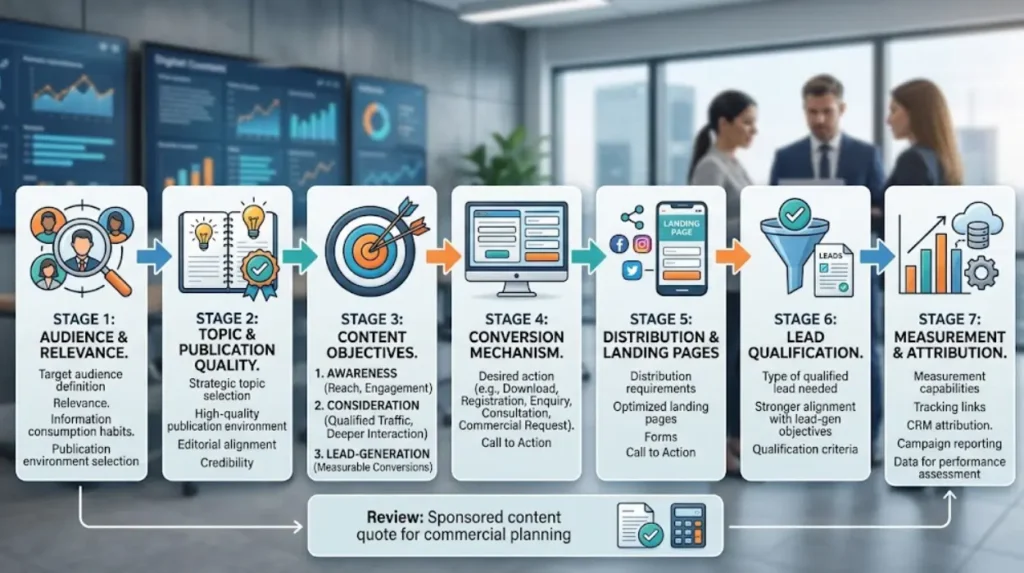
Businesses should select a sponsored content approach based on audience relevance, publication quality, content objectives, conversion intent, distribution requirements, measurement capabilities, and the type of qualified lead the campaign needs to generate.
The first consideration is the target audience. The campaign needs a publication environment where relevant readers already consume business information.
The second consideration is the content objective. Awareness campaigns prioritise reach and engagement. Consideration campaigns prioritise qualified traffic and deeper interaction. Lead-generation campaigns prioritise measurable conversions.
The third consideration is the conversion mechanism. A business needs to decide whether the desired action is a download, registration, enquiry, consultation, or commercial request.
The fourth consideration is measurement. Tracking links, landing pages, forms, CRM attribution, and campaign reporting create the data required to assess performance.
A structured approach therefore follows this sequence:
Audience → Topic → Publication → Content → Call to action → Landing page → Qualification → Measurement
This process creates stronger alignment between sponsored media activity and lead-generation objectives.
Businesses evaluating the next stage of a sponsored content campaign can review:
Sponsored content quote to understand the commercial planning process.
What is the main advantage of using sponsored content for qualified leads?
The main advantage of sponsored content is its ability to connect targeted audience exposure with useful information and measurable actions, allowing businesses to identify readers who demonstrate genuine interest in a relevant product, service, or business solution.
Sponsored content provides a structured bridge between visibility and lead generation.
Explore More Expert Insights:
How Recruitment Sponsored Content Reaches UK Candidates
Sponsored Content vs Display Ads: What Converts Better
The strongest campaigns do not treat every reader as a prospect. They use relevant subjects to attract appropriate audiences, useful information to sustain engagement, and specific calls to action to identify commercial interest.
For UK businesses, this creates a measurable consideration-stage channel. The campaign begins with audience discovery and ends with identifiable actions that marketing and sales teams can evaluate.
The result is a clearer relationship between content consumption, reader intent, lead qualification, and business opportunity.



