

Recruitment firms use sponsored content to place structured, brand-controlled stories across relevant media environments while reaching UK candidates, employers, hiring managers, and professional audiences. Recruitment sponsored content by Time Intelligence Media Group provides a paid media route for recruitment brands seeking controlled publication, audience reach, and measurable content distribution.
Sponsored content differs from traditional editorial coverage because the organisation funds the placement and retains greater control over the published message. For recruitment businesses, this format supports employer positioning, vacancy campaigns, recruitment insights, sector commentary, candidate education, and service promotion.
For organisations assessing recruitment sponsored content, the decision depends on publication relevance, audience alignment, content quality, distribution, campaign objectives, and reporting. A structured campaign connects the content topic with a defined recruitment audience and measurable business outcome.
What is recruitment sponsored content by Time Intelligence Media Group?
Recruitment sponsored content is paid media content created for recruitment businesses and distributed through selected publication environments, giving firms controlled messaging, audience targeting, measurable exposure, and a structured route to communicate with UK candidates.
The content can present a recruitment firm’s expertise, explain employment trends, promote specialist recruitment services, or support a specific hiring campaign. The commercial relationship is disclosed according to applicable publication and advertising requirements.
Time Intelligence Media Group positions sponsored content as a media distribution service rather than conventional recruitment advertising alone. The format supports longer-form communication than a standard display advertisement.
A recruitment company can use sponsored content to communicate information such as:
- Specialist recruitment expertise
- Salary and employment insights
- Candidate guidance
- Employer recruitment challenges
- Sector hiring trends
- Recruitment technology developments
- Executive search expertise
- Apprenticeship and graduate opportunities
- Workforce planning information
- Recruitment service capabilities
The central distinction is control. A recruitment firm supplies the campaign message, subject matter, brand information, and required commercial details. The publishing process then places that content within an appropriate media environment.
How does Time Intelligence Media Group distribute recruitment sponsored content?
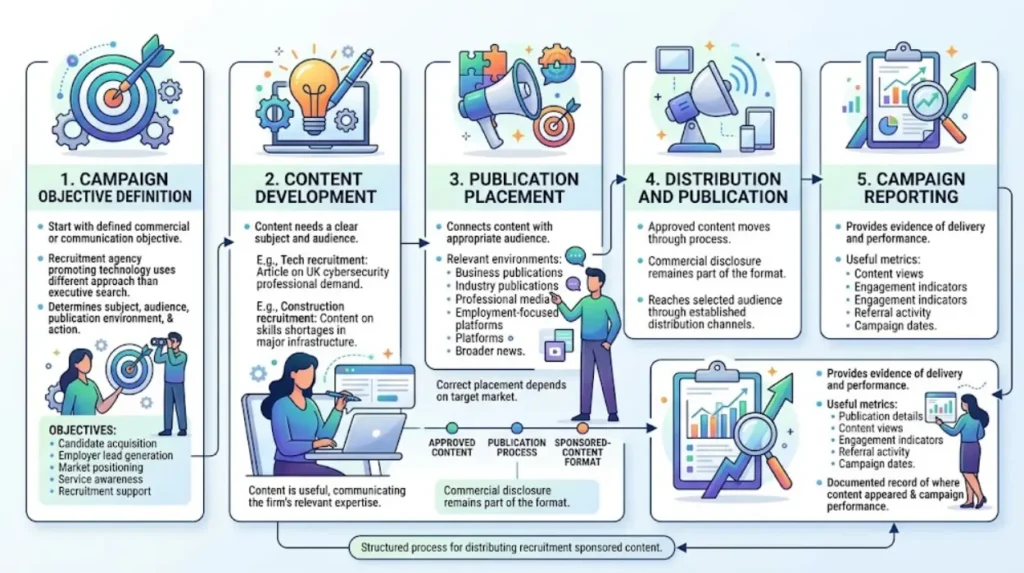
Time Intelligence Media Group distributes recruitment sponsored content through a structured process covering campaign objectives, content preparation, publication selection, placement, distribution, and reporting, allowing recruitment firms to maintain message control while reaching relevant UK professional and candidate audiences.
1. Campaign objective definition
The campaign begins with a defined commercial or communication objective.
A recruitment agency promoting technology recruitment uses a different content approach from a firm promoting executive search. The objective determines the subject, audience, publication environment, and desired action.
Typical objectives include candidate acquisition, employer lead generation, market positioning, service awareness, and recruitment campaign support.
2. Content development
The content needs a clear subject and audience.
A technology recruitment firm can publish an article explaining the demand for cybersecurity professionals in the UK. A construction recruitment agency can publish content addressing skills shortages across major infrastructure projects.
The content remains useful while communicating the recruitment firm’s relevant expertise.
3. Publication placement
Publication selection connects the content with an appropriate audience.
Relevant environments include business publications, industry publications, professional media, employment-focused platforms, and broader news audiences. The correct placement depends on the recruitment firm’s target market.
4. Distribution and publication
The approved content moves through the publication process. Commercial disclosure remains part of the sponsored-content format.
The campaign then reaches the selected audience through the publication’s established distribution channels.
5. Campaign reporting
Reporting provides evidence of campaign delivery and performance.
Useful metrics include publication details, content views where available, engagement indicators, referral activity, campaign dates, and other supplied performance information.
This creates a documented record of where the recruitment firm’s sponsored content appeared and how the campaign performed.
What does recruitment sponsored content include?
Recruitment sponsored content includes branded articles, recruitment insights, candidate-focused education, employer guidance, sector analysis, hiring commentary, and service-led stories designed for publication within relevant UK media environments.
Branded recruitment articles
A recruitment company can explain a specific industry issue through a branded article.
For example, an engineering recruitment agency can publish content about demand for electrical engineers across UK infrastructure projects.
Candidate-focused content
Candidate content addresses questions related to careers, recruitment processes, skills, interviews, salaries, and employment markets.
For example, a specialist finance recruiter can publish guidance explaining the qualifications required for senior financial roles.
Employer-focused content
Employer content addresses hiring challenges and workforce decisions.
For example, an IT recruitment firm can publish an article explaining how businesses structure recruitment for cloud engineering positions.
Sector commentary
Sector-specific commentary establishes relevance around an identifiable employment market.
Examples include healthcare recruitment, construction recruitment, financial services recruitment, technology recruitment, legal recruitment, and logistics recruitment.
Recruitment service content
Sponsored content can explain a firm’s recruitment service without relying solely on a short advertisement.
An executive search business can explain its approach to senior appointments, leadership hiring, or specialist talent acquisition.
Why do UK recruitment firms use sponsored content?
UK recruitment firms use sponsored content to control campaign messaging, reach defined professional audiences, support recruitment services, communicate specialist expertise, and create measurable media assets around candidate acquisition, employer engagement, and recruitment brand visibility.
Traditional recruitment advertising often prioritises immediate response. Sponsored content adds an informational layer to the campaign.
A recruitment firm can explain its expertise before asking an audience to enquire, apply, register, or visit a service page.
The format also supports specific market positioning.
For example, a recruitment company specialising in financial technology can publish content focused on fintech hiring requirements. The topic establishes contextual relevance while presenting the company’s expertise.
Sponsored content also provides a controlled environment for messages that require more explanation than a banner advertisement permits.
A recruitment firm entering a new UK sector can use content to explain its specialist knowledge, recruitment methodology, and understanding of that market.
How does recruitment sponsored content reach UK candidates?
Recruitment sponsored content reaches UK candidates by placing relevant recruitment information within media environments that attract professional audiences, allowing firms to communicate career, employment, sector, and candidate-focused messages beyond individual vacancy advertising.
Audience relevance starts with subject selection.
A candidate searching for information about engineering careers responds to different content from a senior finance professional researching leadership recruitment trends.
The campaign therefore needs a defined audience before content production begins.
Audience segmentation
Recruitment audiences can include:
- Jobseekers
- Passive candidates
- Senior professionals
- Hiring managers
- HR professionals
- Business owners
- Department leaders
- Sector specialists
- Graduates
- Contractors
For example, a graduate recruitment campaign can focus on early-career guidance, while an executive search campaign can focus on leadership hiring and senior-level career trends.
Contextual relevance
The content topic determines the audience context.
A healthcare recruitment article about nursing workforce demand has stronger contextual relevance for healthcare professionals than a generic recruitment advertisement.
Media distribution
Publication through established media environments expands the campaign beyond the recruitment firm’s owned website.
The result is a content asset that combines recruitment messaging with a media publication environment.
What business outcomes can recruitment sponsored content support?
Recruitment sponsored content supports candidate awareness, employer engagement, recruitment brand positioning, specialist-market visibility, website referral activity, and campaign communication when content, publication placement, audience targeting, and measurement align with defined business objectives.
The outcome depends on the campaign objective and measurement framework.
Candidate acquisition
Content can direct interested candidates towards vacancies, registration pages, career resources, or specialist recruitment services.
Employer lead generation
Recruitment firms targeting employers can publish content around workforce challenges and hiring requirements before directing qualified business audiences towards a consultation or service page.
Specialist positioning
A recruitment firm can demonstrate expertise within a defined employment market.
For example, a cybersecurity recruiter can create content around cyber skills demand, specialist roles, and recruitment challenges.
Brand visibility
Sponsored publication creates an additional branded media presence outside the company’s owned channels.
Website traffic
Campaign content can direct users towards relevant recruitment services or informational pages where appropriate tracking is available.
How should recruitment firms evaluate a sponsored content campaign?
Recruitment firms should evaluate sponsored content through publication relevance, audience alignment, content quality, campaign objectives, distribution scope, reporting detail, commercial disclosure, and total campaign value rather than judging performance through publication volume alone.
A decision framework helps recruitment firms compare providers consistently.
Publication relevance
The publication needs an audience connected to the campaign objective.
A specialist recruitment campaign benefits from relevant professional or industry environments rather than unrelated reach.
Content quality
The article needs a defined subject, accurate information, logical structure, and a clear relationship with the recruitment brand.
Distribution scope
Firms need to understand where the content appears and how distribution is handled.
Reporting
The provider needs to define what campaign reporting includes.
Relevant reporting can cover publication information, campaign timing, URLs, available engagement data, and other agreed metrics.
Commercial transparency
Sponsored content needs clear commercial identification where required. Recruitment firms also need clarity about what the service includes before approving a campaign.
What types of recruitment businesses can use sponsored content?
Recruitment sponsored content applies to specialist agencies, executive search firms, temporary staffing businesses, permanent recruitment agencies, talent consultancies, sector-specific recruiters, and recruitment technology companies targeting defined UK professional audiences.
Specialist recruitment agencies
Specialist agencies can use sector-specific content to communicate expertise within areas such as technology, engineering, healthcare, finance, legal services, and construction.
Executive search firms
Executive search companies can publish leadership and workforce content aimed at senior professionals and business decision-makers.
Temporary staffing firms
Temporary staffing providers can communicate information about workforce flexibility, seasonal hiring, labour requirements, and candidate preparation.
Recruitment technology companies
Recruitment software businesses can use sponsored content to explain hiring technology, applicant management, automation, workforce analytics, and recruitment processes.
Talent consultancies
Talent consultancies can publish content around workforce strategy, skills planning, employee development, and talent acquisition.
How can a recruitment firm start a sponsored content campaign?
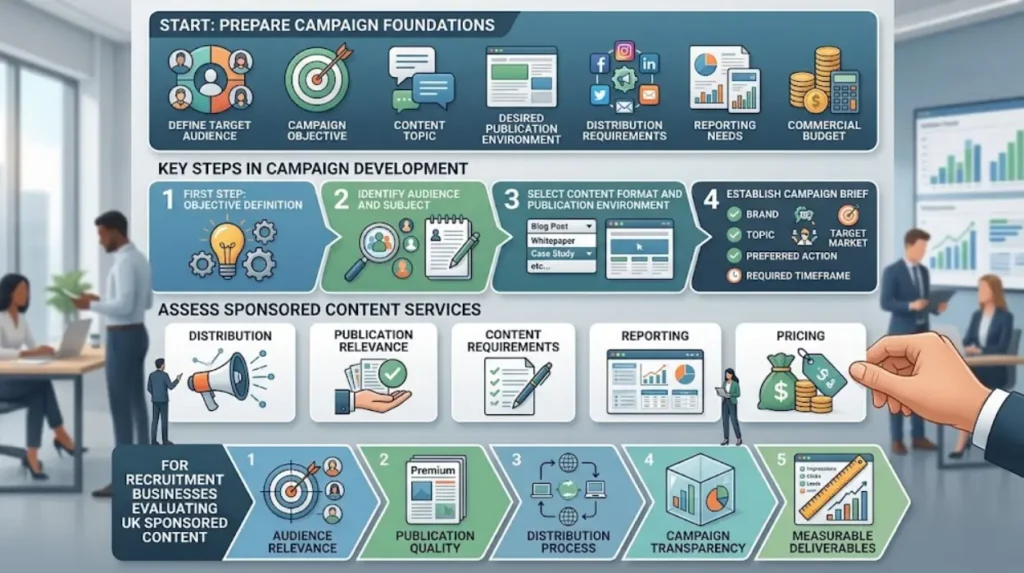
A recruitment firm can start by defining its target audience, campaign objective, content topic, desired publication environment, distribution requirements, reporting needs, and commercial budget before selecting a sponsored content provider and approving campaign materials.
The first step is objective definition.
The firm then identifies the audience and subject.
The next step is selecting the appropriate content format and publication environment. The campaign brief needs to establish the brand, topic, target market, preferred action, and required campaign timeframe.
The firm can then assess available sponsored content services based on distribution, publication relevance, content requirements, reporting, and pricing.
For recruitment businesses evaluating:
UK sponsored content, the most important comparison points are audience relevance, publication quality, distribution process, campaign transparency, and measurable deliverables.
Is recruitment sponsored content by Time Intelligence Media Group suitable for UK recruitment campaigns?
Recruitment sponsored content by Time Intelligence Media Group suits UK recruitment campaigns that require controlled branded messaging, media publication, professional audience reach, and documented campaign delivery across a structured sponsored content distribution process.
The service is particularly relevant when a recruitment firm needs more communication space than a conventional vacancy advertisement provides.
A campaign can focus on candidate education, employer engagement, recruitment expertise, sector commentary, or service awareness.
Explore More Expert Insights:
Time Intelligence Media Group vs Display Ads: Cost Compared
Niche Audience Sponsored Content by Time Intelligence Media Group
The decision depends on the recruitment firm’s objective, target audience, required publication environment, campaign scope, content requirements, and reporting expectations.
For firms ready to evaluate a campaign, the next step is to define the recruitment audience, campaign topic, business objective, preferred timeframe, and required distribution outcome. These inputs create a clear basis for selecting and commissioning recruitment sponsored content through Time Intelligence Media Group.



