

Sponsored content targets niche UK audiences by combining audience research, publication selection, contextual relevance, content formats, and distribution data. The approach connects a defined audience segment with content placed in media environments that already attract readers interested in a specific subject.
For UK brands, niche audience targeting focuses on relevance rather than broad exposure alone. A specialist publication can provide access to readers within sectors such as fintech, healthcare, property, technology, food and drink, professional services, or sustainability.
Understanding how this targeting process works helps marketing teams evaluate sponsored content options, select suitable publishers, and measure whether content reaches the intended UK audience.
What is sponsored content targeting for niche UK audiences?
Sponsored content targeting uses audience data, publication relevance, subject alignment, and distribution choices to place branded editorial-style material in media environments where defined UK audience segments actively consume information about specific industries, interests, products, or professional topics.
Sponsored content is paid media content created for a defined commercial purpose and published through a media platform. It differs from conventional display advertising because the content provides information through an article, feature, interview, guide, analysis, or other editorial-style format.
Niche audience targeting adds a second layer. The objective is not simply to generate impressions. The objective is to reach a specific group with a shared interest, occupation, location, industry, or purchasing context.
For example, a cybersecurity company targeting UK IT decision-makers benefits from technology and business publications that attract professionals responsible for security infrastructure. A property technology company targeting UK property professionals benefits from publications covering commercial property, construction, real estate investment, and development.
The targeting process therefore depends on audience-media alignment.
Readers researching a specialist subject already have a relevant information need. Sponsored content placed within that environment reaches the audience in a context connected to that need.
For broader educational context, readers can also explore:
How do brands identify niche audiences in the UK?
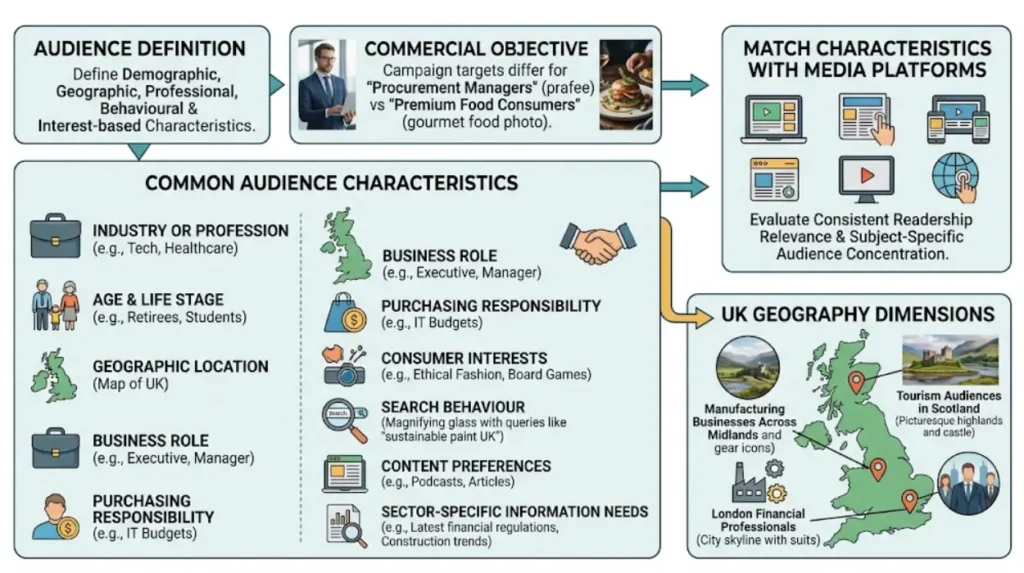
Brands identify niche UK audiences by defining demographic, geographic, professional, behavioural, and interest-based characteristics, then matching those characteristics with media platforms that demonstrate consistent readership relevance and subject-specific audience concentration.
Audience definition starts with the commercial objective. A campaign targeting procurement managers has different requirements from a campaign targeting consumers interested in premium food products.
Common audience characteristics include:
- Industry or profession
- Age and life stage
- Geographic location
- Business role
- Purchasing responsibility
- Consumer interests
- Search behaviour
- Content preferences
- Sector-specific information needs
UK geography also provides important targeting dimensions. A campaign focused on London financial professionals requires different media selection from one focused on manufacturing businesses across the Midlands or tourism audiences in Scotland.
Why does audience segmentation matter?
Audience segmentation separates a broad market into defined groups with identifiable characteristics. This improves media selection because publishers can be assessed against a specific audience rather than a general readership figure.
For example, “UK business audience” represents a broad category. “UK SME finance directors” represents a narrower segment with clearer professional responsibilities and information requirements.
The second definition creates stronger criteria for publisher selection.
How do publishers help sponsored content reach specialist audiences?
Publishers help sponsored content reach specialist audiences through established readerships, subject-focused editorial environments, relevant content categories, subscriber communities, search visibility, newsletters, and distribution channels connected to defined UK interests and professional sectors.
A publisher’s audience is shaped by its editorial focus. Specialist publications attract readers because they consistently cover a particular industry, profession, location, or interest.
This creates useful contextual alignment for sponsored content.
A healthcare publication attracts healthcare professionals and organisations. A construction publication attracts contractors, developers, architects, suppliers, and related professionals. A food publication attracts readers interested in restaurants, recipes, ingredients, hospitality, and food trends.
What is contextual relevance?
Contextual relevance describes the relationship between sponsored content and the subject matter of the publication where it appears.
A sponsored article about construction software has stronger contextual relevance within a construction industry publication than within an unrelated entertainment publication.
Context also affects reader expectations. Audiences visiting specialist publications expect detailed information about their chosen subject. Content that directly addresses that subject fits naturally within the surrounding information environment.
What role does content relevance play in niche audience targeting?
Content relevance connects the sponsored message with the audience’s existing information interests by addressing a specific topic, problem, trend, product category, or professional requirement that matches the publication’s established editorial subject and reader expectations.
Relevant content starts with the audience rather than the brand.
For example, a financial services company targeting UK small-business owners can publish content about business finance, cash-flow planning, payment technology, or financial regulation.
A technology company targeting UK CIOs can focus on cloud infrastructure, cybersecurity, data governance, or digital transformation.
The subject must match the audience’s information requirements.
Which content formats work for specialist audiences?
Common sponsored content formats include:
- Expert-led articles
- Industry guides
- Interviews
- Research-based features
- Data-led reports
- Trend analysis
- Educational explainers
- Product-focused editorial features
- Case-study content
A technology audience often responds to detailed technical explanations. A consumer audience often engages with practical guides, product information, and lifestyle-focused features.
Format selection therefore depends on audience expectations and subject complexity.
How does keyword and topic alignment improve niche targeting?
Keyword and topic alignment improves niche targeting by connecting sponsored content with the language, questions, entities, and subject areas used by a defined audience when researching products, services, industries, regulations, trends, and professional challenges across UK search environments.
Semantic relevance extends beyond one target keyword.
For example, content targeting UK fintech professionals can include related entities such as open banking, payments, financial regulation, digital banking, fraud prevention, embedded finance, and financial technology.
This creates a broader topical relationship around the primary subject.
Search engines and AI systems evaluate relationships between concepts, entities, and information. Clear topical coverage gives sponsored content stronger contextual signals.
Why are entities important?
Entities are identifiable subjects such as companies, industries, technologies, regulations, locations, professional roles, and product categories.
A sponsored article about UK renewable energy, for example, can establish context through entities such as solar power, wind energy, energy efficiency, sustainability, National Grid, and renewable energy policy.
Specific entities make the subject easier to understand for both readers and information retrieval systems.
How do brands select the right UK publications?
Brands select suitable UK publications by comparing audience relevance, editorial subject, geographic reach, readership profile, content standards, distribution channels, search visibility, publication authority, and alignment with the intended niche audience and campaign objective.
Publication selection requires more than checking traffic figures.
A publisher with a large audience does not automatically provide access to the right audience. A smaller specialist publication often delivers stronger audience concentration for a defined subject.
What should marketers compare between publications?
Useful comparison criteria include:
- Audience profile
- Industry relevance
- Geographic coverage
- Content format
- Editorial standards
- Search visibility
- Newsletter distribution
- Social distribution
- Estimated readership
- Historical content performance
For example, a campaign targeting UK construction professionals can compare publications based on construction-sector relevance instead of selecting media solely by total monthly visitors.
This approach creates a stronger connection between media placement and campaign objectives.
How does geographic targeting support niche UK campaigns?
Geographic targeting narrows sponsored content distribution by focusing on specific UK locations, regions, cities, or national audiences, allowing brands to align media placement with local demand, regional industries, business communities, consumer behaviour, and geographic campaign objectives.
The United Kingdom contains distinct regional markets.
London has a high concentration of financial services, technology, professional services, and corporate decision-makers. Manchester has strong business, technology, media, and professional communities. Birmingham has significant manufacturing, construction, logistics, and business activity.
Scotland, Wales, and Northern Ireland also contain distinct media ecosystems and audience groups.
Regional targeting becomes important when the product or service has geographic relevance.
For example, a regional property developer requires different media targeting from a national software company. A restaurant group opening locations in Manchester requires different audience targeting from a UK-wide financial platform.
How can sponsored content support different niche UK industries?
Sponsored content supports niche UK industries by placing sector-specific information within relevant media environments, allowing campaigns to address professional audiences, consumer communities, decision-makers, and specialist interest groups through content aligned with each sector’s information needs.
Different sectors require different audience and content strategies.
Financial services
Financial audiences include fintech professionals, investors, business owners, accountants, finance directors, and consumers researching financial products.
Relevant content includes financial technology, payments, investment, business finance, regulation, and digital banking.
Healthcare
Healthcare audiences include professionals, organisations, patients, carers, and health-focused consumers.
Content requires clear terminology, accurate information, and appropriate audience positioning.
Property and construction
Property audiences include developers, investors, estate professionals, architects, contractors, and buyers.
Relevant subjects include construction technology, property investment, development, sustainability, and commercial real estate.
Food and drink
Food audiences include consumers, hospitality professionals, retailers, producers, chefs, and food enthusiasts.
Relevant content includes product trends, ingredients, dining, hospitality, sustainability, and consumer behaviour.
How do brands measure the performance of niche sponsored content?
Brands measure niche sponsored content through reach, engagement, referral traffic, content consumption, audience relevance, search visibility, conversions, lead activity, and other campaign metrics connected to the defined audience and commercial objective.
Measurement starts with the campaign goal.
If the objective is awareness, relevant metrics include impressions, readership, page views, and engagement.
If the objective is consideration, marketers can examine referral traffic, time spent on content, downloads, enquiries, and visits to related website pages.
If the objective is lead generation, measurement focuses on completed forms, qualified enquiries, registrations, and attributed conversions.
Why does audience quality matter more than raw reach?
Raw reach measures exposure. Audience quality measures relevance.
A campaign reaching 100,000 unrelated readers has limited value for a specialist product. A campaign reaching 10,000 highly relevant professionals creates a more focused audience opportunity.
For niche UK campaigns, measurement therefore needs to connect distribution data with audience characteristics.
When is niche sponsored content a suitable media strategy?
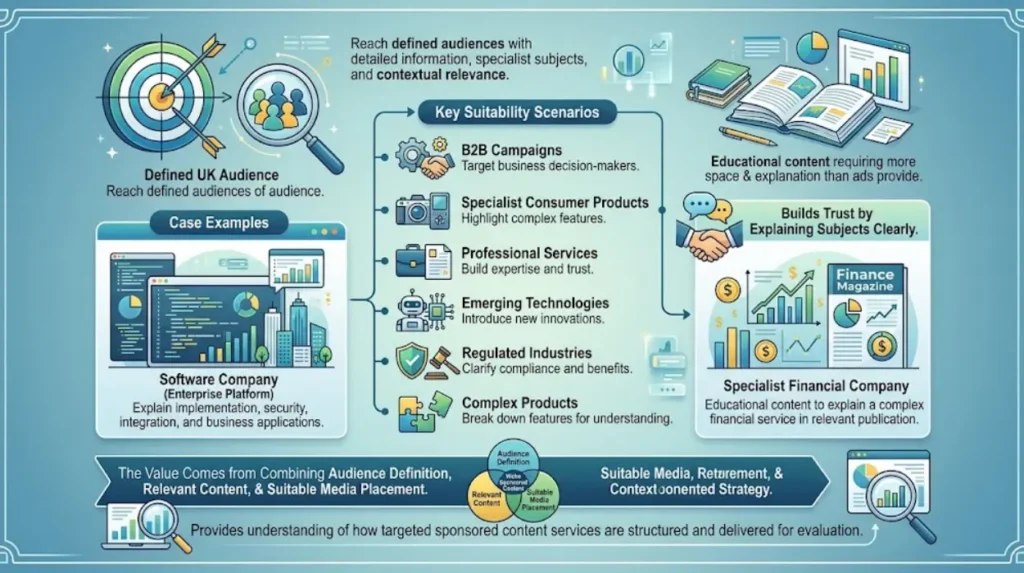
Niche sponsored content is suitable when a brand needs to reach a defined UK audience with detailed information, specialist subject matter, contextual relevance, or educational content that requires more space and explanation than conventional advertising formats provide.
It is particularly relevant for B2B campaigns, specialist consumer products, professional services, emerging technologies, regulated industries, and complex products.
The approach also supports campaigns where trust depends on explaining a subject clearly.
For example, a software company introducing an enterprise platform can use sponsored content to explain implementation, security, integration, and business applications.
A specialist financial company can use educational content to explain a complex financial service within an appropriate business or finance publication.
The value comes from combining audience definition with relevant content and suitable media placement.
For readers evaluating specific solutions,
Niche audience sponsored content provides the next stage for understanding how targeted sponsored content services are structured and delivered.
What is the overall process for targeting niche UK audiences?
The process involves defining the audience, identifying relevant topics, researching suitable publishers, selecting content formats, creating audience-focused material, distributing it through relevant channels, and measuring performance against predefined reach, engagement, traffic, and conversion objectives.
A practical workflow contains seven stages:
- Define the audience — Identify the specific UK demographic, professional group, industry, location, or interest segment.
- Map audience interests — Identify subjects, questions, problems, entities, and information needs.
- Research publishers — Compare specialist publications against audience and editorial criteria.
- Select content formats — Choose articles, interviews, guides, research features, or other suitable formats.
- Create relevant content — Develop information around the audience’s interests rather than broad promotional messaging.
- Distribute the content — Place and promote the content through relevant publication and distribution channels.
- Measure results — Evaluate reach, engagement, traffic, audience relevance, and commercial outcomes.
This process gives sponsored content a defined strategic purpose.
Explore More Expert Insights:
How Food and Drink Sponsored Content Reaches UK Readers
How Beauty Sponsored Articles Reach UK Consumers
Niche targeting is therefore not simply about selecting a small publication. It is a structured media strategy that connects audience definition, topical relevance, publisher selection, content development, distribution, and measurement.
For UK brands operating in specialist markets, this framework provides a practical method for moving from broad media exposure towards more precise audience engagement.



