

Sponsored content is paid media content created to communicate a brand message through a publisher, media platform, or digital publication. Food and drink brands use sponsored content to explain products, introduce ideas, educate audiences, support campaigns, and build sustained visibility across relevant media environments.
The food and drink sector includes restaurants, food manufacturers, beverage producers, retailers, hospitality businesses, specialist producers, and emerging consumer brands. These businesses operate in a competitive market where product information, consumer preferences, seasonal demand, and purchasing behaviour influence visibility.
Sponsored content provides a structured format for communicating information beyond a short advertisement. It uses editorial-style formats such as articles, guides, interviews, features, recipes, explainers, and product-focused stories.
What is sponsored content in the food and drink industry?
Sponsored content is paid media material that communicates a food or drink brand’s message through an identified publishing environment, using formats such as articles, guides, recipes, interviews, features, and educational content.
The defining feature is commercial sponsorship. A business funds the creation or distribution of the content, while the publishing environment provides access to an established audience.
Food and drink sponsored content can focus on several subjects. Examples include new product launches, ingredient information, food trends, production methods, sustainability initiatives, recipes, nutrition education, hospitality experiences, and seasonal campaigns.
Sponsored content differs from traditional display advertising because the information is presented through a longer-form content format. A banner can communicate a short promotional message. A sponsored article provides space for context, explanation, supporting information, and structured storytelling.
The content remains commercially connected to the sponsoring organisation. Proper disclosure helps audiences distinguish sponsored material from independent editorial coverage.
Why do food and drink brands use sponsored content?
Food and drink brands use sponsored content to provide detailed product information, reach defined audiences, explain complex subjects, support seasonal campaigns, strengthen digital visibility, and maintain consistent communication across relevant publishing platforms and consumer information environments.
Food and drink purchasing decisions often involve more information than a product name or price. Consumers encounter questions about ingredients, preparation, provenance, sourcing, dietary requirements, production processes, packaging, and usage.
Sponsored content creates space for these subjects.
For example, a beverage producer can publish educational content about cold-brew preparation. A food manufacturer can explain a new ingredient. A restaurant group can publish a guide to seasonal menus. A specialist producer can explain how a particular production method works.
Each example gives the audience additional context while keeping the sponsoring business connected to the subject.
Sponsored content also supports different stages of consumer awareness. Informational content introduces a topic. Educational content develops understanding. Product-focused content provides specific information for people already researching a category.
How does food and drink sponsored content work?
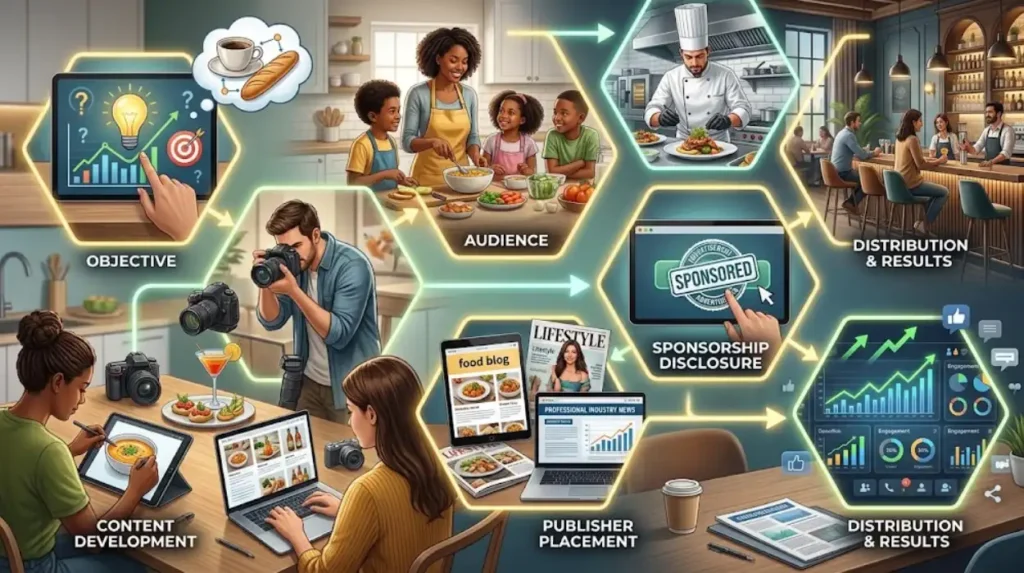
Food and drink sponsored content normally follows a structured process involving topic selection, audience definition, content development, publisher placement, sponsorship disclosure, distribution, and performance measurement across relevant digital or media channels.
The process begins with a communication objective. The business identifies what information the audience needs and what subject relates to its products or market.
The next step involves audience definition. A food business targeting home cooks requires different content from a supplier targeting hospitality professionals. A premium beverage producer also communicates differently from a mass-market grocery business.
Content development follows the selected topic and audience.
The completed material then appears through a suitable publishing environment. This can include consumer publications, specialist food websites, lifestyle platforms, business publications, hospitality media, or regional media.
The content includes appropriate sponsorship disclosure. This distinction is important because paid content needs to remain identifiable as commercial communication.
Performance measurement can include views, engagement, referral traffic, content interactions, search visibility, and other defined campaign metrics.
Readers seeking more information about:
How food and drink sponsored content reaches UK readers can examine the next stage of the topic.
What types of content do food and drink brands sponsor?
Food and drink brands sponsor multiple content formats, including educational articles, product features, recipes, interviews, buying guides, trend reports, seasonal features, ingredient explainers, production stories, and hospitality-focused content.
Educational articles
Educational articles explain a specific subject connected to food or drink. Examples include guides to fermentation, coffee preparation, food storage, or plant-based ingredients.
Recipes and preparation guides
Recipes connect products with practical use. A sponsored recipe can demonstrate preparation steps, serving ideas, ingredient combinations, or seasonal applications.
Product features
Product features provide detailed information about a specific product category or offering. Information can include ingredients, format, usage, packaging, or product characteristics.
Interviews
Interviews provide a human-focused format. A sponsored interview can feature a chef, producer, founder, food specialist, or industry professional.
Trend reports
Trend content examines developments within a food or beverage category. Examples include alcohol-free drinks, plant-based foods, convenience products, speciality coffee, and sustainable packaging.
Ingredient explainers
Ingredient explainers focus on a particular ingredient and its role in food production or preparation. These articles work well when audiences require technical or practical information.
How does sponsored content differ from traditional food advertising?
Sponsored content differs from traditional advertising through its format, information depth, and publishing environment; advertisements prioritise concise promotional messages, while sponsored content provides greater space for explanations, context, educational information, and subject-specific detail.
Traditional advertising commonly uses formats such as display banners, video adverts, sponsored social posts, print advertisements, and paid search placements.
These formats often prioritise immediate recognition and concise messaging.
Sponsored content uses longer formats. An article can contain several sections, supporting facts, images, quotations, examples, and practical information.
The difference does not mean sponsored content is independent editorial coverage. Sponsorship remains a defining characteristic. Clear labelling maintains transparency between paid content and publisher-generated editorial material.
For food and drink businesses, the format is useful when the subject requires explanation rather than a short promotional statement.
What information makes food and drink sponsored content useful?
Useful food and drink sponsored content provides accurate information, a defined subject, relevant examples, clear structure, appropriate terminology, practical context, transparent sponsorship, and information that directly addresses the audience’s questions about products, categories, or industry developments.
Accuracy is particularly important in food-related communication. Content can discuss ingredients, preparation, storage, production, packaging, sourcing, or dietary information.
Claims need to remain factually supportable.
Structure also affects usefulness. A clearly organised article allows readers to identify the information they need without navigating unrelated subjects.
Specific examples improve understanding. For instance, an article about sustainable packaging can examine recyclable paperboard, reusable containers, or lightweight packaging rather than discussing sustainability as a broad concept.
Audience relevance also matters. A professional hospitality audience requires different terminology and information from a household consumer audience.
How does sponsored content support food and drink product education?
Sponsored content supports product education by giving food and drink businesses space to explain ingredients, preparation, production, usage, storage, sourcing, product characteristics, and category information in a structured format that audiences can research and understand.
Product education becomes important when consumers need information before evaluating an item.
A coffee brand, for example, can explain differences between roast levels. A food producer can explain preparation instructions. A beverage company can provide information about serving formats.
This information does not need to focus exclusively on direct purchasing. Educational content can address the broader category.
Category education also creates useful context. An article about speciality tea can discuss brewing temperatures, leaf types, preparation methods, and serving practices. The sponsoring organisation remains associated with the subject while the reader receives broader information.
How does sponsored content support seasonal food and drink campaigns?
Sponsored content supports seasonal campaigns by giving brands a structured way to address time-specific consumer interests, including Christmas food, summer drinks, Easter products, barbecue season, festive recipes, school holidays, and major UK calendar events.
Seasonality has a significant role in food and drink marketing.
Consumer interests change throughout the year. Summer increases attention around outdoor dining, chilled drinks, barbecues, and lighter meals. December creates demand for festive food, entertaining ideas, gift products, and seasonal recipes.
Sponsored content can align with these predictable information needs.
A seasonal article can provide recipe ideas, preparation guidance, serving suggestions, ingredient information, or category education. This gives the campaign a defined informational purpose rather than relying only on a promotional message.
How does sponsored content help food and drink brands reach specific audiences?
Sponsored content helps food and drink brands reach specific audiences by placing relevant information within publishing environments that already attract defined consumer, professional, regional, lifestyle, hospitality, or specialist food and beverage audiences.
Audience relevance is determined by the relationship between the publication and its readership.
Consumer food publications attract people interested in recipes, cooking, ingredients, and household food choices. Hospitality publications serve professionals working in restaurants, hotels, catering, and foodservice.
Specialist publications focus on narrower categories. Examples include coffee, wine, baking, organic food, hospitality technology, food manufacturing, or grocery retail.
Regional publications provide another audience layer. A food business operating in London, Manchester, Birmingham, Edinburgh, or another UK market can communicate with audiences interested in local food and hospitality activity.
This targeting helps align subject matter with reader interests.
How does sponsored content contribute to long-term food and drink visibility?
Sponsored content contributes to long-term visibility by creating published digital material that remains accessible after initial distribution, supports repeated discovery, provides searchable information, and gives audiences an additional resource when researching food and drink subjects.
Unlike a temporary promotional placement, an online article can remain available on a publisher’s website after its initial campaign period.
This creates an additional information asset.
Search engines can discover indexed content when it meets technical and content requirements. Readers can also encounter articles through search queries, publisher archives, social sharing, referrals, or direct navigation.
Long-term visibility depends on factors such as content quality, publication accessibility, search relevance, topic demand, and the publisher’s digital environment.
The value therefore extends beyond the initial publication date.
When do food and drink brands use sponsored content?
Food and drink brands use sponsored content for product launches, category education, seasonal campaigns, recipes, brand storytelling, industry education, audience engagement, new market communication, and subjects requiring more explanation than conventional advertising provides.
Common use cases include:
- New food or beverage product launches
- Seasonal recipes and campaigns
- Ingredient education
- Food preparation guides
- Sustainable production topics
- Hospitality and restaurant features
- Beverage category education
- Consumer trend content
- Founder or producer interviews
- Product usage guides
- Regional food campaigns
- Specialist trade communication
Each use case requires a defined subject and audience.
A product launch focuses on introducing something new. A recipe campaign focuses on practical usage. A production feature focuses on how a product is made. A trend article focuses on category developments.
The format therefore adapts to the communication objective.
What are the key benefits of food and drink sponsored content?
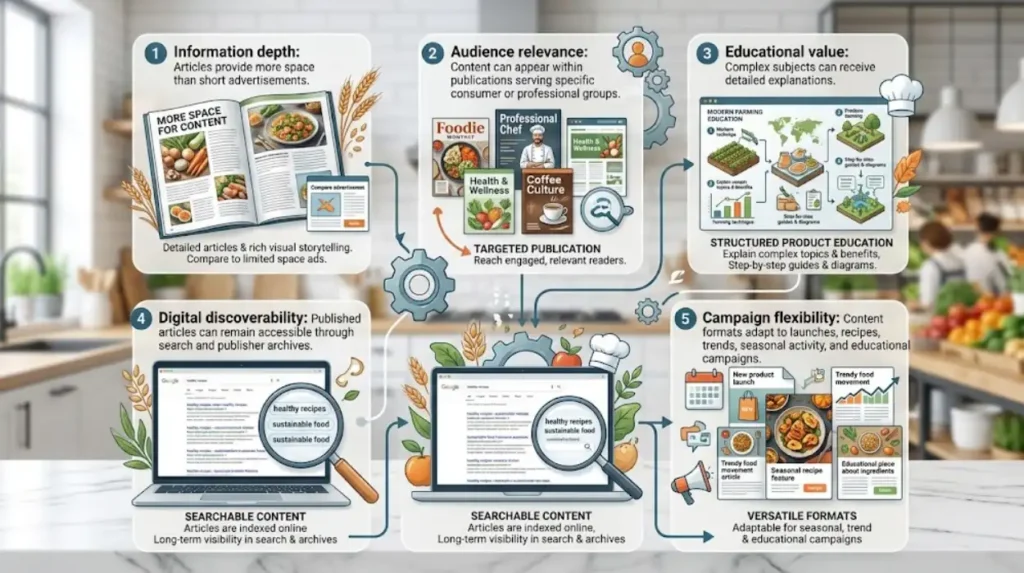
The main benefits include greater space for information, audience-specific communication, structured product education, seasonal relevance, searchable digital content, sustained publication visibility, and the ability to address detailed food and drink topics through credible publishing environments.
The principal benefits can be grouped into five areas.
Information depth: Articles provide more space than short advertisements.
Audience relevance: Content can appear within publications serving specific consumer or professional groups.
Educational value: Complex subjects can receive detailed explanations.
Digital discoverability: Published articles can remain accessible through search and publisher archives.
Campaign flexibility: Content formats adapt to launches, recipes, trends, seasonal activity, and educational campaigns.
These characteristics explain why sponsored content has become a distinct communication format within the food and drink sector.
Explore More Expert Insights:
What Beauty Brands Gain From UK Sponsored Articles
How Sponsored Content Drives Long-Term Brand Visibility
What should readers understand about food and drink sponsored content?
Food and drink sponsored content is a paid communication format designed to combine commercial messaging with useful information, using structured publishing formats that explain products, categories, trends, recipes, production methods, and other relevant food and beverage subjects.
The format sits between advertising and longer-form content communication.
Its commercial purpose comes from sponsorship. Its informational value comes from the depth and structure of the content.
For food and drink brands, the format provides a way to discuss subjects that require more than a short promotional statement. For readers, it provides access to detailed information within a clearly identified sponsored environment.
Understanding this distinction helps audiences evaluate sponsored material accurately. It also explains why food and drink businesses use sponsored content for education, seasonal communication, product information, audience targeting, and sustained digital visibility.



