Sponsored case studies are paid editorial-style content formats that document a business problem, solution, implementation process, and measurable result. In UK B2B marketing, they explain how products or services operate in real business environments while presenting evidence through a structured customer story.
Unlike conventional advertisements, a sponsored case study centres on a specific business situation. It identifies the organisation, explains the operational challenge, describes the response, and reports the resulting outcomes. This structure gives readers contextual information about how a product, service, or approach functions in practice.
For B2B brands, the format sits between commercial promotion and educational content. The content remains sponsored, but its information architecture focuses on evidence, process, business context, and outcomes.
What is a sponsored case study?
A sponsored case study is paid business content that presents a real customer situation, explains the solution applied, documents implementation, and reports measurable outcomes in an editorial-style format for a defined professional audience.
A sponsored case study contains commercial sponsorship but uses a case-based structure. The central subject is a documented business experience rather than a general product description.
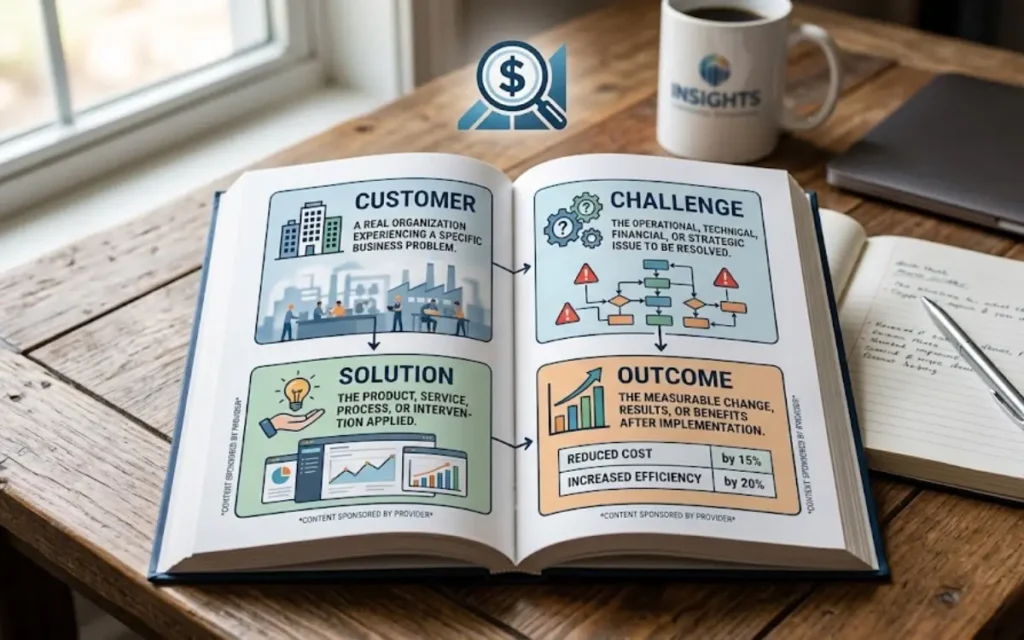
A typical case study identifies four core entities:
- Customer: The organisation experiencing the business problem.
- Challenge: The operational, financial, technical, or strategic issue.
- Solution: The product, service, process, or intervention applied.
- Outcome: The measurable change produced after implementation.
For example, a software company can publish a case study about a UK manufacturer that reduced invoice-processing time from five days to two days after implementing an automated workflow. The evidence gives the reader a defined business context.
This differs from a product page because the case study explains application. It differs from a standard advertisement because the narrative is organised around a documented customer situation.
How does a sponsored case study work?
A sponsored case study works by connecting a defined business problem with a documented intervention and measurable result, allowing professional readers to evaluate relevance through customer context, implementation details, evidence, and reported business outcomes.
The production process normally follows a sequence.
1. Select a customer situation
The first step identifies a customer with a clear business problem and sufficient information for documentation. Strong cases contain measurable changes and identifiable implementation stages.
A useful case involves specific variables. These include operating costs, processing time, conversion rates, employee productivity, delivery performance, compliance results, or revenue-related metrics.
2. Define the business challenge
The challenge establishes why the organisation required a change. It provides the baseline against which later results are measured.
For example, a logistics company can report that manual shipment documentation required 12 staff hours each week. The case then has a measurable starting point.
3. Document the intervention
The case study explains what changed. It identifies the technology, process, service, or operational method introduced and describes how the organisation implemented it.
4. Record measurable outcomes
The final stage documents results using specific metrics. A statement such as “operations became more efficient” provides limited evidence. A statement such as “processing time fell by 38% over six months” provides a defined result.
This sequence creates a clear relationship between problem, intervention, and outcome.
What information does a sponsored case study contain?
A complete sponsored case study contains customer context, business challenge, solution details, implementation information, measurable outcomes, supporting evidence, and relevant industry conditions that help professional readers assess the reported business result.
Customer background
The introduction establishes the organisation’s sector, size, operating model, location, or relevant business function. It gives readers enough context to understand the situation.
For example, a case involving a 250-employee UK professional services firm differs from one involving a multinational manufacturer with 20,000 employees.
Business challenge
The challenge section defines the original problem. It explains its operational effect and establishes the baseline.
Common challenges include:
- High operating costs
- Slow administrative processes
- Low lead conversion
- Manual data entry
- Supply chain delays
- Compliance requirements
- Customer retention problems
- Limited reporting visibility
Solution and implementation
This section explains the response. It identifies what was introduced, how it was deployed, and which business functions changed.
Implementation detail is important because outcomes depend on execution. A case study that states only the name of a solution provides less useful information than one that describes deployment stages, user adoption, process changes, and timescales.
Results and evidence
Results provide the strongest factual component. Metrics can include percentages, monetary values, time reductions, productivity levels, customer numbers, or operational volumes.
For example, a B2B organisation can report a 25% reduction in customer-response time after restructuring its support workflow.
Why do sponsored case studies use real customer evidence?
Sponsored case studies use real customer evidence because B2B purchasing decisions require contextual information about implementation, performance, operational impact, and measurable results rather than product descriptions without a documented business application.
B2B products often involve complex purchasing decisions. Buyers assess technical requirements, implementation effort, organisational fit, costs, risks, and expected results.
Customer evidence addresses part of this information gap.
A documented case also provides a sequence that readers can evaluate. The reader sees the starting condition, intervention, implementation process, and final result.
Evidence does not automatically prove that the same result will occur for every organisation. Business conditions differ between companies. Instead, the case establishes what happened in one defined situation.
This distinction is important for accurate B2B communication. A reported 30% efficiency improvement represents the documented customer outcome. It does not represent a universal industry benchmark unless independent evidence supports that conclusion.
How do sponsored case studies support B2B content discovery?
Sponsored case studies support B2B content discovery by combining specific business problems, industry terminology, customer evidence, solution descriptions, and measurable outcomes into a structured content asset that search systems can interpret.
Search visibility depends partly on the information contained within a document. A detailed case study naturally includes entities and relationships associated with a particular business problem.
For example, a manufacturing case study can contain terms such as predictive maintenance, production downtime, industrial sensors, maintenance scheduling, equipment failure, and operational efficiency.
These terms establish topical relationships. The document becomes relevant to several connected concepts rather than one isolated keyword.
Sponsored case studies also provide specific factual statements. Search engines and AI systems process structured information more effectively when entities, actions, metrics, and relationships are clearly expressed.
A case study therefore contributes to content discovery through its information structure, not simply through the presence of commercial terminology.
Readers exploring the next stage of evaluating case-study effectiveness can review:
Sponsored case study conversion for a deeper consideration-stage perspective.
What makes a sponsored case study credible?
Credibility in a sponsored case study comes from transparent sponsorship, identifiable business context, specific evidence, consistent metrics, clear methodology, realistic claims, and accurate separation between documented customer results and broader performance expectations.
Transparent sponsorship
Readers need to understand that the content is sponsored. Clear disclosure separates paid content from independent editorial reporting.
Specific evidence
Specific metrics strengthen factual clarity. Examples include:
- 42% reduction in processing time
- £180,000 annual cost reduction
- 18% increase in qualified leads
- 3-hour reduction in average response time
- 27% decrease in manual errors
Defined measurement periods
Results require a timeframe. A metric reported over three months has a different context from one measured over three years.
Consistent measurement
The baseline and final measurement must use comparable definitions. A productivity increase requires a clear explanation of how productivity was calculated.
Relevant customer context
The reader needs sufficient information to determine whether the case resembles their own business environment. Sector, organisation size, operating model, and implementation conditions all affect relevance.
How are sponsored case studies different from traditional advertising?
Sponsored case studies differ from traditional advertising because they organise commercial information around a documented customer experience, while traditional advertising generally concentrates on product attributes, promotional messages, brand positioning, or direct response actions.
Traditional advertising often prioritises a product, service, offer, or brand message. Its purpose centres on communicating a commercial proposition.
A sponsored case study prioritises the customer situation.
Consider the structural difference:
| Content format | Primary focus | Typical evidence |
|---|---|---|
| Advertisement | Product or brand | Features and claims |
| Product page | Product details | Specifications |
| Customer testimonial | Customer opinion | Customer statement |
| Sponsored case study | Customer business situation | Process and measurable outcomes |
| Independent editorial | Subject or issue | Journalistic research |
The formats serve different information needs. A buyer researching technical specifications requires product information. A buyer researching implementation needs operational evidence. A sponsored case study addresses the second requirement.
How can sponsored case studies help UK B2B audiences understand complex solutions?
Sponsored case studies simplify complex B2B solutions by placing technical or commercial information inside a defined customer scenario, allowing professional readers to understand the problem, implementation sequence, operational changes, and measured results together.
Complex B2B solutions often involve multiple departments. A cybersecurity implementation can involve IT, compliance, finance, procurement, and senior management. A supply chain platform can involve procurement, logistics, inventory, finance, and operations.
A case study connects these functions through one documented implementation.
For example, a UK retailer implementing demand forecasting software can explain how purchasing data entered the system, how forecasts changed replenishment decisions, and how stock availability was measured afterwards.
This gives readers operational context without requiring the content to become a technical manual.
The same principle applies across sectors such as financial services, manufacturing, healthcare, professional services, construction, technology, logistics, and energy.
When are sponsored case studies most useful for B2B marketing?
Sponsored case studies are most useful when buyers need evidence about implementation, operational impact, customer experience, or measurable outcomes and when a documented business example provides more decision-relevant information than general promotional product descriptions.
They are particularly relevant when a solution has a complex buying process.
High-consideration products
Expensive or technically complex products require more information before purchase. Case studies provide application evidence.
New categories
Emerging technologies often lack established buyer knowledge. A documented implementation helps explain practical use.
Regulated industries
Businesses operating under regulatory requirements need detailed information about processes, controls, documentation, and implementation.
Operational solutions
Solutions affecting workflows benefit from evidence showing how processes changed after adoption.
Enterprise purchasing
Enterprise purchases involve multiple stakeholders. A case study gives marketing, procurement, technical, finance, and operational teams a common business example to assess.
What should readers look for when evaluating a sponsored case study?

Readers evaluating a sponsored case study should examine the customer context, baseline conditions, intervention, measurement period, evidence quality, sponsorship disclosure, and distinction between documented results and broader claims about business performance.
Explore More Expert Insights:
How Edinburgh Brands Reach Readers With Sponsored Content
Why Sponsored Interviews Build Trust for UK Brands
Sponsored case studies therefore function as structured B2B information assets. Their value comes from connecting customer context, business problems, implementation details, and measurable outcomes. For UK B2B audiences, this structure provides practical information about how commercial solutions operate in defined business environments.
The format also creates a bridge between awareness and deeper evaluation. Once readers understand: sponsored case studies contain and how their evidence works, they can assess their role in the wider B2B buyer journey more accurately.