Education providers publish UK sponsored content to explain courses, qualifications, learning services, and institutional expertise to defined audiences. Sponsored content gives education organisations a structured publishing format that combines useful information with transparent commercial messaging across relevant digital media environments.
What is UK sponsored content in education?
UK-sponsored content is paid editorial-style material created for education organisations and published through media platforms. It explains educational subjects, services, courses, or expertise while clearly identifying the commercial relationship to maintain audience transparency.
Sponsored content differs from traditional advertising because it uses an article-based format. The content provides information around a defined subject instead of relying only on a short promotional message.
For education providers, topics include professional development, university programmes, vocational qualifications, online learning, executive education, apprenticeships, student support, and specialist training.
The content remains commercially funded. Clear labelling helps readers understand that the material is sponsored.
How does sponsored content differ from an advertisement?
A display advertisement normally focuses on a headline, visual, offer, or direct response. Sponsored content provides more space for context.
An education provider can explain:
- What a qualification covers
- Who the programme serves
- Which skills learners develop
- How a training format works
- What an educational subject involves
- Why a particular learning issue matters
This format creates space for factual explanation while retaining a commercial purpose.
Why do education providers use sponsored content?
Education providers use sponsored content to communicate educational expertise, explain programmes, reach defined audiences, support brand visibility, and provide detailed information in a media format that gives prospective learners greater context than conventional advertising.
Education decisions involve information. Prospective learners compare courses, qualifications, institutions, costs, delivery formats, career outcomes, and entry requirements.
Sponsored articles provide space to address these information needs.
A university, college, training provider, or professional education organisation can use an article to explain a specific subject before introducing relevant educational offerings.
For example, a professional training provider can publish an article explaining how leadership qualifications support management development. A university can publish content explaining changes in a particular academic discipline.
What information can education content explain?
Education sponsored content can cover several information categories.
Course information explains programme subjects, learning formats, duration, and assessment structures.
Career information connects qualifications with professional skills and workplace requirements.
Industry information examines developments affecting learners and employers.
Educational guidance explains concepts such as apprenticeships, postgraduate study, continuing professional development, and vocational qualifications.
Institutional expertise presents research, teaching knowledge, specialist facilities, or subject expertise through an informative article.
These categories allow education providers to address different stages of the learner research process.
How does sponsored content reach UK education audiences?
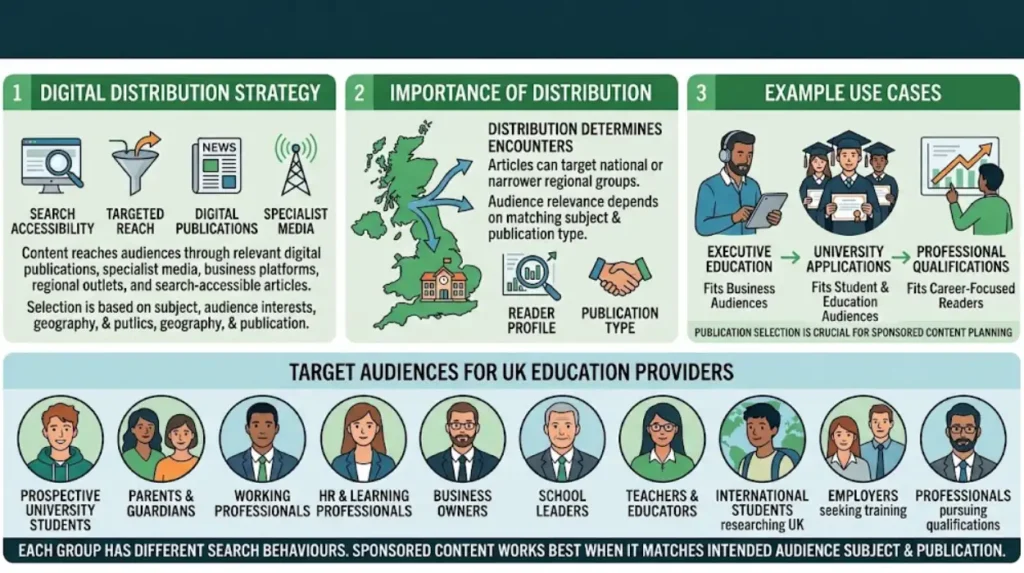
UK sponsored content reaches education audiences through relevant digital publications, specialist media, business platforms, regional outlets, and search-accessible articles selected according to subject relevance, audience interests, geography, and publication characteristics.
Distribution determines who encounters an article.
A UK-focused education article can target national audiences or narrower groups. Audience relevance depends on the publication, subject, location, and reader profile.
For example, an article about executive education fits business-focused audiences. A piece about university applications fits student and education audiences. A professional qualifications article fits career-focused readers.
Publication selection therefore forms an important part of sponsored content planning.
What audiences can education providers reach?
Education providers address multiple audience groups.
- Prospective university students
- Parents and guardians
- Working professionals
- HR and learning professionals
- Business owners
- School leaders
- Teachers and educators
- International students researching UK education
- Employers seeking workforce training
- Professionals pursuing qualifications
Each group uses different search behaviours and information sources.
A professional considering an MBA searches differently from a parent researching undergraduate education. Sponsored content works best when its subject and publication environment match the intended audience.
For readers examining the distribution process,
What makes education sponsored content useful for prospective learners?
Education sponsored content is useful because it gives prospective learners structured information about subjects, qualifications, learning models, career skills, and educational developments in a readable format that supports research before a final enrolment decision.
Prospective learners often research several questions before contacting an education provider.
They want to understand the subject first. They then examine available learning options. After that, they compare providers and evaluate practical details.
Sponsored content can address the earlier informational stages of this process.
Which learner questions can articles answer?
An education article can answer questions such as:
- What does this qualification involve?
- Which skills does this subject develop?
- Who studies this type of programme?
- What does online learning involve?
- Why is continuing professional development important?
- How does an apprenticeship work?
- What changes are affecting a particular profession?
- What factors influence course selection?
Answers to these questions provide useful context without requiring every reader to enter an enrolment journey immediately.
How does educational relevance affect sponsored content performance?
Educational relevance affects sponsored content performance because readers engage with subjects that match their learning needs, professional interests, search behaviour, and information requirements. Relevant topics create stronger contextual connections between the article, publication audience, and education provider.
Relevance begins with topic selection.
A generic article about education has broad scope but limited contextual precision. A focused article about cybersecurity qualifications for working professionals has a clearer audience and subject relationship.
Search engines also process topical relationships between entities, concepts, and terminology. Education content therefore benefits from accurate subject vocabulary.
What entities belong in education sponsored content?
Important education entities include:
- Universities
- Colleges
- Training providers
- Qualifications
- Degree programmes
- Professional certifications
- Apprenticeships
- Online learning platforms
- Academic disciplines
- Professional sectors
- Student groups
- Employers
- Regulatory and awarding bodies
Clear entity definitions improve comprehension.
For example, an article discussing professional development can distinguish between a short course, a professional certification, a postgraduate qualification, and workplace training. Each represents a different educational product or learning structure.
How can education providers use sponsored content for different objectives?
Education providers use sponsored content for objectives including subject education, audience awareness, programme explanation, thought leadership, institutional visibility, recruitment support, and communication around changes affecting learners, employers, and education professionals.
Different objectives require different article structures.
An awareness article focuses on an educational issue. A programme-focused article explains a learning option. An industry article connects education with workplace developments.
The objective determines the subject, audience, evidence, terminology, and publication environment.
What are common education sponsored content use cases?
University awareness: Articles explain academic subjects, student issues, research areas, and developments in higher education.
Professional training: Content explains workplace skills, certifications, leadership development, compliance training, and technical education.
Vocational education: Articles explain practical qualifications, apprenticeships, trade skills, and employment-focused learning.
Online education: Content examines remote learning, digital classrooms, flexible study, and technology-enabled education.
Executive education: Articles address leadership, management, strategy, finance, technology, and other professional development areas.
These use cases give education organisations different ways to communicate with defined audiences.
Why is transparency important in UK sponsored content?
Transparency is important because sponsored content involves commercial funding, and clear labelling helps readers distinguish paid material from independent editorial content while supporting responsible communication and maintaining clarity about the article’s commercial status.
UK advertising and consumer protection frameworks place importance on identifying commercial communications clearly.
Sponsored content therefore needs appropriate disclosure. Labels such as “Sponsored”, “Advertisement Feature”, or equivalent wording communicate the commercial relationship.
Transparency also improves reader understanding.
The article can remain informative while clearly identifying its commercial status. This distinction separates sponsored content from independently produced journalism.
What should transparent sponsored content contain?
Transparent content normally includes:
- Clear sponsorship identification
- Accurate claims
- Relevant supporting information
- Factual descriptions of educational offerings
- Appropriate commercial disclosure
- Clear distinction between editorial and promotional material
Accuracy matters particularly in education because readers use information to evaluate significant learning and career decisions.
How does sponsored content support education sector visibility?
Sponsored content supports education sector visibility by placing structured educational information within digital media environments where relevant audiences consume news, professional information, industry analysis, and specialist educational content.
Visibility involves more than appearing in search results.
An education provider needs consistent associations between its subject expertise, educational entities, and relevant topics.
An article about data science education, for example, can discuss skills, curriculum developments, workplace demand, and learning pathways. This creates a detailed topical environment around the subject.
Repeated publishing across relevant topics builds a broader body of educational information.
How does topical consistency matter?
Topical consistency connects multiple pieces of content around related concepts.
An education organisation focusing on professional development can cover leadership training, management qualifications, workplace learning, digital skills, and continuing professional development.
Each article addresses a different search need while maintaining a coherent subject area.
This approach creates clearer relationships between the provider, its educational subjects, and the audiences researching those subjects.
When do education providers publish sponsored content?
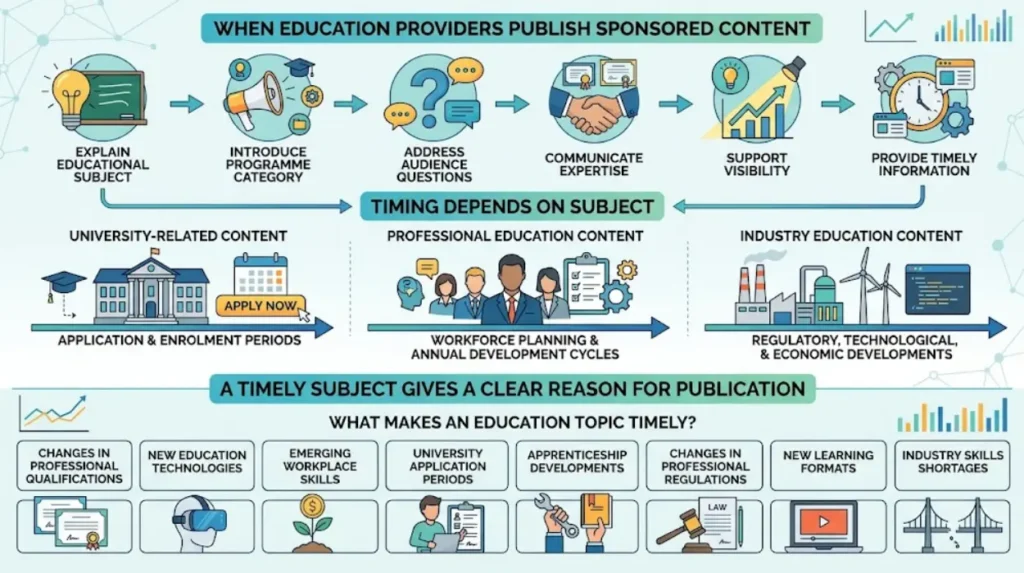
Education providers publish sponsored content when they need to explain an educational subject, introduce a programme category, address audience questions, communicate expertise, support visibility, or provide timely information around developments affecting learners and professional education.
Timing depends on the subject.
University-related content often aligns with application and enrolment periods. Professional education content connects with workforce planning and annual development cycles. Industry education content follows relevant regulatory, technological, or economic developments.
A timely subject gives the article a clear reason for publication.
What makes an education topic timely?
Examples include:
- Changes in professional qualifications
- New education technologies
- Emerging workplace skills
- University application periods
- Apprenticeship developments
- Changes in professional regulations
- New learning formats
- Industry skills shortages
Timeliness creates a defined information need for readers.
Explore More Expert Insights:
What AI Means for Sponsored Content Discovery in 2026
How Legal Firms Build Authority With Sponsored Articles
What should readers understand about education sponsored content?
Education sponsored content is a paid communication format that provides detailed information about educational subjects, learning opportunities, expertise, and sector developments while maintaining clear commercial disclosure and targeting audiences through relevant UK media environments.
Its value depends on relevance, accuracy, transparency, audience alignment, and useful information.
Education providers use the format across universities, colleges, vocational organisations, professional training companies, and specialist education businesses.
The strongest educational articles answer specific questions. They define important terms. They use accurate information. They address a clear audience. They maintain transparent sponsorship.
Sponsored content therefore occupies a distinct position between conventional advertising and independent editorial publishing. It provides education organisations with structured space to explain complex subjects while giving readers information that supports further research.
Readers evaluating specific publishing approaches can explore:
Education sponsored content by Time Intelligence Media Group.