

AI-optimised sponsored content combines commercial messaging, structured information, search intent, and clear entity signals to improve discovery across traditional search and AI-powered platforms. Time Intelligence Media Group delivers sponsored content designed for UK audiences, with content structures built around relevance, clarity, authority, and measurable distribution.
Sponsored content is paid editorial-style content created to communicate a brand, service, product, expertise, or announcement through a publisher or media platform. AI-optimised sponsored content adds another layer. It structures information so search engines and AI systems can identify the subject, organisation, offering, audience, location, and supporting claims.
For UK businesses, this distinction matters because discovery now occurs across search engines, AI answer systems, publisher websites, news databases, and conversational interfaces. A sponsored article needs more than keyword placement. It needs identifiable entities, direct answers, consistent terminology, factual context, and a clear relationship between the brand and its subject.
Businesses evaluating content distribution can first review:
Optimise Sponsored Content using the anchor AI-optimised sponsored content for practical optimisation guidance.
What is AI-optimised sponsored content?
AI-optimised sponsored content is paid media content structured for human readers, search engines, and AI systems through explicit entities, topical relevance, direct answers, semantic terminology, factual evidence, and clear relationships between brands, services, audiences, and locations.
Traditional sponsored content focuses on publication, audience reach, brand visibility, and commercial messaging. AI optimisation extends this framework by improving machine-readable context.
A well-structured article answers fundamental questions quickly:
- What is the company?
- What does it provide?
- Who does it serve?
- Which market does it target?
- What problem does the offering address?
- What evidence supports the claims?
- How does the offering differ from alternatives?
These answers create a stronger information structure.
For example, a UK fintech company promoting compliance software needs consistent references to fintech, financial services, compliance technology, UK regulation, target users, and the specific software function. These relationships provide context beyond a single keyword.
Why entity clarity matters
An entity is a distinct person, organisation, product, place, service, or concept that search systems can identify.
Time Intelligence Media Group is an organisation. Sponsored content is a content format. AI search is a discovery environment. The United Kingdom is a geographic market.
Clear references to these entities reduce ambiguity and establish topical relationships within an article.
How does Time Intelligence Media Group optimise sponsored content for AI search?
Time Intelligence Media Group optimises sponsored content through intent-led topic selection, entity definition, semantic coverage, direct-answer formatting, UK market relevance, structured content, publication distribution, and measurable content performance.

The process starts with the commercial objective. A campaign can target brand awareness, product discovery, authority building, lead generation, service visibility, or a specific market segment.
The content strategy then connects that objective with search intent.
1. Identify the primary search intent
Search intent defines what the audience wants to accomplish.
A business targeting decision-stage users needs content that answers commercial questions. Examples include:
- What does the service provide?
- How does the service work?
- Who uses it?
- What are the benefits?
- What distinguishes the provider?
- How can a business get started?
The article structure reflects these questions.
2. Establish the core entity
The brand receives clear contextual definition early in the content. The service also receives a precise definition.
For example, a sponsored article about UK legal technology needs consistent relationships between the company, legal technology, law firms, compliance, automation, and the UK market.
3. Expand semantic coverage
Semantic optimisation uses related concepts rather than repeating one keyword.
Relevant terms for sponsored content include:
- sponsored articles
- sponsored media content
- branded content
- paid editorial content
- digital PR
- content distribution
- AI search visibility
- search intent
- entity optimisation
- semantic relevance
- UK media
- publisher distribution
These terms support topical completeness when they accurately describe the subject.
Which components make sponsored content AI-ready?
AI-ready sponsored content contains a defined topic, identifiable entities, direct answers, factual claims, relevant terminology, logical headings, useful examples, UK-specific context, and consistent references that connect the brand with its service and audience.
Content quality depends on structure as much as wording.
Clear headline and introduction
The headline establishes the primary topic. The opening section confirms the subject and commercial context.
A title such as “AI-Optimised Sponsored Content for UK Fintech Brands” immediately identifies the optimisation method, content format, audience, and market.
Question-based headings
Question headings provide explicit information architecture.
Examples include:
- What is AI-optimised sponsored content?
- How does sponsored content support AI search visibility?
- Which businesses benefit from AI-optimised sponsored articles?
- How is sponsored content distributed?
- What results can businesses measure?
Each heading creates a defined information unit.
Direct answers
A direct answer immediately after a question-based heading provides concise context. Supporting paragraphs then expand the subject.
This structure improves usability for readers and creates clearly segmented information for automated systems.
Factual examples
Examples make abstract concepts specific.
A property company promoting a development service can define its market, location, service type, customer group, and project expertise. A healthcare technology company can identify its technology category, professional audience, geographic market, and application.
How does AI optimisation improve sponsored content discovery?
AI optimisation improves:
sponsored content discovery by making the article easier to classify, retrieve, interpret, and associate with relevant entities, topics, questions, and audiences across search engines, AI answer systems, publisher platforms, and digital media environments.
AI-powered discovery systems process relationships between concepts. Keyword repetition alone does not establish these relationships.
A strong article creates a consistent topical framework.
For instance, an article about UK financial technology can connect:
Brand → fintech service → UK market → business problem → target audience → solution → supporting evidence.
This structure gives every major concept a defined role.
Search visibility and AI visibility are connected
Search engines remain important discovery channels. AI interfaces increasingly provide direct answers based on indexed information and identified relationships.
Sponsored content therefore needs a format that serves both environments.
The objective is not to write separate content for every platform. The objective is to create clear, useful, well-structured information that supports multiple discovery environments.
Which businesses benefit from AI-optimised sponsored content?
AI-optimised sponsored content benefits UK businesses that need stronger brand discovery, service visibility, authority signals, audience targeting, or commercial content distribution across publishers, search engines, and AI-powered discovery environments.
The approach applies across multiple sectors.
Professional services
Law firms, accountants, consultants, recruitment companies, and financial advisers use sponsored content to explain expertise and communicate specialist services.
A legal firm can publish content around corporate law, employment law, dispute resolution, or regulatory services while defining its expertise and target market.
Technology companies
Software companies need clear product definitions because technical terminology often has multiple interpretations.
Sponsored content can explain software functionality, target users, industry applications, implementation requirements, and business outcomes.
Financial services
Fintech brands, lenders, investment firms, and financial technology providers require precise terminology.
Content can establish relationships between the brand, financial product, target customer, UK market, and relevant industry context.
Property and construction
Property developers, construction companies, architects, and property service providers can use sponsored articles to establish location, project category, expertise, and market relevance.
Examples include commercial property, residential development, construction technology, property investment, and sustainable building services.
How is AI-optimised sponsored content distributed?
AI-optimised sponsored content is distributed through relevant media and publisher environments where the content gains an identifiable publication context, audience exposure, searchable presence, and supporting relationships between the brand, subject, industry, and target market.
Distribution is an important part of content performance.
Publishing content on a relevant media platform creates a separate information context around the article. The publisher, article topic, publication date, industry, and brand all contribute to the content environment.
Relevant publication matters
A technology company benefits from technology-focused audiences. A legal business benefits from professional and business audiences. A property company benefits from property and business publications.
Relevance provides contextual alignment.
UK distribution creates market specificity
UK-focused sponsored content uses British English, UK terminology, UK market references, and relevant local context.
For example, an article targeting British professional readers can reference UK business practices, British industry terminology, London-based markets, and UK-specific commercial considerations where relevant.
What results can businesses measure from AI-optimised sponsored content?
Businesses can measure sponsored content through publication placements, referral traffic, branded search activity, engagement, content visibility, lead interactions, backlink acquisition where applicable, and changes in discovery across relevant search and AI environments.
Measurement needs defined objectives.
A brand awareness campaign focuses on reach and visibility. A lead-generation campaign focuses on qualified traffic and enquiries. An authority campaign focuses on relevant publication presence, branded discovery, and topical association.
Key performance indicators
Useful metrics include:
- Number of published placements.
- Referral sessions.
- Engagement with the sponsored article.
- Branded search activity.
- Qualified enquiries.
- Conversion actions.
- Backlinks where included and appropriate.
- Search visibility for relevant queries.
- Content indexing status.
- AI discovery observations.
The measurement model needs to match the campaign objective.
How does Time Intelligence Media Group fit into a sponsored content strategy?
Time Intelligence Media Group provides sponsored content support for businesses seeking structured, AI-aware content and UK media distribution, combining content development, semantic optimisation, audience relevance, publication placement, and campaign-focused reporting.
The service is designed for businesses that need a complete sponsored content workflow rather than an isolated article.
The workflow connects content strategy with publication distribution.
Content development
The article is developed around the commercial objective, audience, subject, and search intent.
The content uses explicit terminology and clear entity relationships.
AI-focused optimisation
The content receives structural optimisation for machine interpretation. This includes question-led headings, direct answers, semantic terminology, factual context, and consistent entity references.
Media distribution
The finished content is positioned within relevant media environments according to the campaign’s audience and market requirements.
Performance reporting
Campaign reporting connects publication activity with measurable outcomes.
This creates a complete workflow from planning through publication and measurement.
When is AI-optimised sponsored content the right choice?
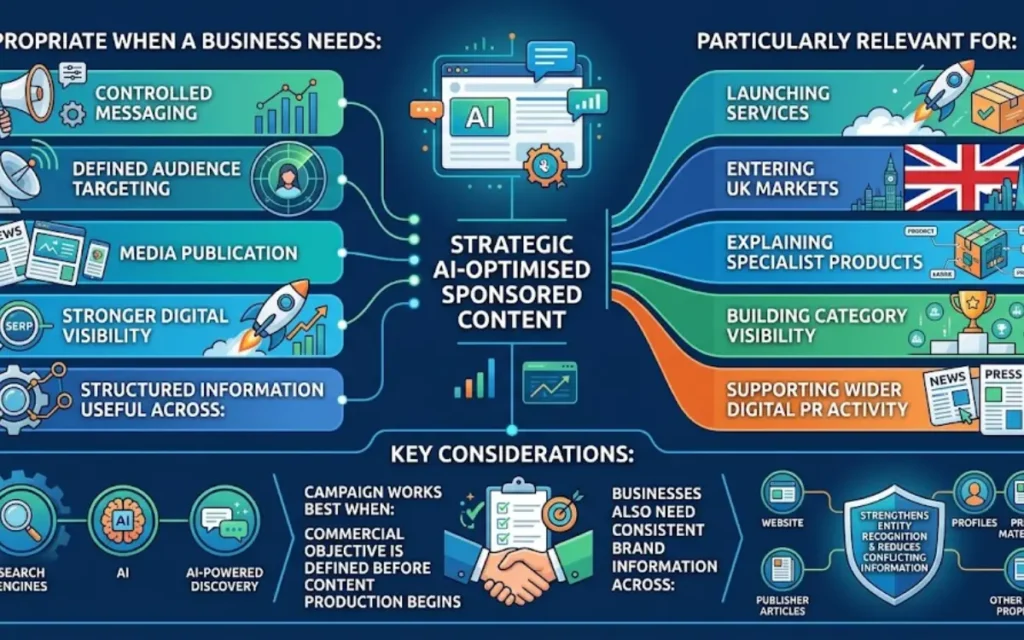
AI-optimised sponsored content is appropriate when a business needs controlled messaging, defined audience targeting, media publication, stronger digital visibility, and structured information that remains useful across search engines and AI-powered discovery environments.
It is particularly relevant for businesses launching services, entering UK markets, explaining specialist products, building category visibility, or supporting wider digital PR activity.
A campaign works best when the commercial objective is defined before content production begins.
Businesses also need consistent brand information across their website, publisher articles, profiles, press materials, and other digital properties. Consistency strengthens entity recognition and reduces conflicting information.
For organisations evaluating providers, the decision depends on four core factors:
- Content quality.
- Audience and publication relevance.
- AI and search optimisation.
- Reporting and measurable outcomes.
How can businesses start an AI-optimised sponsored content campaign?
Businesses can start by defining the campaign objective, target audience, primary topic, UK market, commercial offer, preferred publication environment, measurement goals, and content requirements before commissioning and distributing the sponsored article.
The first step is to define what the campaign needs to achieve.
The second step is to identify the audience and search questions. The third step is to establish the core entities and supporting concepts. The fourth step is to develop the article around those relationships.
The fifth step is publication and distribution. The final step is measurement.
This process keeps sponsored content connected to a defined business outcome rather than treating publication as the final objective.
Explore More Expert Insights:
Legal Sponsored Content by Time Intelligence Media Group
Travel Sponsored Content by Time Intelligence Media Group 2026
Time Intelligence Media Group provides an option for UK businesses that require AI-optimised sponsored content combined with media distribution and campaign support.
For businesses ready to move from research to implementation, an AI-focused sponsored content campaign provides a structured route from commercial message to searchable, publishable, and measurable media content.



