
Sponsored content combines paid publication with useful editorial information. For SEO, its value comes from the relationship between published content, referring domains, backlinks, topical relevance, and search visibility. Understanding these connections helps UK brands evaluate sponsored content as part of a wider digital strategy.
What is sponsored content in SEO?
Sponsored content is paid editorial-style content published on a third-party website to communicate information about a business, product, service, or topic. Its SEO value depends on relevance, publication quality, link attributes, content usefulness, and audience alignment.
Sponsored content appears across digital publications, industry websites, business magazines, news platforms, and specialist publications. The advertiser funds publication, while the host website provides access to its established audience and website environment.
From an SEO perspective, sponsored content involves more than placing a link inside an article. Search engines evaluate the broader context surrounding that link. Relevant content, credible publishing environments, useful information, and appropriate link attributes all contribute to how the publication fits within a brand’s search strategy.
In the United Kingdom, sponsored content can target national, regional, and sector-specific audiences. Examples include a technology company publishing an article on a UK technology publication, a property company appearing on a construction website, or a financial business publishing educational content on a finance platform.
How does sponsored content differ from ordinary advertising?
Traditional display advertising primarily targets visibility through banners, placements, or paid promotional units. Sponsored content uses an article or editorial-style format to communicate information within a publication.
The distinction matters for SEO because an article creates a crawlable content asset. The page contains text, entities, headings, contextual references, and potentially links. These elements create a stronger semantic relationship between the subject and the publishing website than a standalone visual advert.
How do backlinks from sponsored content work?
A backlink is a hyperlink from one website to another website. Sponsored content can contain links to relevant pages, but search engines distinguish paid links through attributes such as rel="sponsored" and evaluate them differently from editorially earned links.
A backlink connects two web documents. The source page contains the hyperlink, while the destination page receives the referral.
Search engines use links as part of their systems for understanding relationships between pages and websites. However, paid placements require appropriate disclosure and link treatment. Google identifies rel="sponsored" as the preferred attribute for links created as part of advertisements, sponsorships, or other compensation agreements.
This distinction is important. Sponsored content does not automatically create traditional ranking equity simply because an article contains a hyperlink. The link attribute, publication context, relevance, and overall content quality determine its SEO role.
What is a sponsored link?
A sponsored link is a link associated with paid placement. The rel="sponsored" attribute communicates that the relationship exists because of advertising or sponsorship.
This classification supports clearer search-engine interpretation. It also separates paid promotional relationships from naturally earned editorial recommendations.
For example, a paid article about UK commercial property can link to a relevant commercial property resource. The link provides a useful pathway for users while accurately identifying the commercial relationship.
Can sponsored content still support SEO when links are sponsored?
Yes. SEO value extends beyond direct link equity. Sponsored content can create referral traffic, brand exposure, entity associations, content discovery opportunities, and visibility across relevant websites.
A published article also becomes a searchable web document. Its title, headings, body content, linked entities, publication domain, and references contribute to the wider online presence of the subject.
How does sponsored content contribute to SEO authority?
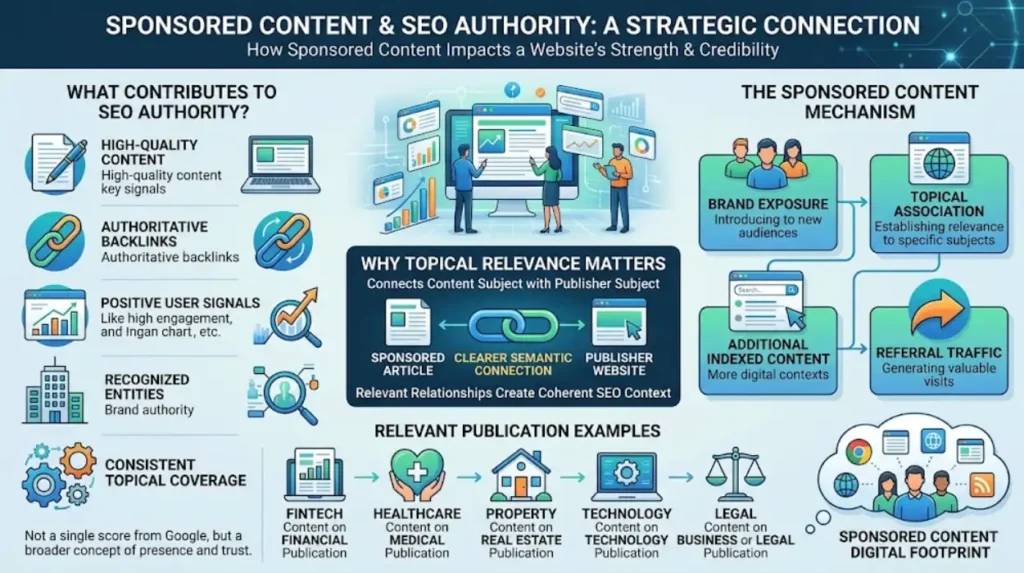
SEO authority describes the strength and credibility search engines associate with a website or topic through signals including relevant content, quality references, recognised entities, links, user engagement, and consistent topical coverage across trustworthy digital environments.
SEO authority is not represented by one universal score assigned by Google. It is a broader concept used to describe the strength of a website’s search presence.
Sponsored content contributes to this environment through several mechanisms. A publication can introduce a brand to a new audience. It can establish associations with relevant topics. It can generate referral visits. It can also create additional indexed content discussing the brand.
For example, a UK cybersecurity company publishing useful content across cybersecurity, technology, and business publications creates a broader topical footprint. Each relevant publication adds another digital context in which the company is discussed.
Why does topical relevance matter?
Topical relevance connects the subject of the sponsored article with the subject of the publishing website. A relevant relationship creates a clearer semantic connection.
A fintech article on a financial publication has stronger contextual relevance than a fintech article placed on an unrelated entertainment website. Similarly, a construction article on a UK property publication provides clearer topical alignment.
Relevant publication examples include:
- Fintech content on financial publications
- Healthcare content on medical publications
- Property content on real estate publications
- Technology content on technology publications
- Legal content on business or legal publications
The relationship between the topic, publisher, audience, and destination page creates a more coherent SEO context.
How does sponsored content build backlink opportunities?
Sponsored content creates backlink opportunities by placing relevant website references within published articles. Each publication can provide a new referring domain, while the surrounding content establishes topical context between the source page and the destination page.
A referring domain is a website that links to another website. SEO strategies often focus on acquiring links from multiple relevant referring domains rather than repeatedly receiving links from one domain.
Sponsored content can therefore expand a website’s backlink profile when publications are relevant and independently established.
For example, a UK brand publishing useful articles across 15 relevant publications creates 15 separate publication environments. The resulting backlink profile contains links from different domains rather than multiple links from one website.
What makes a backlink valuable?
Several factors influence the usefulness of a backlink:
- Relevance — The source page relates directly to the destination topic.
- Publishing quality — The source website maintains useful, credible content.
- Context — The link appears within relevant surrounding information.
- Referring-domain diversity — Links come from multiple relevant websites.
- Link accuracy — The destination page genuinely supports the article’s subject.
- User value — The link provides a meaningful next step for readers.
A large number of unrelated links does not create the same contextual value as a smaller collection of relevant references.
How does sponsored content improve brand visibility in search?
Sponsored content increases the number of searchable web pages associated with a brand, topic, product, or organisation. These pages create additional opportunities for users to discover, recognise, and associate the brand with relevant search subjects.
Search visibility extends beyond a company’s own website. Search results can contain articles, interviews, reviews, industry discussions, publisher pages, and other third-party content.
Sponsored content adds another layer to this search ecosystem. A published article can rank for informational queries connected to its subject. Users who discover the article encounter the brand within that relevant context.
For example, an article about UK business finance can introduce a financial services company to readers searching for information about funding, investment, or financial management.
Why does third-party visibility matter?
Third-party websites provide independent publishing environments. Their content can appear separately from the brand’s own domain.
This creates additional branded search results. A user searching for a company can encounter its website alongside relevant third-party publications. The resulting search environment contains more references to the organisation.
This is particularly relevant for brands competing in crowded UK markets where established publishers already have significant search visibility.
How does sponsored content support referral traffic?
Sponsored content can generate referral traffic when readers click links from the published article to relevant pages. Traffic depends on publication audience, article relevance, placement, search visibility, and the usefulness of the linked destination.
Referral traffic is website traffic generated from another website rather than directly from a search engine.
A sponsored article can direct users towards a research page, service explanation, product information, company profile, or educational resource. The destination page needs to match the reader’s intent.
For example, an article explaining UK commercial property trends can link to a detailed market report. Readers interested in the subject receive a logical next resource.
What makes sponsored content useful for referral traffic?
The article needs a clear relationship between its subject and the linked destination. Irrelevant links create weak user experiences.
Effective contextual linking connects a specific statement with a useful supporting resource. A reader researching UK employment trends, for example, benefits from a link leading to detailed employment research rather than an unrelated commercial page.
Referral traffic also provides measurable data. Analytics platforms can track sessions, landing pages, engagement, and conversions originating from external publications.
How does sponsored content support semantic SEO?
Semantic SEO focuses on relationships between entities, topics, attributes, concepts, and search intent. Sponsored content supports semantic SEO by placing brands and their relevant entities inside authoritative topical contexts across multiple external publishing environments.
Search engines increasingly interpret content through relationships between concepts rather than isolated keywords.
A sponsored article about renewable energy, for example, can naturally contain entities such as energy efficiency, carbon reduction, solar power, sustainability reporting, and UK energy policy.
These related concepts establish a semantic field around the main subject.
What entities belong in sponsored content?
Relevant entities depend on the topic. A fintech article can reference payments, banking, financial regulation, digital finance, and investment. A healthcare article can reference healthcare providers, clinical research, medical technology, and patient care.
Entity relationships need factual accuracy. Content should explain how the entities connect rather than inserting keywords without context.
This approach creates stronger topical consistency and makes the article useful to readers and search systems.
What types of businesses use sponsored content for SEO?
Businesses in competitive sectors use sponsored content to expand digital visibility, develop topical coverage, generate referral opportunities, and establish relevant third-party references. Common sectors include finance, technology, healthcare, property, professional services, retail, education, and construction.
Sponsored content applies across sectors because every industry has specialist publications and defined audiences.
UK businesses can select publication environments based on geography, industry, audience, and topic. A London property company has different publishing requirements from a Manchester technology company or a UK-wide financial organisation.
Examples include:
- Fintech: articles about payments, digital banking, and financial technology
- Property: content about development, investment, and commercial property
- Healthcare: educational content about medical services and healthcare innovation
- Technology: articles covering software, cybersecurity, cloud computing, and artificial intelligence
- Professional services: content covering legal, accounting, consulting, and business strategy
The strongest applications maintain a clear relationship between the brand’s expertise and the publication’s audience.
How should businesses measure sponsored content SEO performance?
Sponsored content performance requires measurable SEO and marketing indicators. Useful metrics include referring domains, indexed pages, referral sessions, branded searches, engagement, link attributes, publication relevance, and conversions from referred visitors.
Measurement separates publication activity from actual outcomes.
A backlink report identifies referring domains and destination URLs. Analytics data identifies referral traffic. Search data identifies changes in branded queries and organic visibility. Content analysis identifies which subjects generate stronger engagement.
Which metrics matter most?
Relevant metrics include:
- Number of referring domains
- Number of published articles
- Referral sessions
- Engaged sessions
- Landing-page performance
- Branded search visibility
- Indexed publication pages
- Target-page traffic
- Conversions from referral traffic
Metrics need to connect with the original objective. A campaign focused on awareness requires different evaluation criteria from one focused on referral traffic.
Businesses moving from general SEO education towards specific backlink-building methods can explore:
Backlink building for UK brands through the relevant next-stage resource.
How does sponsored content fit into a wider SEO strategy?
Sponsored content works as one component of a broader SEO strategy that includes technical optimisation, useful owned content, internal linking, digital PR, organic link acquisition, structured data, search-intent targeting, and continuous performance measurement.
Sponsored content does not replace foundational SEO.
A technically accessible website remains essential. Pages need clear information architecture, useful content, appropriate internal links, and strong relevance to search intent.
Sponsored content complements these activities by extending the brand’s presence beyond its own domain.
The relationship can be structured as follows:
- Technical SEO creates a crawlable website.
- Content strategy develops useful resources.
- Internal linking connects related pages.
- Organic outreach earns relevant references.
- Sponsored content creates paid third-party publishing opportunities.
- Digital PR expands external visibility.
- Measurement evaluates traffic, visibility, and conversions.
This integrated structure gives sponsored content a defined role within search marketing.
What are the main SEO benefits of sponsored content?
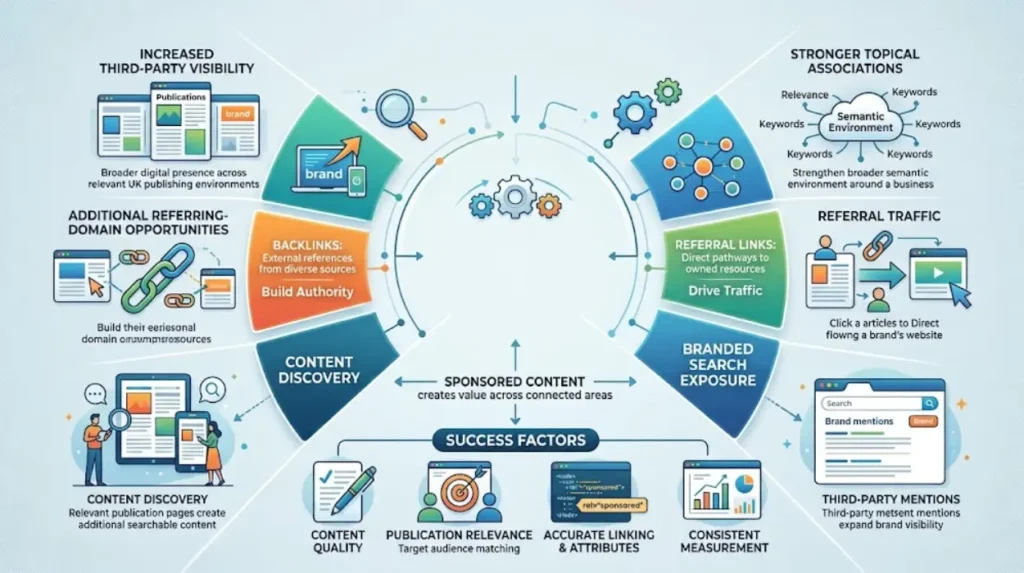
The main SEO benefits include increased third-party visibility, additional referring-domain opportunities, stronger topical associations, referral traffic, branded search exposure, content discovery, and broader digital presence across relevant UK publishing environments.
Sponsored content creates value across several connected areas.
Backlinks provide external references. Relevant publication pages create additional searchable content. Third-party mentions expand brand visibility. Referral links create direct pathways to owned resources. Topical associations strengthen the broader semantic environment around a business.
The results depend on content quality, publication relevance, accurate linking, appropriate sponsored-link attributes, and consistent measurement.
For businesses evaluating the next stage of sponsored-content execution, the relevant resource on:
Building backlinks with sponsored content provides a more focused explanation of backlink campaign structures.
What should businesses remember about sponsored content and SEO authority?
Sponsored content supports SEO authority through relevant third-party publishing, contextual references, referral traffic, semantic associations, and diversified digital visibility. Its strongest role comes from integration with a wider strategy based on useful content, technical SEO, relevance, accurate measurement, and responsible link practices.
Sponsored content is fundamentally a publishing activity with SEO implications.
Its effectiveness depends on the quality of the article, relevance of the publication, usefulness of the information, accuracy of links, and transparency of paid relationships.
Explore More Expert Insights:
What Makes Sponsored Content Rank in Google in 2026
How Manchester Firms Use Sponsored Articles for Growth
A strong approach focuses on relevant audiences and meaningful topics rather than publishing links without context.
For UK brands, this means selecting publications based on subject relevance, audience alignment, geographic reach, publishing quality, and measurable outcomes.
The central principle is clear: sponsored content creates SEO opportunities when it adds useful information to relevant publishing environments and forms part of a structured, measurable search strategy.