Sponsored content is paid editorial-style content created to communicate a brand message through a publisher’s established audience. In the UK, multi-site sponsored content involves content preparation, editorial review, publication, distribution, and performance tracking across selected news websites.
For businesses, the value of a 15-site campaign comes from coordinated exposure rather than a single publication. A campaign can place one relevant story across national, regional, business, technology, lifestyle, or specialist news environments.
Understanding how the process works helps marketers assess distribution options, publication quality, audience relevance, and reporting before selecting a sponsored content solution.
What is sponsored content across UK news sites?
Sponsored content across UK news sites is paid media content published through participating publishers to reach defined audiences. A 15-site campaign uses multiple publications, coordinated content placement, and distribution management to increase visibility across relevant UK media environments.
Sponsored content sits between traditional advertising and editorial publishing. The advertiser funds the placement, while the content follows the publisher’s requirements for format, quality, disclosure, and presentation.
A campaign across 15 UK news sites uses one coordinated distribution strategy. The selected publications depend on the target audience, sector, content topic, geographic relevance, and campaign objectives.
How does sponsored content differ from traditional advertising?
Traditional advertising normally uses display banners, video placements, paid search, or other promotional formats. Sponsored content uses an article-style format.
The content can explain a business development, product category, industry issue, research finding, company perspective, or market trend. Publisher disclosure identifies the commercial nature of the content.
Why does publisher relevance matter?
Publisher relevance determines whether the audience matches the campaign objective. A fintech announcement requires different media environments from a property development story.
For example, a UK fintech campaign benefits from business and financial publications, while a regional property announcement requires stronger geographic relevance.
How does sponsored content get distributed across 15 UK news sites?
A 15-site sponsored content campaign follows a defined workflow covering topic development, content preparation, publisher selection, submission, editorial checks, publication, distribution confirmation, and reporting across the agreed UK news websites.
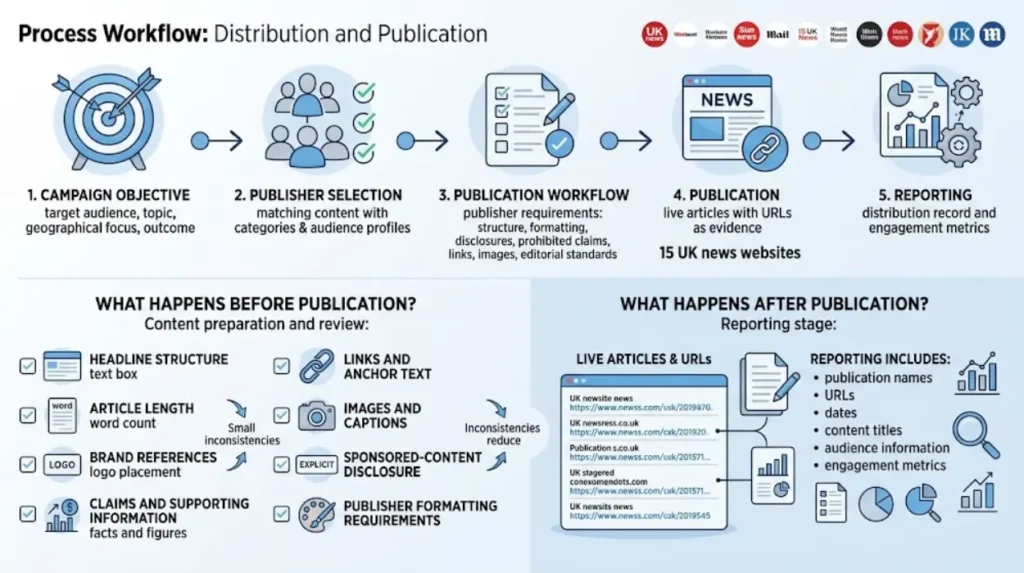
The process starts with the campaign objective. Marketers define the audience, topic, geographical focus, and desired outcome.
The next stage involves selecting suitable publications. Distribution teams match the content with available publisher categories and audience profiles.
Content then enters the publication workflow. Each publisher applies its own requirements. These requirements cover article structure, formatting, disclosures, prohibited claims, links, images, and editorial standards.
After approval, the article is published on the selected websites. Publication URLs provide evidence of placement.
What happens before publication?
Before publication, the content undergoes preparation and review. The process checks:
- Headline structure
- Article length
- Brand references
- Claims and supporting information
- Links and anchor text
- Images and captions
- Sponsored-content disclosure
- Publisher formatting requirements
This stage reduces inconsistencies across the campaign.
What happens after publication?
After publication, the campaign enters its reporting stage. The distribution record identifies the live articles and their corresponding publication URLs.
Reporting can include publication names, URLs, publication dates, content titles, audience information, and available engagement metrics.
What components make a 15-site sponsored content campaign effective?
A 15-site campaign depends on four core components: relevant publishers, consistent content, controlled distribution, and transparent reporting. These components connect campaign objectives with publication quality, audience relevance, content consistency, and measurable media visibility.
Publisher selection forms the first component. Fifteen publications provide broader coverage than one placement, but every site still requires relevance.
Content consistency forms the second component. The campaign needs a clear central message across all placements. Publisher formatting can differ without changing the core information.
Distribution control forms the third component. A managed campaign tracks where the content goes and whether each placement meets the agreed requirements.
Reporting forms the fourth component. A campaign record connects each published article with its publication and URL.
How does publisher selection affect campaign quality?
Publisher selection affects audience alignment and contextual relevance. A large publication is not automatically suitable for every campaign.
For example, a technology company targeting UK decision-makers needs technology, business, and B2B environments rather than unrelated lifestyle audiences.
A property company can prioritise property, business, regional, and construction publications when these environments match the target market.
How does content consistency support multi-site publication?
Consistent content protects the campaign’s central message. It also simplifies quality control.
The headline, company description, key facts, statistics, and campaign objective remain aligned. Publication-specific formatting creates variation without changing the factual foundation.
How should businesses choose between different sponsored content distribution options?
Businesses can compare sponsored content options by examining publisher relevance, site quality, audience alignment, number of placements, content control, publication timelines, disclosure practices, reporting detail, and total campaign cost before selecting a distribution model.
A 15-site package is one distribution model. Other options include single-publication placement, sector-specific campaigns, regional campaigns, and larger multi-publication packages.
The correct choice depends on campaign objectives.
A local announcement requires geographic relevance. A national business announcement requires broader UK visibility. A specialist product launch requires sector-specific publications.
Marketers also need to distinguish guaranteed publication from earned editorial coverage. Sponsored content is paid placement. Earned media depends on independent editorial interest.
What should marketers compare between distribution providers?
Marketers can compare:
- Number of included publications
- Publication categories
- UK audience relevance
- Content approval process
- Publication timeframe
- Sponsored disclosure
- Link policies
- Reporting format
- Replacement policies
- Campaign management
- Total cost
These criteria create a clearer basis for evaluating competing distribution solutions.
How does sponsored content support UK audience visibility?
Sponsored content supports UK audience visibility by placing a controlled brand message within established publisher environments. A 15-site campaign creates multiple publication touchpoints across relevant audiences, sectors, locations, and search-oriented content environments.
The visibility benefit comes from distribution breadth and contextual placement.
A campaign published across business, technology, regional, finance, and specialist publications reaches audiences through different media environments.
This structure also creates multiple URLs containing the campaign information. Each URL provides a reference point for users searching for the company, topic, product, announcement, or industry issue.
Does sponsored content improve search visibility?
Sponsored content can create indexable publication pages, but publication does not automatically produce ranking improvements.
Search visibility depends on content quality, technical accessibility, publisher authority, relevance, internal linking, competition, and search-engine systems.
Links also require careful interpretation. A sponsored link does not carry the same meaning as an independently earned editorial endorsement. Publishers apply their own link and disclosure policies.
What role does content relevance play in search?
Content relevance connects the article with the subject being searched. A financial technology article containing specific information about UK fintech services has stronger contextual relevance than unrelated promotional material.
Useful content includes clear entities, factual statements, defined concepts, relevant terminology, and specific examples.
What types of UK businesses use 15-site sponsored content campaigns?
Businesses use multi-site sponsored content for product announcements, company developments, thought leadership, market education, event promotion, sector campaigns, and brand visibility where controlled publication across several relevant UK media environments supports defined marketing objectives.
Different sectors use different publication strategies.
Which industries use sponsored content?
Common examples include:
- Fintech and financial services
- Technology and SaaS
- Property and construction
- Healthcare
- Professional services
- Retail
- Education
- Recruitment
- Business consulting
- Consumer brands
A fintech company can publish an article explaining a new digital finance service. A property company can publish market commentary linked to a development. A technology company can explain a new software platform.
The content format remains similar, while the publication mix changes according to audience relevance.
When does regional distribution make sense?
Regional distribution fits campaigns with geographic relevance. A business operating in Manchester requires different media targeting from a company focused on London.
A regional campaign can include local news publications alongside business or sector publications. The selection depends on where customers, stakeholders, employees, investors, or partners are located.
How can businesses measure a 15-site sponsored content campaign?
Businesses measure a 15-site sponsored content campaign through publication confirmations, live URLs, audience data, referral traffic, engagement metrics, branded search activity, content visibility, and campaign-level reporting that connects each placement with its distribution objective.
Measurement starts with publication verification. Each article needs a live URL and publication record.
Traffic measurement then identifies visits generated from published content. Engagement metrics provide additional context where publishers or analytics systems make them available.
Brand visibility can also be monitored through branded searches and references across search results.
What should a campaign report include?
A useful report includes:
- Publication name
- Article headline
- Publication date
- Live article URL
- Publication category
- Geographic relevance
- Available traffic or engagement data
- Link information
- Campaign summary
This information creates a permanent record of campaign delivery.
What should businesses consider before running sponsored content across 15 UK news sites?
Businesses should assess audience fit, publication quality, content requirements, disclosure standards, distribution scope, reporting, timing, and budget before launching a 15-site campaign. Clear criteria prevent mismatched placements and improve campaign control.
The first consideration is audience fit. The selected publications need to reach the intended UK audience.
The second is content suitability. Sponsored content needs factual information, a clear purpose, and a format that meets publisher requirements.
The third is transparency. Sponsored content requires appropriate commercial disclosure so readers understand the relationship between advertiser and publisher.
The fourth is reporting. Businesses need evidence showing where the content appeared.
What questions should marketers ask before choosing a provider?
Marketers can ask:
- Which UK publications are included?
- Are all 15 placements guaranteed?
- Which audience categories do the publications represent?
- How is content reviewed?
- What disclosure is used?
- What links are permitted?
- How long does publication take?
- What happens if a placement fails?
- What reporting is provided?
- Are publication URLs included?
These questions establish the practical scope of the campaign.
Explore More Expert Insights:
How Startups Publish Sponsored Articles Across 15 Sites
How Financial Sponsored Content Reaches UK Audiences
How can businesses move from sponsored content research to a distribution decision?
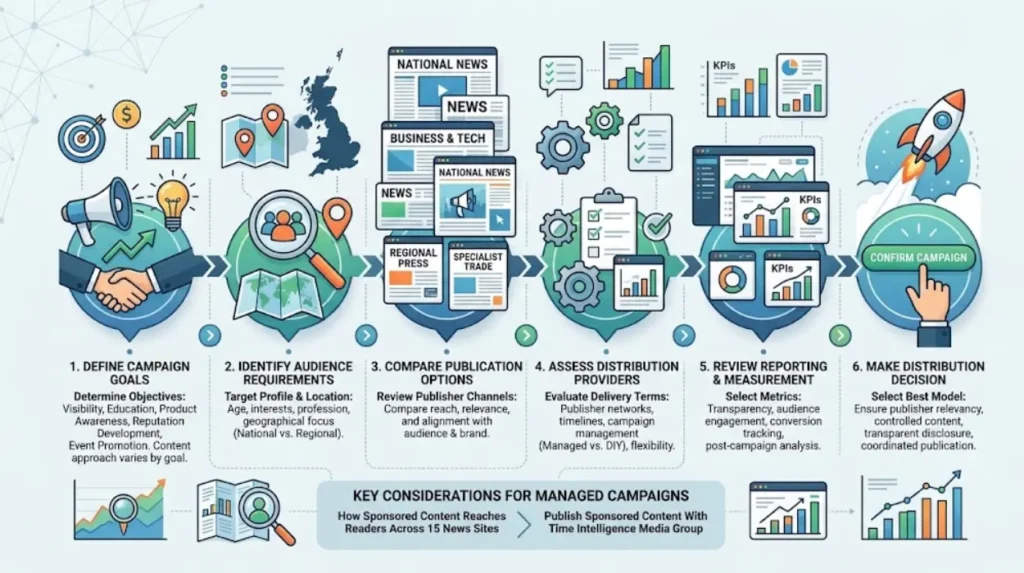
Businesses can move from research to a distribution decision by defining campaign goals, identifying the required audience, comparing publication options, reviewing delivery terms, assessing reporting, and selecting a distribution model that matches the campaign’s UK media requirements.
The decision process starts with the campaign objective. Visibility, education, product awareness, event promotion, and reputation development require different content approaches.
The next step is publication selection. Businesses compare national, regional, business, technology, and specialist environments.
The final step is provider evaluation. Distribution services differ in publisher networks, campaign management, timelines, reporting, and pricing.
For businesses evaluating managed options,
How Sponsored Content Reaches Readers Across 15 News Sites provides the wider context for understanding sponsored content distribution across multiple UK publications.
Once a specific provider becomes part of the decision process,
Publish Sponsored Content With Time Intelligence Media Group helps readers evaluate the practical route from campaign planning to sponsored content publication.
A 15-site sponsored content campaign is therefore a structured media distribution process. Its effectiveness depends on relevant publishers, controlled content, transparent disclosure, coordinated publication, and measurable reporting. UK businesses that define these requirements before distribution gain clearer control over where their sponsored content appears and how campaign delivery is evaluated.